In this guide
💡 The Short Version: Warsaw’s Old Town (Stare Miasto) is entirely pedestrianised and free to explore on foot at any hour (Warszawa Tourism). A classic walking route runs north from Castle Square (Plac Zamkowy)—where King Sigismund III Vasa’s 22-metre bronze column stands in front of the Royal Castle—through the cobbled alleyways of Świętojańska to the Old Town Market Square (Rynek Starego Miasta) with the bronze Mermaid (Syrenka), continuing through the 16th-century brick Barbican (Barbakan Warszawski) into the New Town (Nowe Miasto). Or book a tour: Warsaw: Old Town Guided Walking Tourad (from 50 PLN, 4.8 stars from 1,111 reviews) is a 2-hour guided walking tour of the Old Town.
⚠️ Cobblestones and footwear: The streets and squares are paved with basalt and granite setts, and steep stone steps (such as the Kamienne Schodki) lead down the Vistula escarpment. Wear walking shoes with rubber soles, not smooth leather soles or heels, especially in wet or wintry weather.
A step-by-step walking route through the Old Town
The circuit is 1.5 kilometres. Allow 2 to 3 hours at an easy pace, including time inside the churches and at the viewpoint.
The route runs Castle Square, St John’s Archcathedral, Kanonia Square (the Wishing Bell), the Gnojna Góra viewpoint, Market Square (the Mermaid), the Barbican and city walls, the Podwale ramparts and the Monument of the Little Insurgent.
Stop 1: Castle Square (Plac Zamkowy)
The southern portal to the Old Town. In the centre stands Sigismund’s Column (Kolumna Zygmunta), erected in 1644 by King Władysław IV Vasa to honour his father Sigismund III Vasa, who relocated Poland’s capital from Kraków to Warsaw in 1596. Measuring 22 metres high, it is Warsaw’s oldest secular monument. To the east sits the terracotta-hued Royal Castle, rebuilt from 1971 to 1984 through voluntary public donations.
Stop 2: St John’s Archcathedral (Bazylika Archikatedralna św. Jana Chrzciciela)
Heading north down narrow Świętojańska Street, this red-brick Masovian Gothic cathedral dates back to the 14th century. It served as the coronation and burial site of Polish monarchs, notably King Stanisław August Poniatowski. The crypts contain the tombs of Nobel laureate Henryk Sienkiewicz, Poland’s first president Gabriel Narutowicz, and musical statesman Ignacy Jan Paderewski.
Stop 3: Kanonia Square (Plac Kanonia) and the Wishing Bell
Immediately behind the cathedral apse is Kanonia, a triangular cobbled square named after the 17th-century cathedral canons whose residences line the perimeter. At its centre sits a 17th-century bronze church bell cast in 1646 by Daniel Tym (who also sculpted the statue atop Sigismund’s Column). It was never hung in a belfry; local tradition dictates that walking around the bell three times while touching the bronze brings good fortune. Notice number 20 on the corner—one of Warsaw’s narrowest facades, built that way because property taxes in the 17th century were assessed by frontage width.
Stop 4: Gnojna Góra Viewpoint
Exiting Kanonia towards the Vistula river slope, follow Celna Street to Gnojna Góra (“Dung Mountain”). From the Middle Ages until the 18th century, this terrace was the town’s rubbish heap; today it is a landscaped viewing terrace with views east across the Vistula, the Świętokrzyski and Śląsko-Dąbrowski bridges, the National Stadium (PGE Narodowy) and the right-bank district of Praga.
Stop 5: Old Town Market Square (Rynek Starego Miasta)
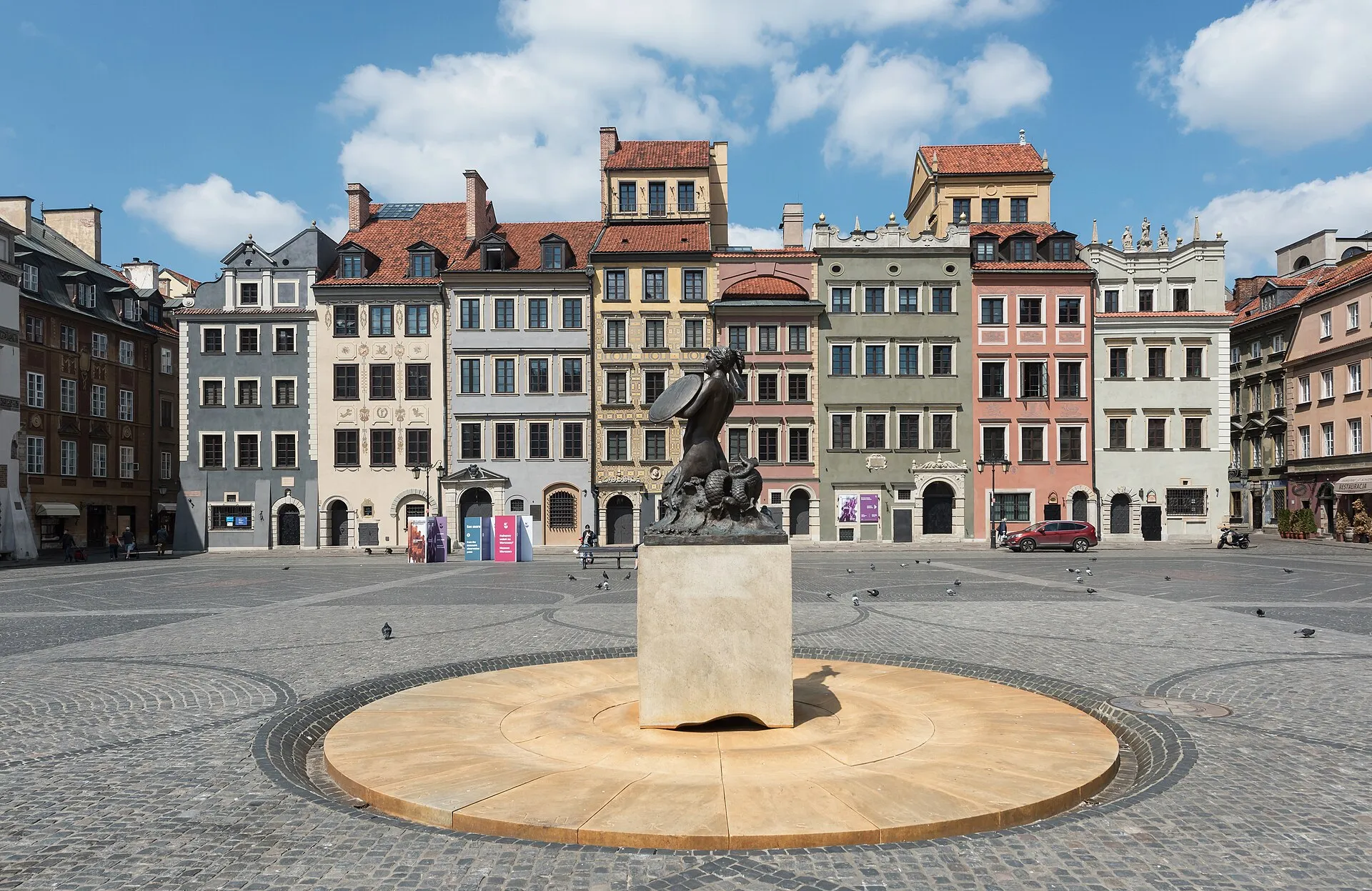
The centre of the medieval town. Laid out in the late 13th century, the square measures 90 by 73 metres, and its four sides are named after 18th-century parliamentary deputies (Dekert on the north, Barss on the east, Kołłątaj on the west, and Zakrzewski on the south). At the centre stands the bronze Mermaid Statue (Pomnik Syrenki), sculpted in 1855 by Konstanty Hegel. The northern Dekert side houses the Museum of Warsaw (Muzeum Warszawy), in eleven connected burgher houses, with 7,350 original artefacts on the history of the city.
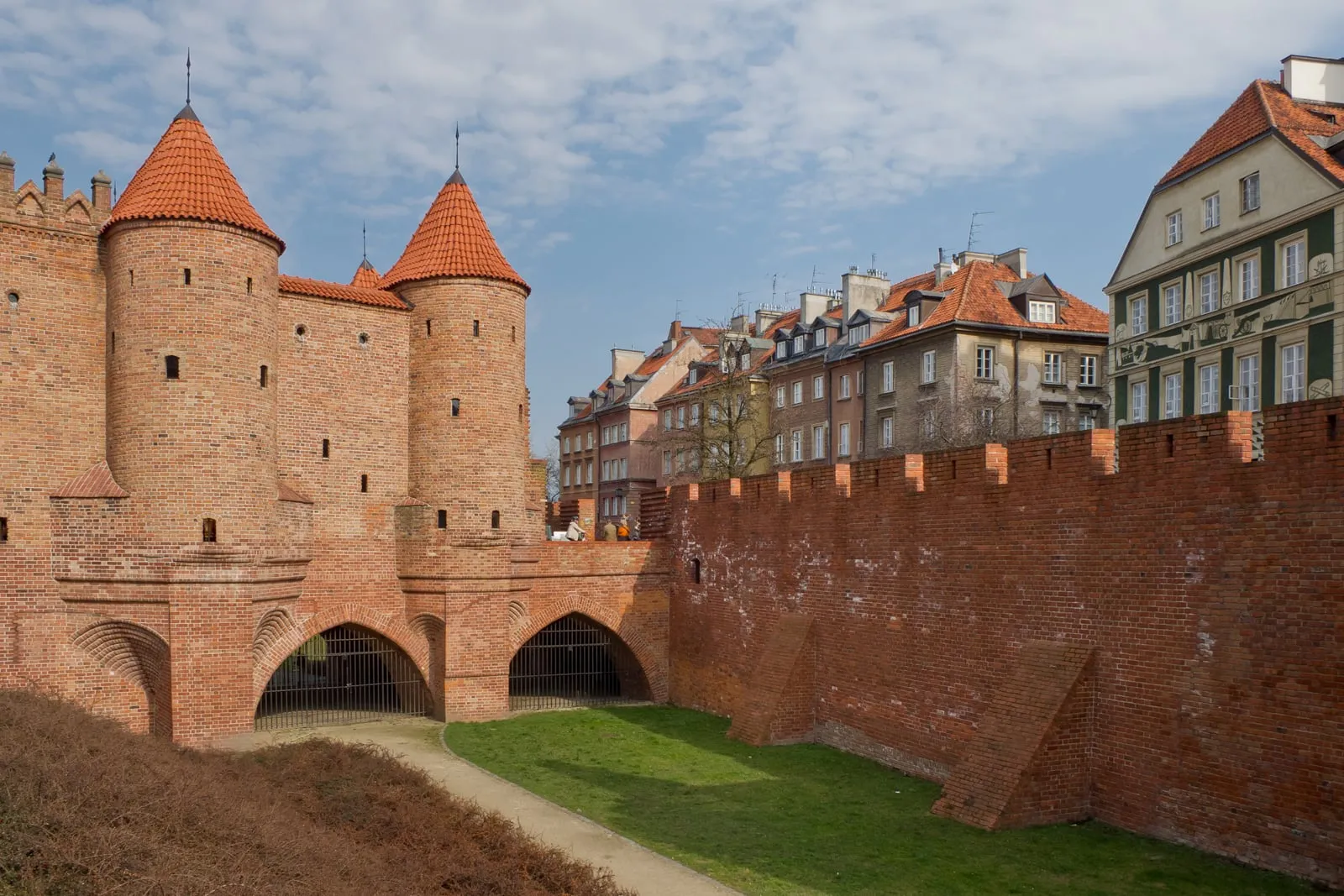
The 16th-century red-brick Warsaw Barbican (Barbakan Warszawski). Photo: Carlos Delgado, Wikimedia Commons, CC BY-SA 3.0 pl.
Stop 6: The Barbican and Defensive Brick Walls
Proceeding north along Nowomiejska leads to the Warsaw Barbican (Barbakan Warszawski), a semicircular fortified brick bastion designed in 1548 by Venetian master architect Giovanni Battista di Quadro. Constructed with distinctive pointed Gothic bricks and arrow slits, it spanned the outer defensive moat to guard the Bridge Gate (Brama Nowomiejska). During the summer months, local artists display oil paintings and ceramics along the red-brick ramparts.
Stop 7: Podwale and the Little Insurgent Monument
Stepping outside the Barbican onto Podwale (“Under the Ramparts”), follow the curve of the preserved 14th-century brick battlements. Here stands the bronze Little Insurgent Monument (Pomnik Małego Powstańca), depicting a young boy in an oversized German helmet and insurgent armband holding a submachine gun, commemorating the scout messengers and boy soldiers who served during the 1944 Warsaw Uprising.
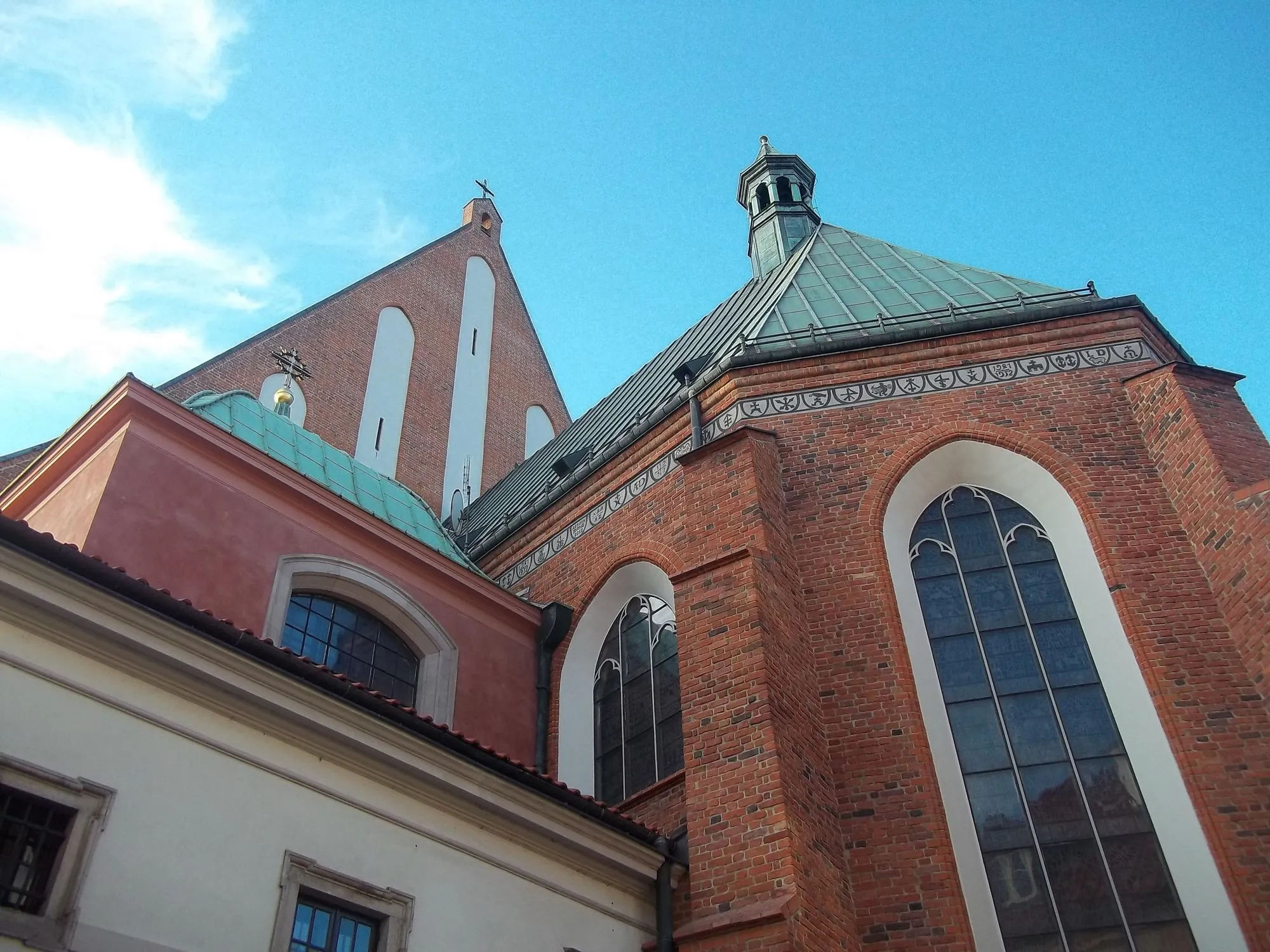 St John’s Cathedral. Photo: Simon Burchell, Wikimedia Commons, CC BY-SA 4.0.
Tours and guided walks
After the 1944 Uprising, German demolition units reduced 85% of these buildings to 20 million cubic metres of rubble. Poles rebuilt them from 18th-century Canaletto paintings, architectural drawings and surviving brick fragments. A guide shows you where the original brick survives.
Warsaw: Old Town Guided Walking Tour
From 50 PLN · 4.8 stars from 1,111 reviews · 2 hours · guided Old Town walk
Warsaw: Old Town Guided Walking Tourad: a guided walking tour of the Old Town.
Warsaw: Royal Route and Old Town Guided Walking Tour
From 61 PLN · 5.0 stars from 5 reviews · 2 hours · Royal Castle and Market Square
Warsaw: Royal Route and Old Town Guided Walking Tourad: a guided walk through the Old Town and along the Royal Route, taking in the Royal Castle and Market Square.
Warsaw: Old Town Highlights Walking Tour
From 101 PLN · 4.7 stars from 1,866 reviews · 2.5 hours · Royal Route, Old Town and Royal Castle
Warsaw: Old Town Highlights Walking Tourad: a small-group walk along the Royal Route and through the UNESCO-listed Old Town, taking in the Royal Castle and the Presidential Palace.
Walk alone or with a guide
| Option | What you get |
|---|---|
| Old Town streets, squares and walls | Free; go at your own pace |
| 2-hour guided walk | The post-war reconstruction and wartime survival explained |
| Royal Route and Old Town walk | Old Town history, plus the palaces down Krakowskie Przedmieście |
| Royal Castle admission | The castle interiors; tickets from the castle’s own site |
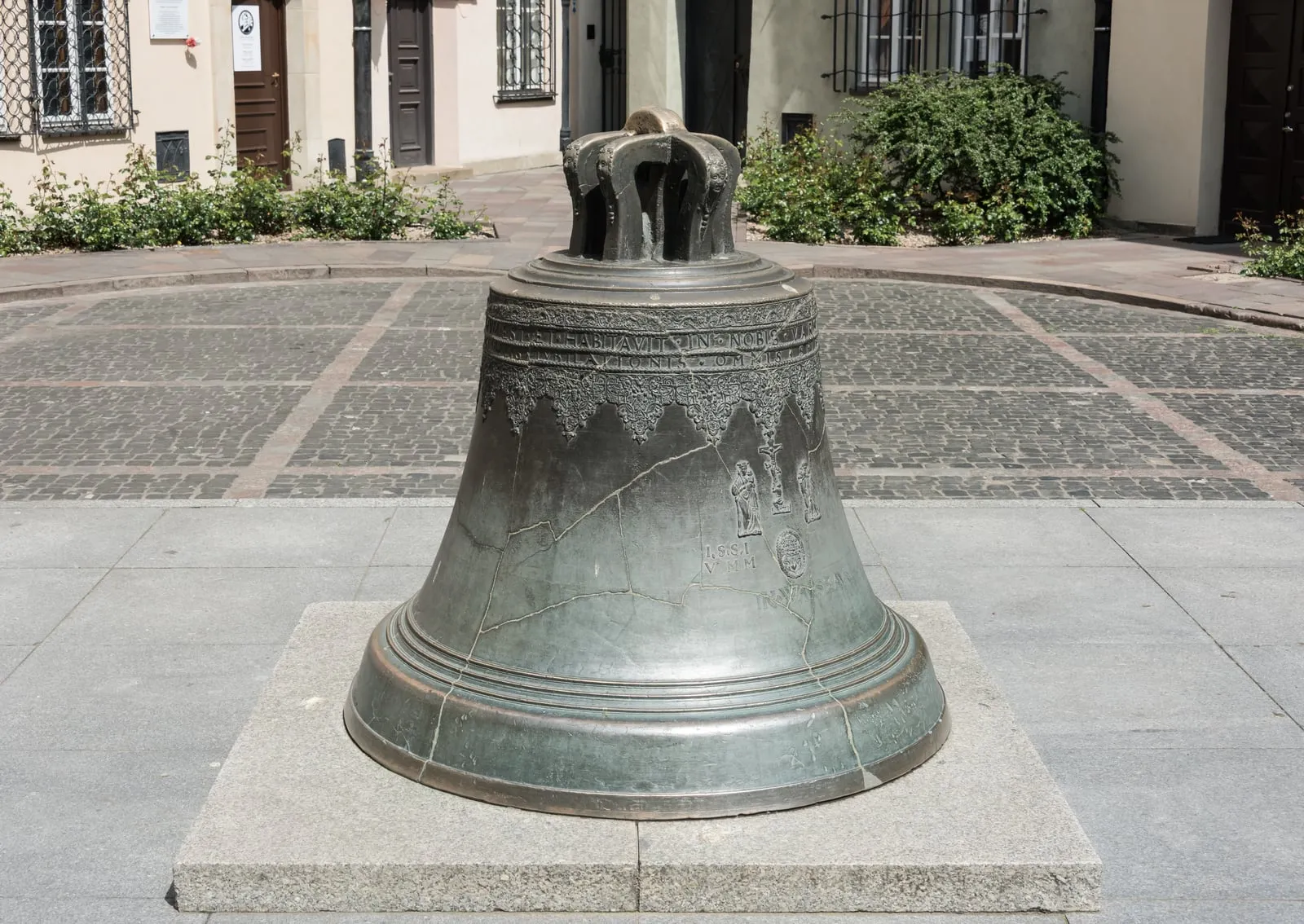
The 17th-century bronze wishing bell on triangular Kanonia Square. Photo: Adrian Grycuk, Wikimedia Commons, CC BY-SA 3.0 pl.
Where to eat in the Old Town
The central squares are full of tourist bistros; the traditional Polish places are on the edges:
- Pyzy Flaki Gorące (Podwale 5): A branch of the Praga dumpling restaurant. Open Monday to Saturday 12:00–22:00, Sunday 12:00–21:00.
- Zapiecek Polskie Pierogarnie (Świętojańska 13 and Freta 1): A tavern for hand-pinched pierogi, boiled or pan-fried with browned butter and bacon, filled with wild boar, duck and cranberry, sauerkraut and forest mushrooms, or sweetened curd cheese.
- U Fukiera (Rynek Starego Miasta 27): A restaurant run by chef Magda Gessler in the old Fukier wine merchants’ house on the Market Square. It serves slow-roasted game, venison and wild chanterelle soup by candlelight.
Getting there
The Old Town stands on the Vistula bluff, 2.5 km north of Warszawa Centralna.
- Trams: Routes 4, 13, 20, 23, and 26 stop at Stare Miasto inside the W-Z Tunnel. Elevators and escalators carry passengers directly up to Castle Square.
- Buses: Lines 116, 178, 180, 222, 503, and 518 stop at Plac Zamkowy along Krakowskie Przedmieście.
- Metro: Line M1 to Ratusz Arsenał, followed by an 8-minute walk east along Aleja Solidarności.
- Fares: Covered by standard Zone 1 public transit tickets; see our guide to public transport in Warsaw.
What to see next
- Royal Castle in Warsaw: Tickets, the Rembrandt rooms and free Wednesdays.
- POLIN Museum of the History of Polish Jews: A 15-minute walk west through Muranów.
- Warsaw Uprising Museum: The 1944 fighting that destroyed the Old Town.
- Warsaw Christmas Market and Winter: The market and ice rink in the Old Town.
- Warsaw in 1 or 2 days: City itineraries that start with this Old Town circuit.
- Warsaw travel guide: Sights, transport, food and hotels.
Common questions
Is Warsaw Old Town free to visit?
Yes. Walking the public cobblestone streets, squares, city wall ramparts, and passing through the Barbican costs nothing. Only interior museum attractions (such as the Royal Castle and the Museum of Warsaw) charge admission.
Why was Warsaw Old Town inscribed as a UNESCO World Heritage Site?
In 1980, UNESCO inscribed Warsaw Old Town as an example of near-total reconstruction of a historic centre spanning the 13th to 20th centuries, rebuilt after 85% of it was deliberately dynamited in 1944.
What is the legend of the Warsaw Mermaid (Syrenka)?
According to folklore, the mermaid Syrenka swam up the Vistula from the Baltic Sea. Rescued by local fishermen, she vowed to defend the city with a sword and shield, becoming Warsaw's coat of arms and civic protector.
What is the wishing bell on Kanonia Square?
Behind St John's Archcathedral lies Kanonia, a quiet triangular courtyard with a giant 17th-century bronze bell. Legend holds that circling the bell three times while touching it brings good luck.