One of 3 self-guided walks in Singapore. See every walk.
In this guide
💡 The Short Version: This self-guided 3.3-kilometre walking route traces Singapore’s historic transformation from ethnic enclaves to the colonial trading river and ultra-modern bayfront. Starting at the four-storey Buddha Tooth Relic Temple (open daily 07:30 to 17:00), the trail weaves past Singapore’s oldest Hindu shrine, Sri Mariamman Temple, down heritage-listed Telok Ayer Street, across the Victorian cast-iron arches of Lau Pa Sat, along riverside Boat Quay, and finishes at Merlion Park. Mind the temple timings: Sri Mariamman Temple closes strictly between 12:00 and 18:00, so begin before 10:30. Or book a tour: travellers wanting rich historical commentary and insider food tastings across the cultural quarters can join the top-rated guided Chinatown, Little India and Arab Street walking tourad from S$113.
No single walking itinerary captures Singapore’s multicultural heritage and rapid urban evolution quite like the route from Chinatown to Marina Bay. Within three kilometres, you step through sacred Taoist, Buddhist, and Hindu shrines, stroll along original 19th-century coastal trading streets, pass beneath Victorian cast-iron market pavilions, and emerge onto the glittering waterfront promenade opposite Marina Bay Sands.
The route is completely paved, wheelchair accessible, and sheltered along many stretches by traditional five-foot-way shophouse arcades.
Route summary and interactive map
Map of the walk numbered stops in walking order
Open the complete walking route in Google Maps — load this interactive walking navigation directly on your smartphone.
| Stop Number & Landmark | Opening Hours | Admission | Key Architectural Highlight |
|---|---|---|---|
| 1. Buddha Tooth Relic Temple | Daily 07:30 to 17:00 | Free | Tang Dynasty Northern style; 420 kg solid gold sacred stupa on 4th floor |
| 2. Sri Mariamman Temple | 06:00 to 12:00, 18:00 to 21:00 (Fri to 21:15) | Free | Six-tiered polychrome gopuram tower; Singapore’s oldest Hindu temple (1827) |
| 3. Thian Hock Keng | Daily 07:30 to 17:30 | Free | Built without nails (1842); dedicated to Mazu; National Monument |
| 4. Lau Pa Sat | Open 24 hours (Satay Street from 19:00) | Free entry | Prefabricated 1894 Victorian cast-iron pavilion; clock tower chime bells |
| 5. Boat Quay | Open pedestrian promenade 24 hours | Free | Conserved 19th-century trading shophouses along the south river bank |
| 6. Merlion Park | Open waterfront park 24 hours | Free | 8.6-metre spouting national icon overlooking Marina Bay Sands |
⚠️ Timing Alert: Sri Mariamman Temple closes from 12:00 to 18:00. To view the ornate ceiling frescoes and sanctum interior, begin your walk before 10:30. If you start in the afternoon, plan to reach Sri Mariamman after 18:00 when priests reopen the sanctum for evening puja prayers.
Guided cultural tours vs self-guided walking
Exploring independently offers total flexibility to linger in tea houses, take photographs, or stop for snacks whenever you choose. However, booking an accredited walking guide brings the complex layers of Singapore’s colonial history, immigrant dialect clans, and architectural symbols vividly to life.
| Feature | Self-Guided Walk | Guided Cultural Tour (GYG) |
|---|---|---|
| Cost | Free (pay only for food and transit) | From S$69 to S$113 per person |
| Pace | Set your own rhythm; detour into shops freely | Structured 3- to 4-hour guided group walking tour |
| Food & Tastings | Buy snacks independently at hawker centres | Curated tastings included (Hainanese chicken rice, teh tarik, snacks) |
| Scope | Focuses on Chinatown, Telok Ayer, and Boat Quay | Connects 3 ethnic quarters (Chinatown, Little India, Arab Street) |
| Historical Insight | Read interpretive panels and mobile guides | Expert live commentary detailing folklore, clans, and architecture |
Recommended guided walking tours
Singapore: Chinatown, Little India, Arab Street Walking Tour
From S$90 · 4.9 stars from 466 reviews · 4 hours · Cultural walk
This top-rated small-group cultural tour explores the contrasting heritage enclaves of Chinatown, Little India, and Kampong Glam. Led by an expert local storyteller, you learn the origins of Singapore’s ethnic quarters, uncover hidden street art murals, sample traditional delicacies, and ride the MRT between districts like a resident. Book on GetYourGuidead.
Singapore: Chinatown Historic Walking Tour with Lunch
From S$69 · 5.0 stars from 155 reviews · 3.5 hours · Small group with lunch
Focusing deeply on the historic core of Chinatown, this guided walking tour visits the Buddha Tooth Relic Temple, Sri Mariamman Temple, traditional medicinal herbal dispensaries, and tea merchants. The tour concludes with an authentic lunch featuring Michelin-recognized soya sauce chicken. Book on GetYourGuidead.
Singapore: Chinatown, Little India & Kampong Glam Walk
From S$100 · 4.8 stars from 200 reviews · 3 hours · Small group
A fast-paced, immersive walking experience taking in the architectural landmarks, incense-filled temples, spice shops, and textile boutiques of Singapore’s three principal historic quarters. Book on GetYourGuidead.
Detailed stop-by-stop walking guide
Stop 1: Buddha Tooth Relic Temple & Museum
Begin your morning at the Buddha Tooth Relic Temple & Museum at 288 South Bridge Road (easily reached via Chinatown MRT station, DT19/NE4, Exit A or Maxwell MRT station, TE18, Exit 2).
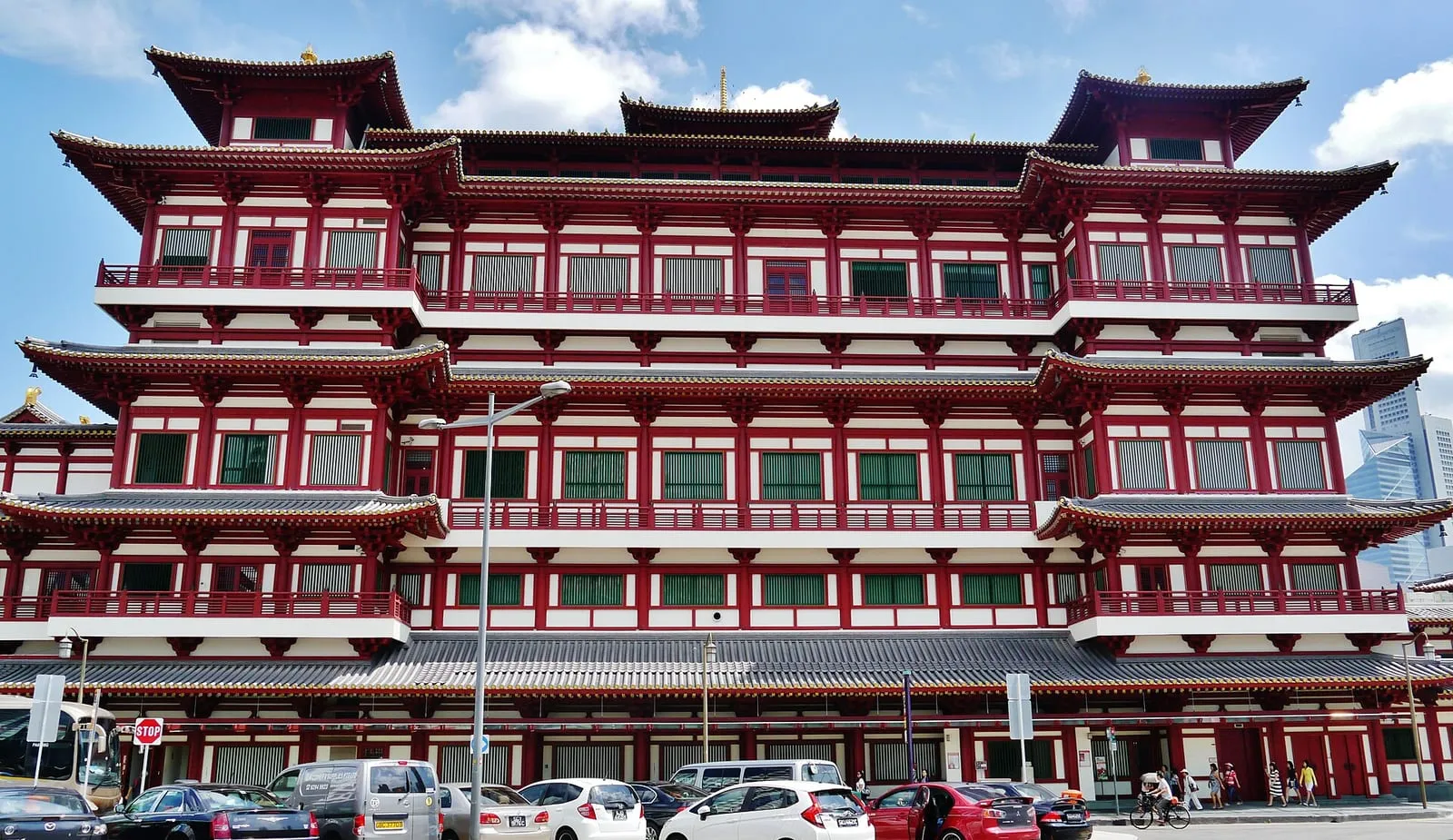
The Buddha Tooth Relic Temple on South Bridge Road. Photo: Zairon, Wikimedia Commons, CC BY-SA 4.0.
Consecrated in 2007, this majestic four-storey temple was designed in the Northern Tang Dynasty architectural style, inspired by the Buddhist art of the Dunhuang caves in China.
- Ground Floor (Hundred Dragons Hall): Features a magnificent 8-metre statue of Maitreya Buddha flanked by ornate gilded altars and 100 miniature dragon carvings.
- Museum & Relic Chamber (4th Floor): The sacred relic chamber houses what believers revere as the left canine tooth of Gautama Buddha, enshrined within a colossal stupa crafted from 420 kilograms of solid gold donated by Buddhist devotees.
- Roof Garden: Take the elevator to the rooftop to admire the Ten Thousand Buddhas Pagoda and spin the giant Tibetan-style Vairocana Buddha Prayer Wheel.
- Etiquette: Admission is free. Strict dress guidelines apply: no bare backs, off-the-shoulder tops, shorts, or mini-skirts. Complimentary sarongs and shawls are available at the entrance counter.
Stop 2: Sri Mariamman Temple
Leaving the Buddha Tooth Relic Temple, turn left and walk 150 metres northward along South Bridge Road to reach Sri Mariamman Temple at number 244.
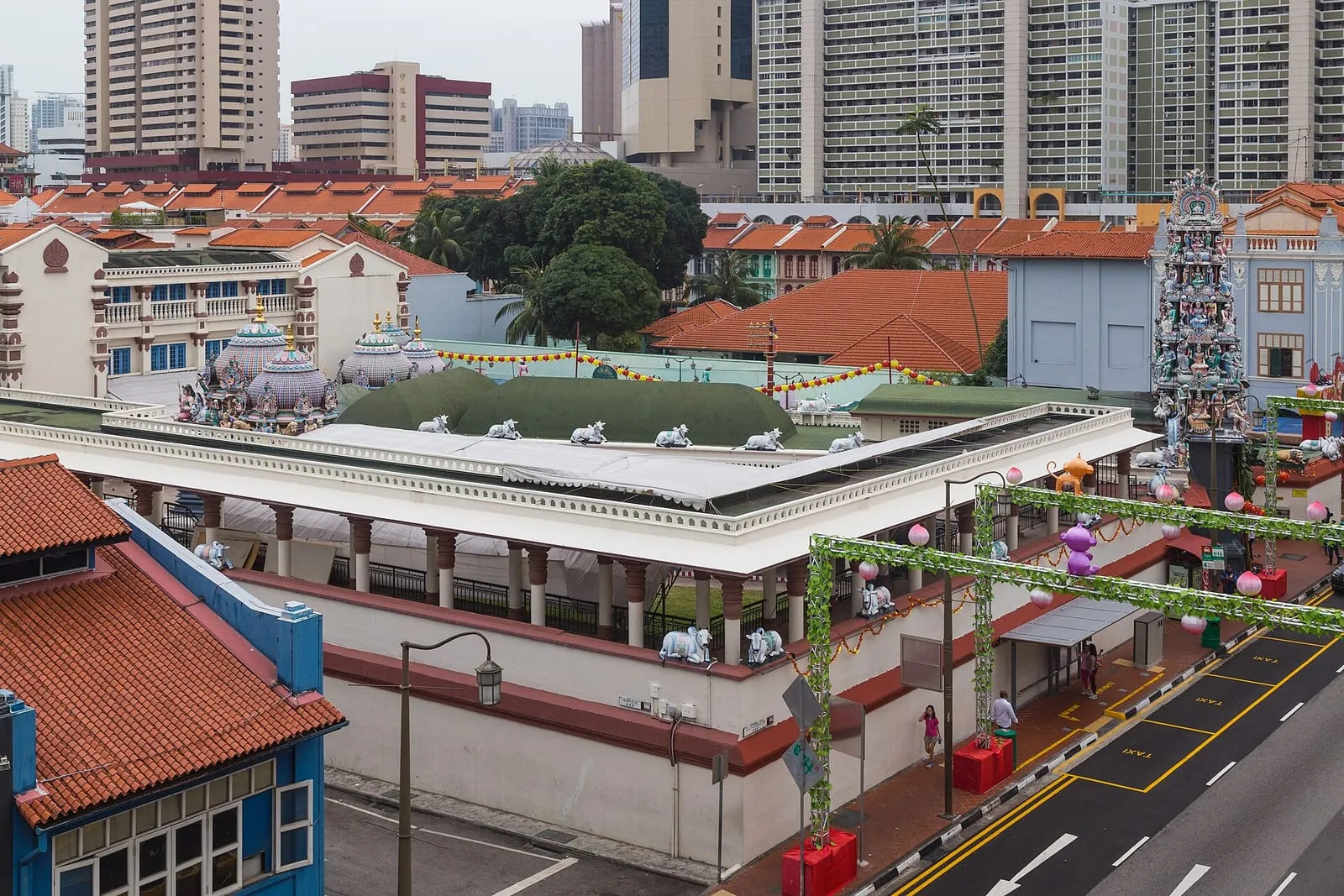
The sculpted gopuram of Sri Mariamman Temple. Photo: Marcin Konsek, Wikimedia Commons, CC BY-SA 4.0.
Founded in 1827 by Naraina Pillai, a government clerk who travelled to Singapore with Sir Stamford Raffles, Sri Mariamman is Singapore’s oldest Hindu place of worship and a gazetted National Monument.
- The Gopuram: The monumental six-tiered entrance tower is covered in vivid polychrome sculptures depicting deities, celestial nymphs, and mythic beasts from Hindu epics, meticulously repainted by master sculptors from Tamil Nadu every 12 years during temple rededication ceremonies.
- Inner Sanctum: Dedicated to goddess Mariamman, revered for her protective powers against epidemic diseases and smallpox in colonial Singapore. Elaborate ceiling frescoes inside the main hall depict concentric astrological mandalas.
- Visiting Rules: Remove footwear at the steps before entering. Photography inside the sanctum requires respectful distance. Modest clothing covering shoulders and knees is mandatory.
Stop 3: Thian Hock Keng Temple on Telok Ayer Street
From Sri Mariamman Temple, turn right down Pagoda Street, walk through the shophouses past Chinatown Heritage Centre, and turn onto Cross Street or Erskine Road towards Telok Ayer Street.
Long before land reclamation pushed Singapore’s shoreline a kilometre eastward, Telok Ayer (“Water Bay” in Malay) was the seafront landing point where Chinese migrants stepped ashore from open-sea junks. In gratitude for safe ocean passage across the South China Sea, Hokkien immigrants erected Thian Hock Keng (the “Palace of Heavenly Happiness”) between 1839 and 1842.
- Architectural Mastery: Dedicated to Mazu (Ma Zu Po), the Taoist goddess of the sea. The entire temple was constructed without using a single iron nail, relying on interlocking timber joinery, solid granite load-bearing columns carved with intertwining dragons, and colourful ceramic shard mosaics (jianci) along the curving eaves.
- Imperial Patronage: Inside the prayer hall hangs a calligraphic imperial plaque presented in 1907 by Emperor Guangxu of the Qing Dynasty, reading Bo Jing Nan Jiang (“Gentle Waves over the Southern Seas”).
- Visiting: Open daily from 07:30 to 17:30. Free admission. Observe quiet reverence around worshippers burning incense and offering joss paper.
Stop 4: Lau Pa Sat (Telok Ayer Market)
Walk southeast along Telok Ayer Street for 300 metres, cross Cross Street into the financial heart of Shenton Way, and arrive at Lau Pa Sat (18 Raffles Quay).
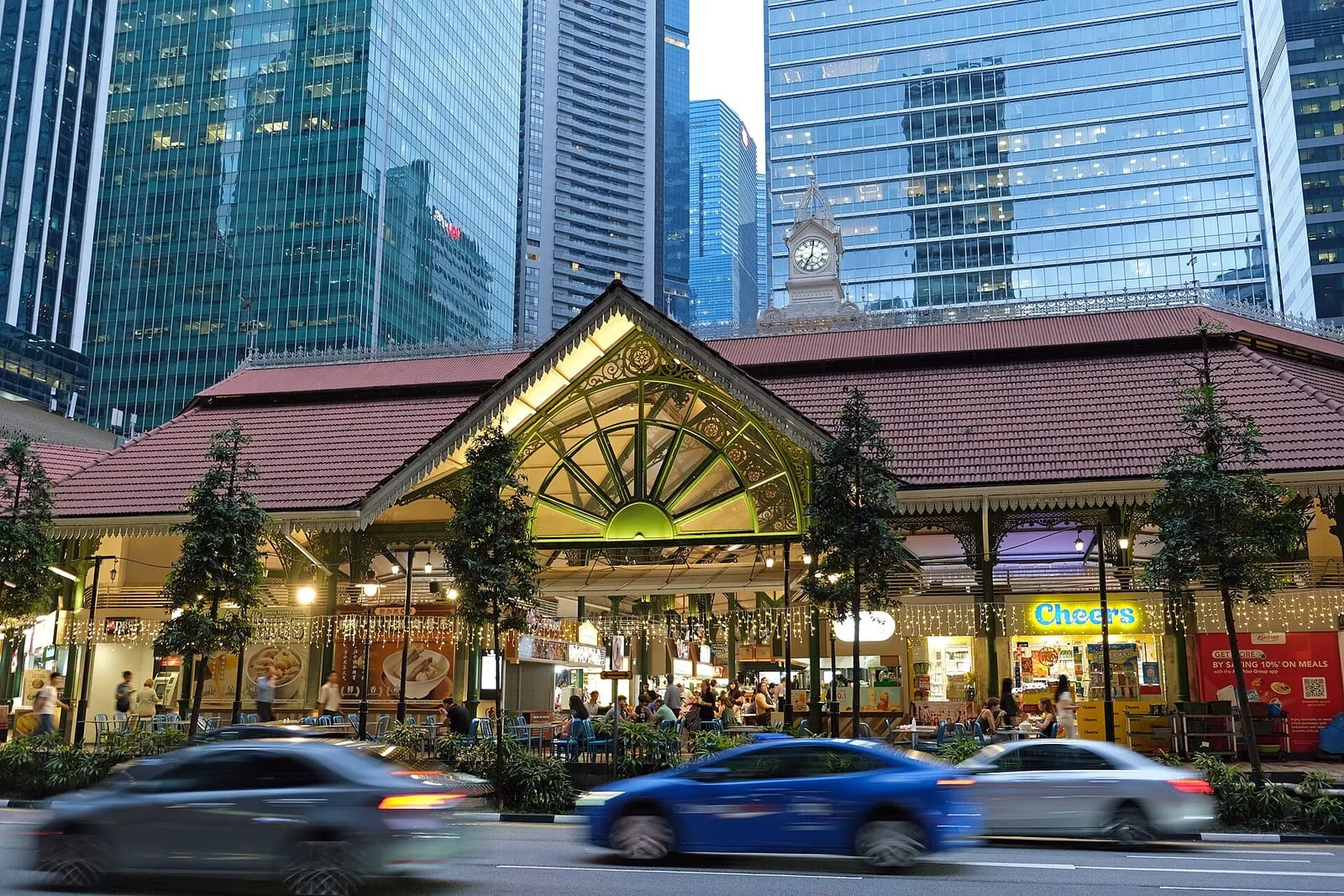
Lau Pa Sat’s Victorian cast-iron market hall. Photo: kallerna, Wikimedia Commons, CC BY-SA 4.0.
Originally built on the waterfront in 1824 and reconstructed in 1894, this octagonal Victorian cast-iron market pavilion was designed by municipal engineer James MacRitchie. The ornate cast-iron filigree columns, brackets, and trusses were prefabricated in Glasgow, Scotland, by P&W MacLellan and shipped across the globe to Singapore.
- The Hawkers: Today, Lau Pa Sat operates 24 hours daily as Singapore’s most celebrated downtown hawker venue, housing over 80 stalls serving Hainanese chicken rice, char kway teow, laksa, and roti prata.
- Clock Tower: The central lantern tower features a chiming clock built in 1991, with 23 bronze bells cast in the Netherlands that chime melodic tunes on the hour.
- Satay Street: Every evening from 19:00 (18:30 on weekends and public holidays), adjacent Boon Tat Street closes completely to motor vehicles. Hawkers roll out portable charcoal grills, and folding plastic tables line the tarmac for open-air satay feasts served with peanut gravy and compressed rice cakes (ketupat).
Stop 5: Boat Quay and the Singapore River
From Lau Pa Sat, walk north along Market Street and Chulia Street for 400 metres toward the Singapore River. Step onto the river promenade at Boat Quay.
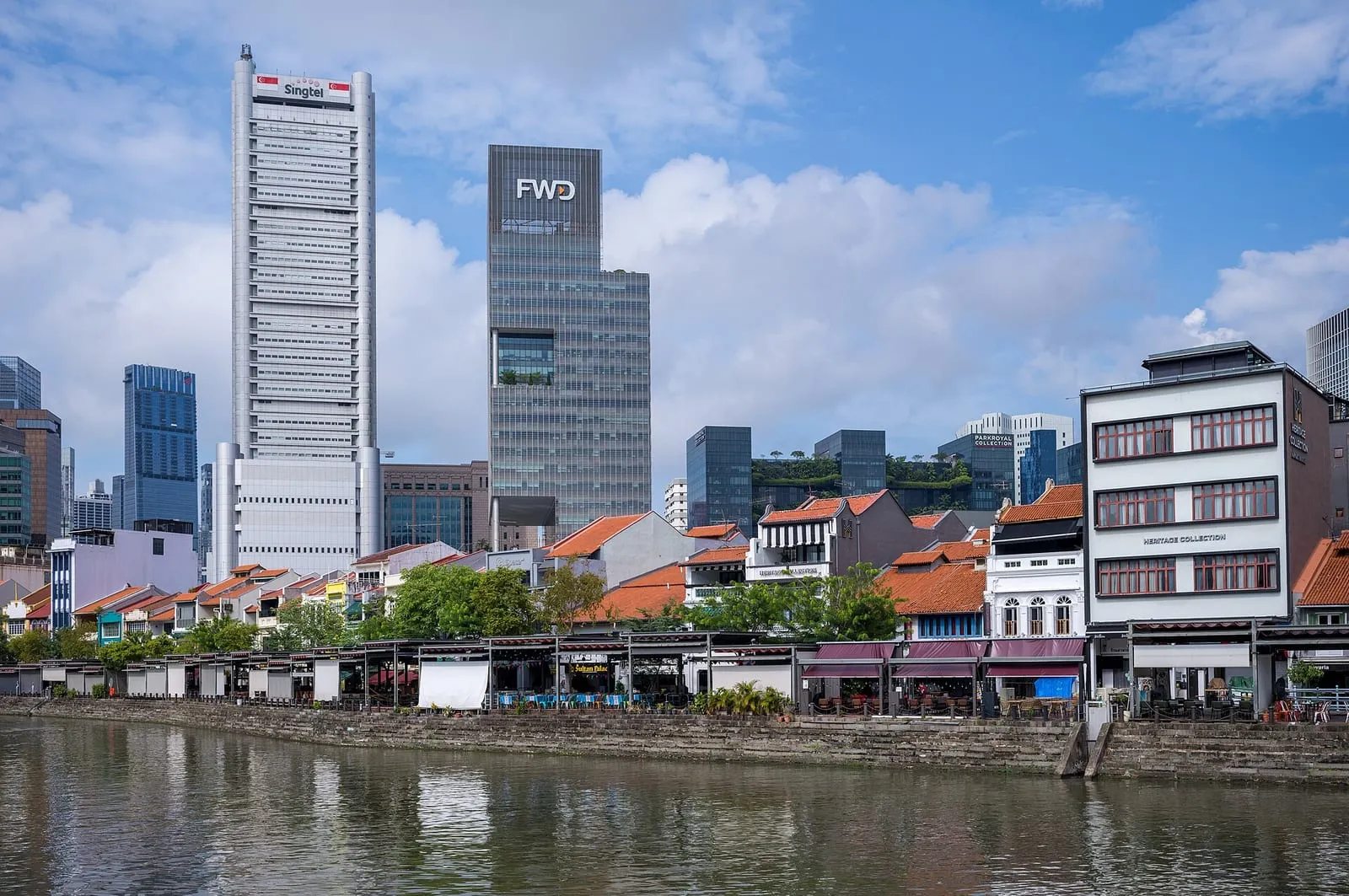
Restored shophouses along Boat Quay on the Singapore River. Photo: Frank Schulenburg, Wikimedia Commons, CC BY-SA 4.0.
In the 19th and early 20th centuries, this U-shaped south bank handled three-quarters of all maritime shipping in the British colony. Hundreds of wooden lighters (twakows) unloaded spices, gambier, tin, and rubber into the shophouses lining the quay.
In 1989, the historic two- and three-storey colonial shophouses were officially conserved. Today, Boat Quay is a scenic pedestrian boardwalk lined with alfresco restaurants, craft beer pubs, and seafood tanks. Looking across the river, you view the historic Empress Place building (Asian Civilisations Museum), the neoclassical Fullerton Hotel, and Victorian Cavenagh Bridge. To see the quays from the water, board a traditional electric Singapore River cruise.
Stop 6: Merlion Park
Follow the riverside promenade beneath Cavenagh Bridge and the Anderson Bridge archways, passing the grand Doric columns of the Fullerton Hotel, until you emerge at Merlion Park on One Fullerton.
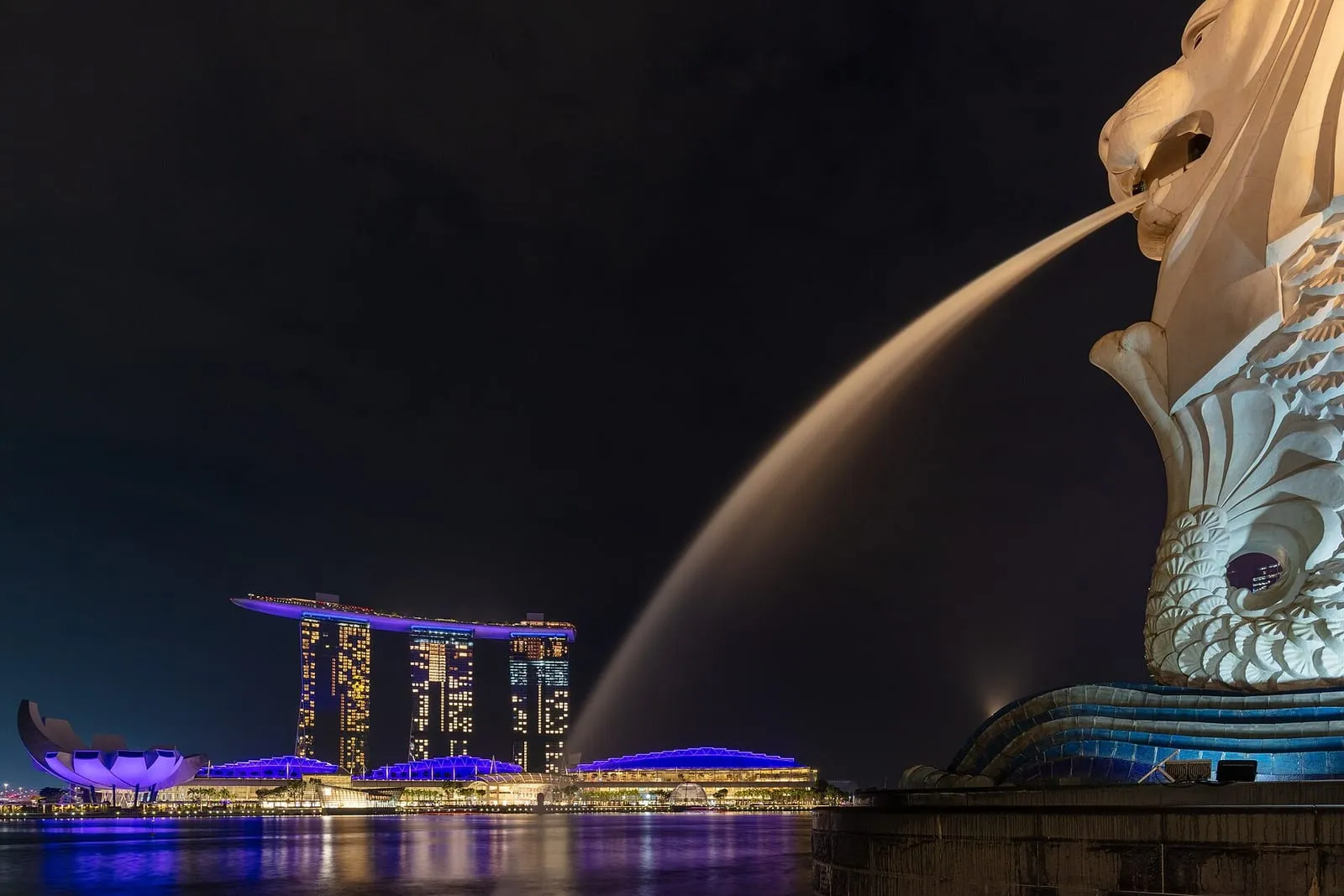
The Merlion spouting into Marina Bay. Photo: Diego Delso, Wikimedia Commons, CC BY-SA 4.0.
Standing 8.6 metres tall and weighing 70 tonnes, the Merlion is Singapore’s internationally famous national symbol. Combining the head of a lion (honouring Sang Nila Utama’s legendary discovery of Singapura, “Lion City”) with the body of a fish (representing Singapore’s origins as a humble fishing port named Temasek, “Sea Town”), the statue continuously spouts water into Marina Bay.
- Photo Platform: Stepped viewing terraces extend over the water, providing the classic postcard perspective of the Merlion spouting with Marina Bay Sands, the lotus-shaped ArtScience Museum, and the Singapore Flyer in the background.
- Merlion Cub: Just behind the main monument stands a smaller 2-metre cub statue, also sculpted in 1972 by local artist Lim Nang Seng.
- Continuing onward: Merlion Park marks the official starting point for the Marina Bay evening walk, which loops around the bay to the Helix Bridge and Gardens by the Bay.
Practical tips for the walk
- Hydration and heat management: Singapore’s equatorial climate averages 31°C with high humidity. While Chinatown shophouses offer covered five-foot walkways, the crossing from Lau Pa Sat to Boat Quay and Merlion Park is exposed to direct sun. Carry a water bottle and take advantage of air-conditioned rests inside temple exhibition halls.
- Footwear: Wear comfortable, slip-on walking shoes. You will need to take off your shoes at Sri Mariamman Temple and any additional Hindu or Taoist sanctuaries you visit along Telok Ayer Street.
- Photography etiquette: Photography is permitted inside the main courtyards of the Buddha Tooth Relic Temple and Sri Mariamman Temple, but avoid photographing worshippers in prayer or aiming cameras directly into the innermost sanctums during sacred ceremonies.
- Public transit connections: The walk starts at Chinatown MRT (North-East and Downtown lines) or Maxwell MRT (Thomson-East Coast Line), and ends at Raffles Place MRT (North-South and East-West lines) near Merlion Park. Contactless bank cards (SimplyGo) can be tapped directly at all fare gates; see our public transport guide.
More Singapore guides
Pair this walking itinerary with our other self-guided routes and neighbourhood deep dives:
- Marina Bay evening walk: continue your walk around the bayfront for the nightly Spectra light show.
- Little India to Kampong Glam walk: explore the spice bazaars, Sultan Mosque, and street art of Arab Street.
- Chinatown Singapore guide: temple rules, street food, and clan heritage.
- Best hawker centres in Singapore: Maxwell Food Centre, Lau Pa Sat, and Chinatown Complex compared.
- Singapore River cruise: bumboats, ticket options, and historic river bridges.
- What to book before you go to Singapore: complete ticket planning and booking checklist.
Common questions
How long is the Chinatown to Marina Bay walk?
The walking route measures approximately 3.3 kilometres from the Buddha Tooth Relic Temple to Merlion Park. At an easy stroll with stops for temple visits, architecture photography, and a meal or drink at Lau Pa Sat, allow two to three hours.
When is the best time of day to start this walk?
Start in the morning between 09:00 and 10:00. This ensures Sri Mariamman Temple (open 06:00 to 12:00 and 18:00 to 21:00) is open before its mandatory six-hour afternoon closure, and positions you at Lau Pa Sat or Boat Quay just in time for lunch.
What should you wear when visiting the temples on this route?
Dress respectfully with shoulders and knees covered. The Buddha Tooth Relic Temple prohibits singlets, low-cut tops, off-the-shoulder cuts, shorts, and mini-skirts. Hindu temples require visitors to remove shoes outside and cover knees and shoulders; free shawls and sarongs are provided at the entrance.
Where does the walk end?
The route concludes at Merlion Park on One Fullerton, where the waters of the Singapore River open into Marina Bay. From here, you can seamlessly continue onto the Marina Bay evening promenade walk.