In this guide
💡 The Short Version: The Entry/Exit System (EES) has run at every external Schengen border since 10 April 2026. UK, US, Canadian and Australian passport holders have a photo and four fingerprints taken at their first entry. It is free, needs nothing before you travel and replaces the passport stamp. ETIAS is not yet required: it will cost €20, last three years and be free under 18 and over 70, and the EU will announce the start date several months ahead. Ireland, the UK, Turkey and Morocco use neither. The UK needs a UK ETA (£20) from US, Canadian, Australian and EU visitors. Ireland, Turkey and Morocco need no visa for a holiday. The days you spend there do not count towards the 90 days in any 180.
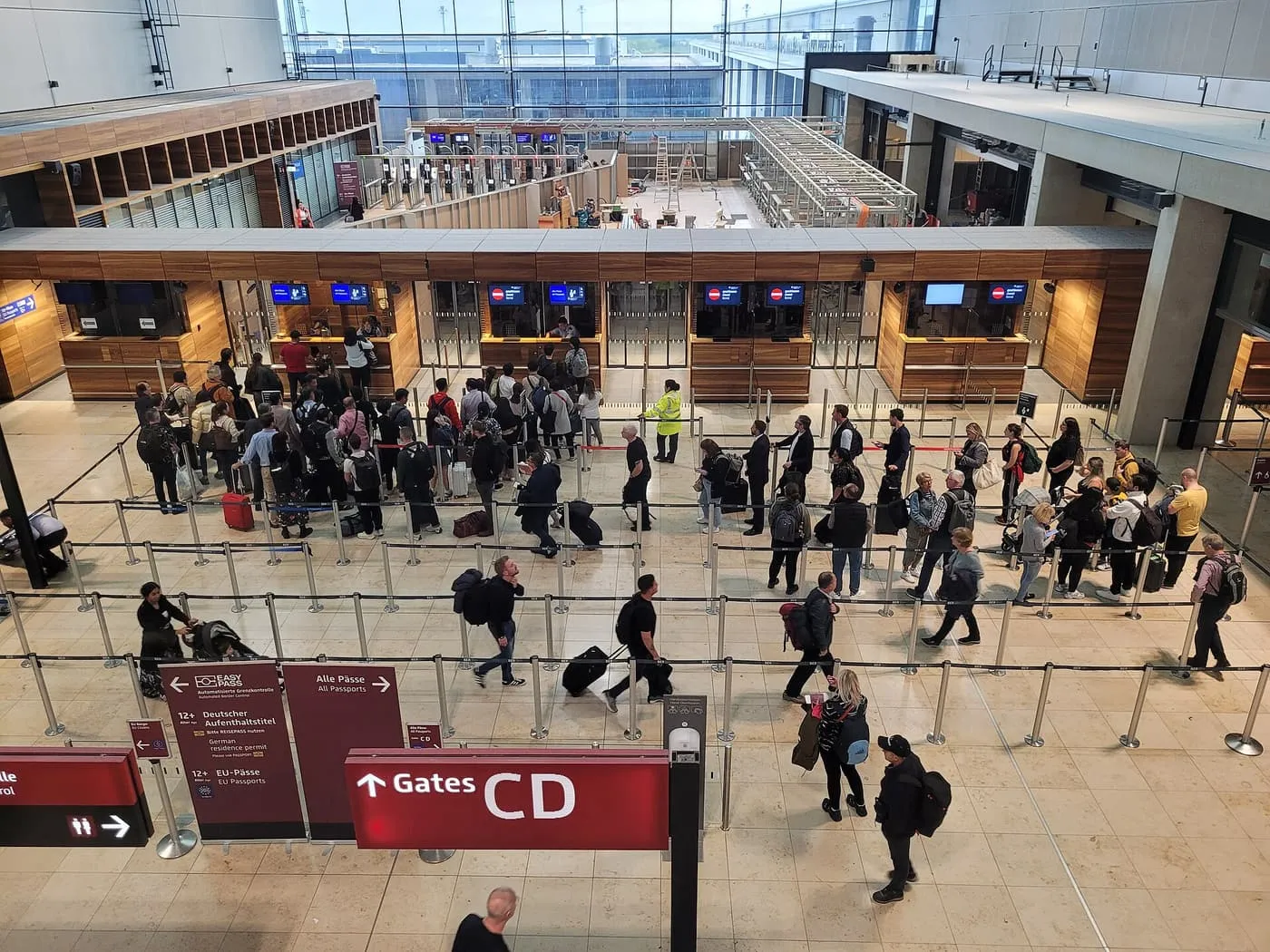
Passport control at Berlin Brandenburg Airport, with signs for EU passports and all passports. Photo: OliverMi1, Wikimedia Commons, CC BY 4.0.
The Entry/Exit System (EES)
The Entry/Exit System registers non-EU nationals each time they cross the external border of a Schengen country.
- Since when. The EU phased it in over six months. From 10 April 2026 it is fully operational at all external border crossing points (EU FAQ).
- Who. Every non-EU national on a short stay of up to 90 days in any 180, with or without a visa. Citizens of the EU (Ireland included), Iceland, Liechtenstein, Norway and Switzerland are not registered, and neither are holders of residence permits or long-stay visas (the EU’s exemption list).
- At the border. On your first entry an officer or a self-service kiosk takes a photo of your face and four fingerprints, and you answer the usual border questions. Children under 12 are not fingerprinted. Your passport is not stamped. If you refuse the photo or fingerprints you are refused entry.
- On later entries. The system checks your face and fingerprints against the record. With a biometric passport you can use self-service gates where a border has them.
- The record. Entry, exit and refusal records are kept for 3 years. If no exit is recorded, the file is kept for 5 years from the end of your authorised stay (EU data rules).
- Your days. The system counts your days in the Schengen area and lists overstayers. How the 90 days in any 180 are counted has the rule and the EU’s tools for checking it.
- Queues. Allow extra time on arrival and before your flight home. Canada’s government advises extra time between connecting flights, and Australia’s Smartraveller warns of long queues at the kiosks. A country can fall back on a passport stamp if its system fails (Travel.gc.ca). The EU’s optional Travel to Europe app pre-registers your passport data, a selfie and the entry questions within 72 hours of the border, in the countries that support it.
- From the UK. If you enter the Schengen area through the Port of Dover, Eurotunnel at Folkestone or Eurostar at St Pancras, the registration is done before you leave the UK (UK Foreign Office).
Ireland and Cyprus are EU members outside the Schengen area and still stamp passports by hand.
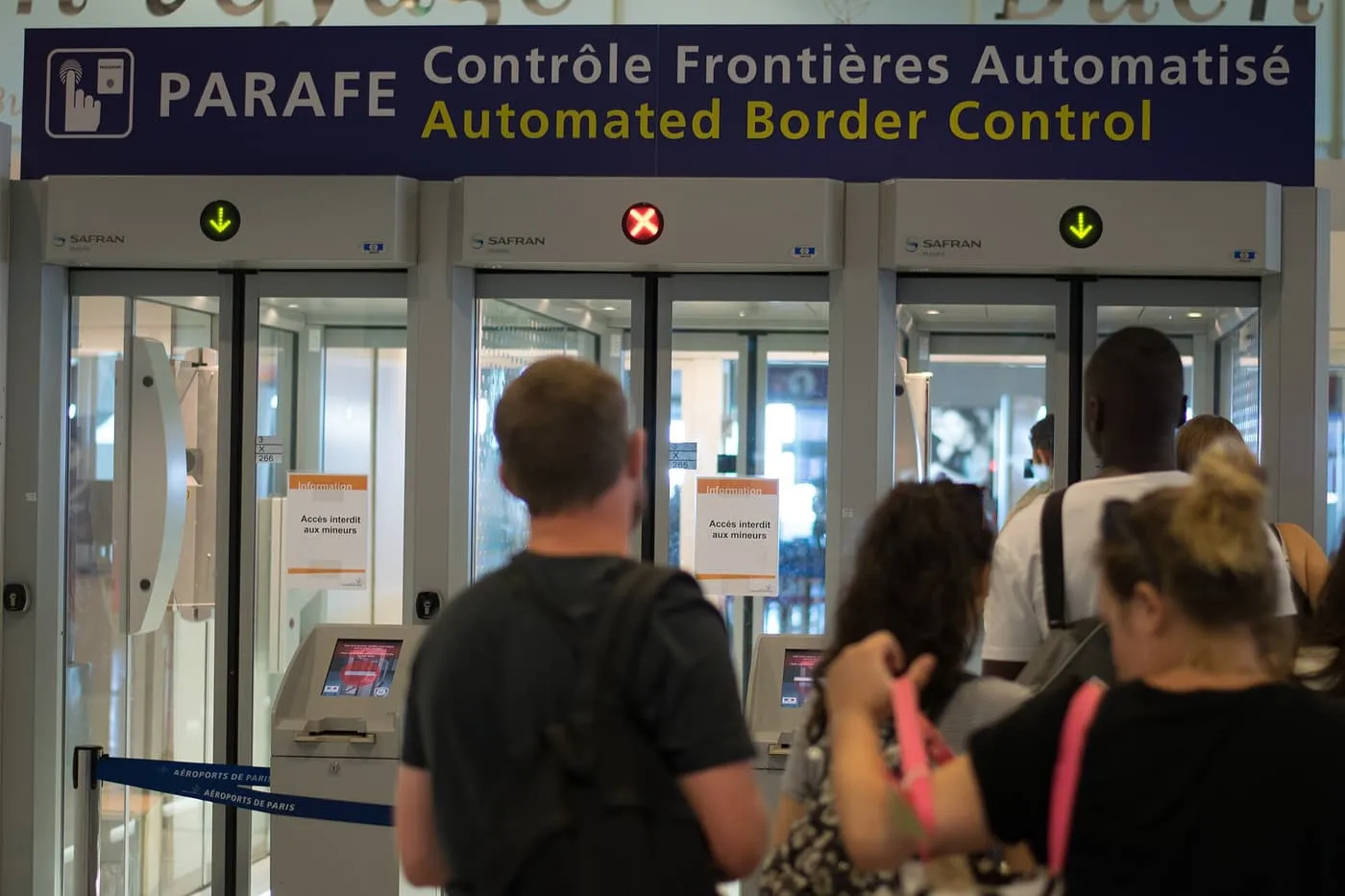
PARAFE automated border control gates at a Paris airport. Photo: 0x010C, Wikimedia Commons, CC BY-SA 4.0.
ETIAS
ETIAS is an online travel authorisation for visitors who need no visa, for the Schengen countries and Cyprus. It is not a visa.
- Status. ETIAS is not in operation and no applications are taken. The EU says it will announce the start date several months before launch. An EU news item dated 15 April 2026 said UK nationals would need it from the last quarter of 2026. Travel.gc.ca says the EU has indicated a transitional period of at least six months, then a grace period, before full enforcement (Travel.gc.ca).
- Price. €20. Applicants under 18 and over 70 pay nothing (EU).
- Validity. Three years or until your passport expires, whichever is first, for stays of up to 90 days in any 180.
- Who. Citizens of the UK, the US, Canada, Australia and the other visa-free countries on the EU’s list. Citizens of the ETIAS countries and of Ireland are exempt, and a dual national of one of them must travel on that passport.
- One for each person. There are no group applications, and children need their own. The authorisation is tied to the passport number.
- Speed. Most applications are decided within minutes and all within 96 hours, but one that needs an interview can take up to 30 days. The EU advises getting it before buying tickets.
- Where to apply. Only on the official ETIAS website or app. Other sites charge extra.
- Checks. Airlines, cruise lines and trains from the UK will check it before boarding (EU).
Cities outside the EES and ETIAS
The UK: the UK ETA
Scotland is in the UK. Its entry system is the UK electronic travel authorisation, the ETA.
- Who needs one. Most visitors who do not need a visa, including US, Canadian, Australian and European citizens. Not British or Irish citizens, and not people with permission to live, work or study in the UK (gov.uk).
- Price and validity. £20. It lasts 2 years or until your passport expires, for any number of visits of up to 6 months each. It covers the UK, Jersey, Guernsey and the Isle of Man.
- Each traveller. Babies and children need their own.
- How to apply. In the UK ETA app or online at gov.uk/eta. The decision usually arrives by email within a day and can take up to 3 working days. There is no refund, and a new passport needs a new ETA. Other websites may charge more.
- Not a guarantee. An ETA does not guarantee entry.
London Travel Geek’s UK ETA guide has the detail, and the Edinburgh entry rules sit on the city guide.
Ireland
Ireland is in the EU but outside the Schengen area, so the EES and ETIAS do not apply and a Schengen visa is not valid. It shares the Common Travel Area with the UK.
- Non-EU, non-UK nationals see an immigration officer on arrival by air or sea. The officer stamps your passport with the length of stay, which is at the officer’s discretion up to a maximum of 3 months (Irish government). Carry your passport, boarding card and a visa if you need one. An itinerary, proof of funds and accommodation details help.
- From Northern Ireland by land, non-EU nationals must report to an immigration officer within 30 days, or 7 days for business.
- UK citizens need no visa and no passport in law, can stay indefinitely, and should carry one anyway: some airlines and ferry operators ask for a passport (UK Foreign Office).
The Dublin entry rules cover the Northern Ireland day trips, which enter the UK and need a UK ETA.
Turkey
Turkey is outside the Schengen area, so the EES and ETIAS do not apply to a trip that stays in Turkey.
- Visa. None for tourism for UK, US, Canadian, Australian and EU citizens, for up to 90 days in any 180 (Turkey’s e-Visa site). Holders of Greek Cypriot (Republic of Cyprus) passports need a visa. A UK passport must be a British citizen passport: British National (Overseas), British Subject and British Protected Person passports need a visa.
- Passport. Valid for at least 60 days beyond your permitted stay, which for 90 days is 150 days after you arrive (Turkish Ministry of Foreign Affairs). Some countries’ ID cards are accepted instead; the same ministry lists them.
- Greek islands. A day trip from Turkey to a Greek island enters the Schengen area, and the EES applies (UK Foreign Office).
The Istanbul entry rules are on the city guide.
Morocco
Morocco is outside the EU, so no EU system applies.
- Visa. None for tourism for up to 90 days. Morocco’s foreign ministry lists the UK, the US, Canada, Australia, Ireland and EU member states as visa-exempt (consulat.ma). To stay longer, ask for an extension at a Moroccan police station before the 90 days end.
- Passport. The UK Foreign Office asks for 3 months’ validity after you arrive and an undamaged passport. Travel.gc.ca asks Canadians for 6 months beyond the day they leave. Carrying 6 months covers both.
- Stamp. Officers should stamp your passport on entry, and some travellers have had trouble leaving without one (UK Foreign Office, Smartraveller).
The Marrakech entry rules are on the city guide.
What changes with your passport
UK passport holders
- You are registered in the EES and will need ETIAS once it starts, unless you hold a Withdrawal Agreement residence document issued by a country that requires ETIAS, other than Ireland or Cyprus.
- You need no UK ETA. Ireland: no visa and no time limit.
- Turkey: visa-free only on a British citizen passport.
- Morocco: passport valid 3 months after you arrive.
US passport holders
- You are registered in the EES and will need ETIAS once it starts.
- You need a UK ETA for Edinburgh, and for a Northern Ireland day trip from Dublin.
- Ireland: up to 3 months, as the immigration officer decides. Turkey and Morocco: no visa for a holiday.
Canadian passport holders
- You are registered in the EES and will need ETIAS once it starts. If you are also an EU or Irish citizen you cannot apply for ETIAS and must travel on the European passport (Travel.gc.ca).
- You need a UK ETA.
- Ireland: up to 90 days. Turkey: passport valid at least 150 days after entry. Morocco: passport valid at least 6 months beyond the day you leave.
Australian passport holders
- You are registered in the EES and will need ETIAS once it starts. Australia has visa waiver agreements with some Schengen countries that allow longer stays: see the 90 days in any 180 guide.
- You need a UK ETA for a visit under 6 months.
- Ireland: a tourist permission of up to 90 days is given on arrival, and the passport needs at least one blank page (Smartraveller). Turkey and Morocco: no visa for a holiday.
EU citizens
- You are not registered in the EES and need no ETIAS.
- You need a UK ETA, except Irish citizens.
- Ireland: a passport or national ID card. Turkey and Morocco: no visa for a holiday.
Entry rules, city by city
Each city guide has its own entry-rules section. The table below lists every city on the site, and the 90 days in any 180 guide covers the Schengen count. The other planning guides are on the Plan your trip page.
The other planning guides cover cards, cash and tipping, eSIMs for Europe and where to go each month.
| City | Country | Entry rules |
|---|---|---|
| Amsterdam | Netherlands | Schengen area: EES now, ETIAS when it starts |
| Athens | Greece | Schengen area: EES now, ETIAS when it starts |
| Barcelona | Spain | Schengen area: EES now, ETIAS when it starts |
| Berlin | Germany | Schengen area: EES now, ETIAS when it starts |
| Budapest | Hungary | Schengen area: EES now, ETIAS when it starts |
| Dublin | Ireland | Ireland: Common Travel Area, no EES or ETIAS |
| Edinburgh | Scotland | United Kingdom: UK ETA, no EES or ETIAS |
| Florence | Italy | Schengen area: EES now, ETIAS when it starts |
| Istanbul | Turkey | Turkey: own visa-free rules, no EES or ETIAS |
| Kraków | Poland | Schengen area: EES now, ETIAS when it starts |
| Lisbon | Portugal | Schengen area: EES now, ETIAS when it starts |
| Madrid | Spain | Schengen area: EES now, ETIAS when it starts |
| Marrakech | Morocco | Morocco: own visa-free rules, no EES or ETIAS |
| Paris | France | Schengen area: EES now, ETIAS when it starts |
| Porto | Portugal | Schengen area: EES now, ETIAS when it starts |
| Prague | Czechia | Schengen area: EES now, ETIAS when it starts |
| Rome | Italy | Schengen area: EES now, ETIAS when it starts |
| Seville | Spain | Schengen area: EES now, ETIAS when it starts |
| Venice | Italy | Schengen area: EES now, ETIAS when it starts |
| Vienna | Austria | Schengen area: EES now, ETIAS when it starts |
Common questions
Do I need to do anything before I travel for the EU's Entry/Exit System?
No. The Entry/Exit System is free and needs nothing before you travel. At your first Schengen border a photo of your face and four fingerprints are taken, and the system replaces the passport stamp. The EU's optional Travel to Europe app can pre-register your passport data and a selfie within 72 hours of the border, in the countries that support it.
Is ETIAS required yet?
No. The EU's ETIAS site says ETIAS is not in operation, no applications are being taken and the start date will be announced several months before launch. When it starts it will cost €20, free under 18 and over 70, and last three years or until the passport expires.
Do I need a UK ETA for Edinburgh?
Yes, unless you are a British or Irish citizen or have permission to live, work or study in the UK. US, Canadian, Australian and European visitors usually need a UK ETA rather than a visa. It costs £20, lasts 2 years or until the passport expires, and covers visits of up to 6 months. Everyone needs their own, babies included. Apply at gov.uk/eta or in the UK ETA app.
Do I need a visa for Dublin, Istanbul or Marrakech?
Not as a UK, US, Canadian, Australian or EU citizen for a holiday. Ireland lets you stay up to 3 months at the immigration officer's decision (UK citizens are not limited). Turkey allows 90 days in any 180 and Morocco 90 days. Turkey wants a passport valid for at least 150 days after you arrive, and Morocco's governments differ, so carry a passport valid for 6 months.
Does the EES apply in Ireland, the UK, Turkey or Morocco?
No. The EES runs at the external borders of the Schengen countries only. Ireland, the UK, Turkey and Morocco have their own entry rules, and days spent there do not count towards the Schengen 90 days in any 180. A day trip from Turkey to a Greek island enters the Schengen area, and the EES applies.
Who is exempt from the EES?
Citizens of the EU (Ireland included), Iceland, Liechtenstein, Norway and Switzerland, holders of residence permits and long-stay visas, and a few other groups the EU lists. UK, US, Canadian and Australian citizens on a short stay are registered.