One of 2 self-guided walks in Chicago. See every walk.
💡 The Short Version: This 11-stop walk covers about 3 km of the Loop, measured between the stops, in the order the skyscraper was invented: Adler & Sullivan’s Auditorium Building (1889), the Monadnock, the last tall building held up by its own masonry walls, the Rookery with Frank Lloyd Wright’s light court, the Art Deco Board of Trade, the glass-fronted Reliance Building, the Picasso and the Chicago Theatre sign, ending at the Michigan Avenue Bridge. The walk is free. Do it on a weekday: the Rookery’s tours (from $15) run Monday to Friday between 10:00 and 13:00.
Or book a tour: GetYourGuide sells guided Loop architecture walks that go inside the lobbies, from $31.10. They are written up below.
⚠️ The Rookery tours are weekday mornings only: The Frank Lloyd Wright Trust runs its Rookery tours Monday to Friday, starting between 10:00 and 13:00. Start the walk by 9:30 to reach the Rookery in time.
The route
Map of the walk numbered stops in walking order
Open the whole route in Google Maps
- Distance: about 3 km, measured between the stops’ map positions.
- Start: the Auditorium Building, Michigan Avenue and Congress Parkway. The ‘L’ stops at Harold Washington Library (Brown, Orange, Pink and Purple lines) and Jackson (Blue and Red) are a few minutes west.
- Finish: the Michigan Avenue Bridge, at Wacker Drive.
| Stop | From start | Entry | Time to allow |
|---|---|---|---|
| 1. Auditorium and Fine Arts buildings | 0.0 km | Free to look | 15 minutes |
| 2. Monadnock and Fisher buildings | 0.4 km | Free to look | 15 minutes |
| 3. Chicago Board of Trade | 0.7 km | Free to look | 10 minutes |
| 4. The Rookery | 0.8 km | Tour from $15 | 45 minutes |
| 5. Marquette and Inland Steel buildings | 1.0 km | Free to look | 15 minutes |
| 6. Sullivan Center | 1.3 km | Free to look | 10 minutes |
| 7. Daley Center and the Picasso | 1.6 km | Free | 10 minutes |
| 8. Reliance Building | 1.8 km | Free to look | 10 minutes |
| 9. Chicago Theatre | 2.1 km | Free to look | 10 minutes |
| 10. Chicago Cultural Center | 2.3 km | Free | 30 minutes |
| 11. Michigan Avenue Bridge | 2.9 km | Free | 15 minutes |
The building facts below come from the City of Chicago’s landmark designations.
1. Auditorium Building and Fine Arts Building
The Auditorium Building (430 S. Michigan Avenue) was built from 1886 to 1890 by Dankmar Adler, the engineer, and Louis Sullivan, the designer. It combined a hotel, offices and a theatre for an opera company, and the city calls it a turning point in Sullivan’s career and a milestone in modern architecture. Inside, the Auditorium Theatre has four broad elliptical arches across its width, covered in gold-leafed plaster reliefs. Roosevelt University now uses the building.
Next door, the Fine Arts Building (410 S. Michigan Avenue) was built by the Studebaker company to assemble and show its carriages, then converted in 1898 into studios and theatres for artists and craftsmen. Its public interiors, including the murals on the 10th floor, are largely as they were in 1898.
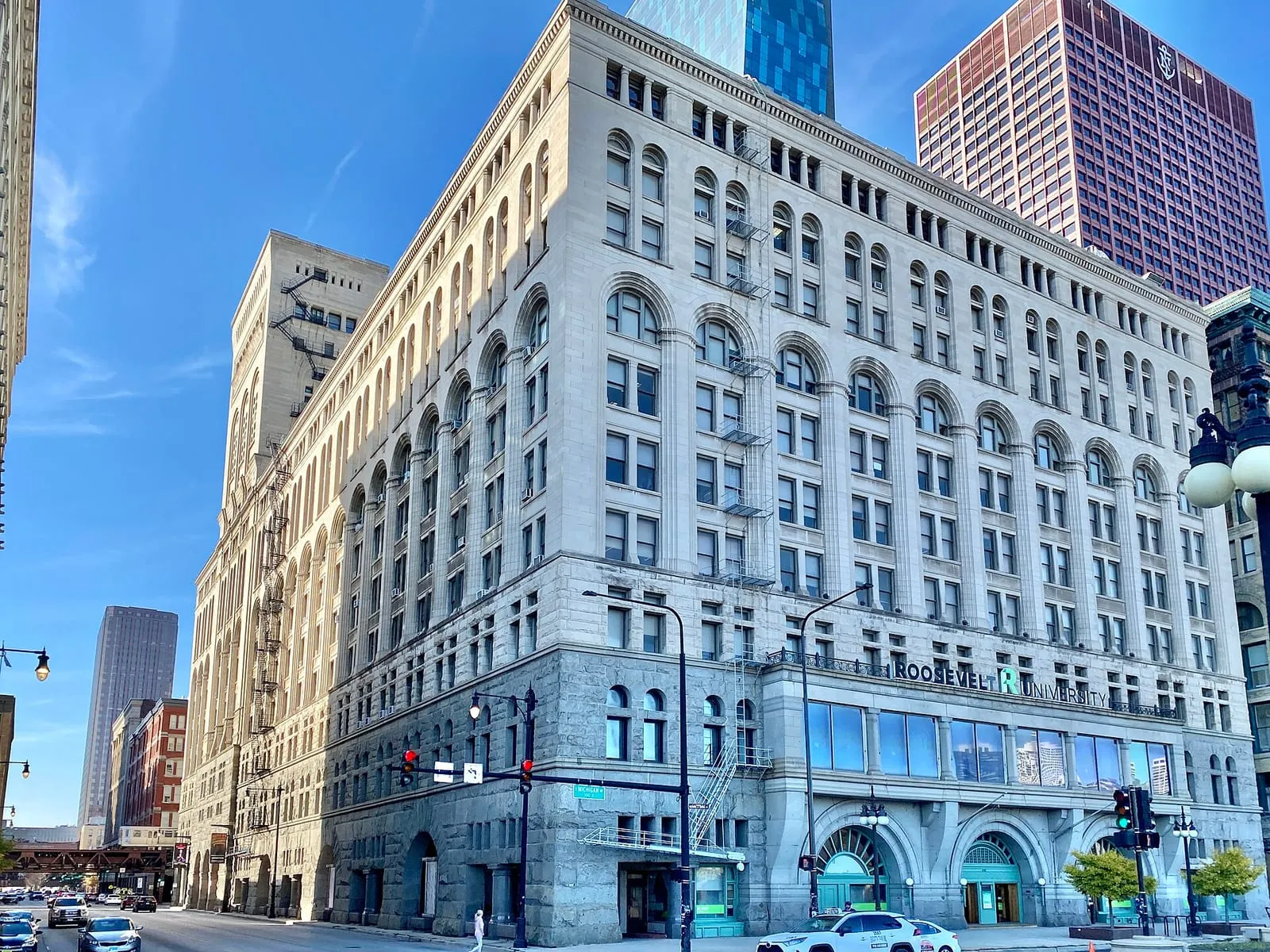
The Auditorium Building. Photo: Warren LeMay, Wikimedia Commons, CC BY-SA 2.0.
Walk west along Congress Parkway and north up Dearborn Street.
2. Monadnock Building and Fisher Building
The Monadnock (53 W. Jackson Boulevard) is two buildings in one. The north half, by Burnham & Root (1889 to 1891), has almost no ornament, and its load-bearing brick walls are six feet thick at the corners, according to the Chicago Architecture Center. The south half, by Holabird & Roche (1891 to 1893), is an early steel frame, with narrower piers and wider windows.
Across Dearborn Street, the Fisher Building (343 S. Dearborn, 1896) is clad in Gothic-style terra-cotta. Look at the base for fish, crabs and shells, a pun on the name of its owner, Lucius G. Fisher; eagles and mythical beasts are higher up.
3. Chicago Board of Trade Building
Holabird & Root’s 1930 Art Deco tower (141 W. Jackson Boulevard) closes the view south down LaSalle Street, the city’s financial district. The city calls it one of Chicago’s finest Art Deco buildings, and its two-storey lobby one of the best interiors of the period. Stand a block north on LaSalle for the photo.
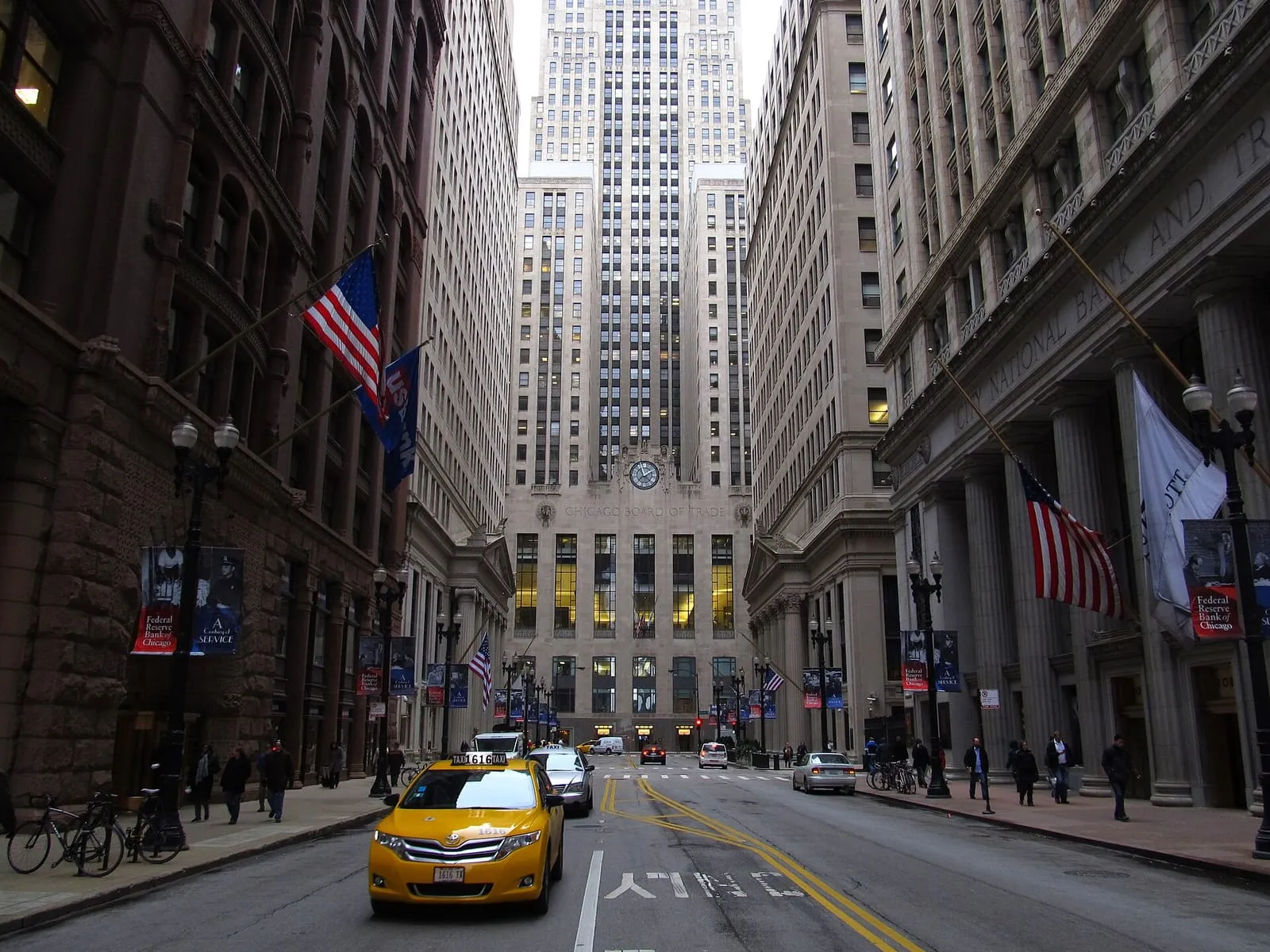
The Board of Trade from LaSalle Street. Photo: Ken Lund, Wikimedia Commons, CC BY-SA 2.0.
4. The Rookery
Burnham & Root’s Rookery (209 S. LaSalle Street, 1885 to 1888) uses both load-bearing masonry and an iron skeleton. It is named after the temporary City Hall and water tank that stood here after the 1871 fire, where pigeons roosted. In 1905 Frank Lloyd Wright remodelled the skylit light court and lobbies, adding Prairie School touches to Root’s ironwork.
The Frank Lloyd Wright Trust runs the tours, from its museum shop in the building, open 9:00 to 17:00 on weekdays:
| Tour | Length | Price | When |
|---|---|---|---|
| Rookery Light Court | 45 minutes | $15 | Monday to Friday, tours from 10:00 to 13:00 |
| Light Court and Burnham Library | 60 minutes | $20 | Mondays and Wednesdays |
The Burnham Library is where architects met to discuss the plans for the 1893 World’s Columbian Exposition. The Trust recommends booking ahead and checking in at the shop 15 minutes before the tour.
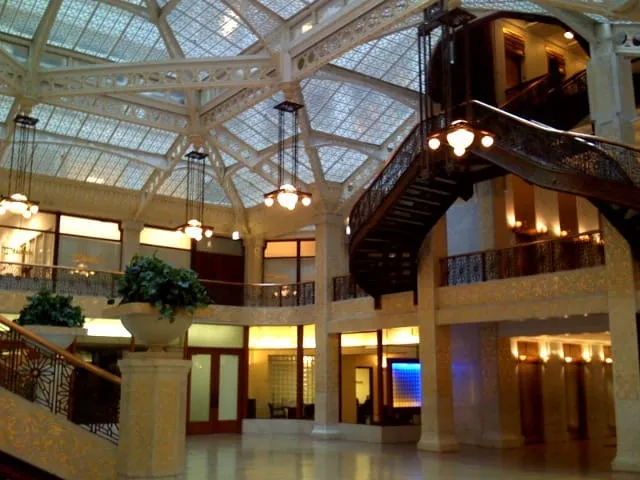
The Rookery light court. Photo: Ronnotel, Wikimedia Commons, CC BY-SA 3.0.
5. Marquette Building and Inland Steel
The Marquette Building (140 S. Dearborn Street, 1895) by Holabird & Roche shows its steel frame on the outside: broad windows set in a grid of narrow piers and spandrels. It is named after Jacques Marquette, the French Jesuit who wintered at the site of Chicago in 1674 to 1675, and the lobby has mosaic panels by the Tiffany firm and bronze heads of Native Americans, animals and early explorers. Next door at 136 S. Dearborn, the Chicago Architecture Center’s Marquette Hub sells walking tours, Wednesday to Saturday, 11:00 to 18:00.
Across Monroe Street, the Inland Steel Building (30 W. Monroe, 1957) was the first skyscraper built in the Loop after the Depression. Skidmore, Owings and Merrill clad it in stainless steel, put its columns on the outside and moved its lifts into a separate tower, leaving each floor open.
6. Sullivan Center (Carson Pirie Scott)
Louis Sullivan designed this department store (1 S. State Street) for Schlesinger and Mayer from 1898; Carson Pirie Scott later occupied it. The cast-iron ornament over the two lower storeys, densest at the rounded corner entrance on State and Madison, is, in the city’s words, frozen in iron but seems to be in fluid motion.
7. Daley Center and the Picasso
The Daley Center (50 W. Washington Street, 1965) by C.F. Murphy Associates was Chicago’s first major public building in a modern style, and the first skyscraper clad in self-weathering Cor-Ten steel, which rusts to a protective brown. On the plaza, Pablo Picasso’s untitled sculpture, unveiled in 1967, is made of the same steel. The plaza is where the city holds the Christkindlmarket in winter.
8. Reliance Building
To Chicagoans of the 1890s, the Reliance Building (32 N. State Street) looked as if it defied gravity. Its base dates from 1890 and its upper floors from 1894 to 1895, by Burnham & Root and D.H. Burnham and Co. Narrow piers covered in cream terra-cotta frame wide “Chicago windows”, a fixed central pane with narrow opening sashes either side, and the city calls it the direct ancestor of today’s glass-and-steel towers. The City restored the exterior in 1996.
9. Chicago Theatre
Rapp & Rapp’s 1921 movie palace (175 N. State Street) was one of the first in the country and is the oldest surviving in Chicago. The city says its upright CHICAGO sign and marquee alone are an unofficial emblem of the city. It still stages concerts and comedy.
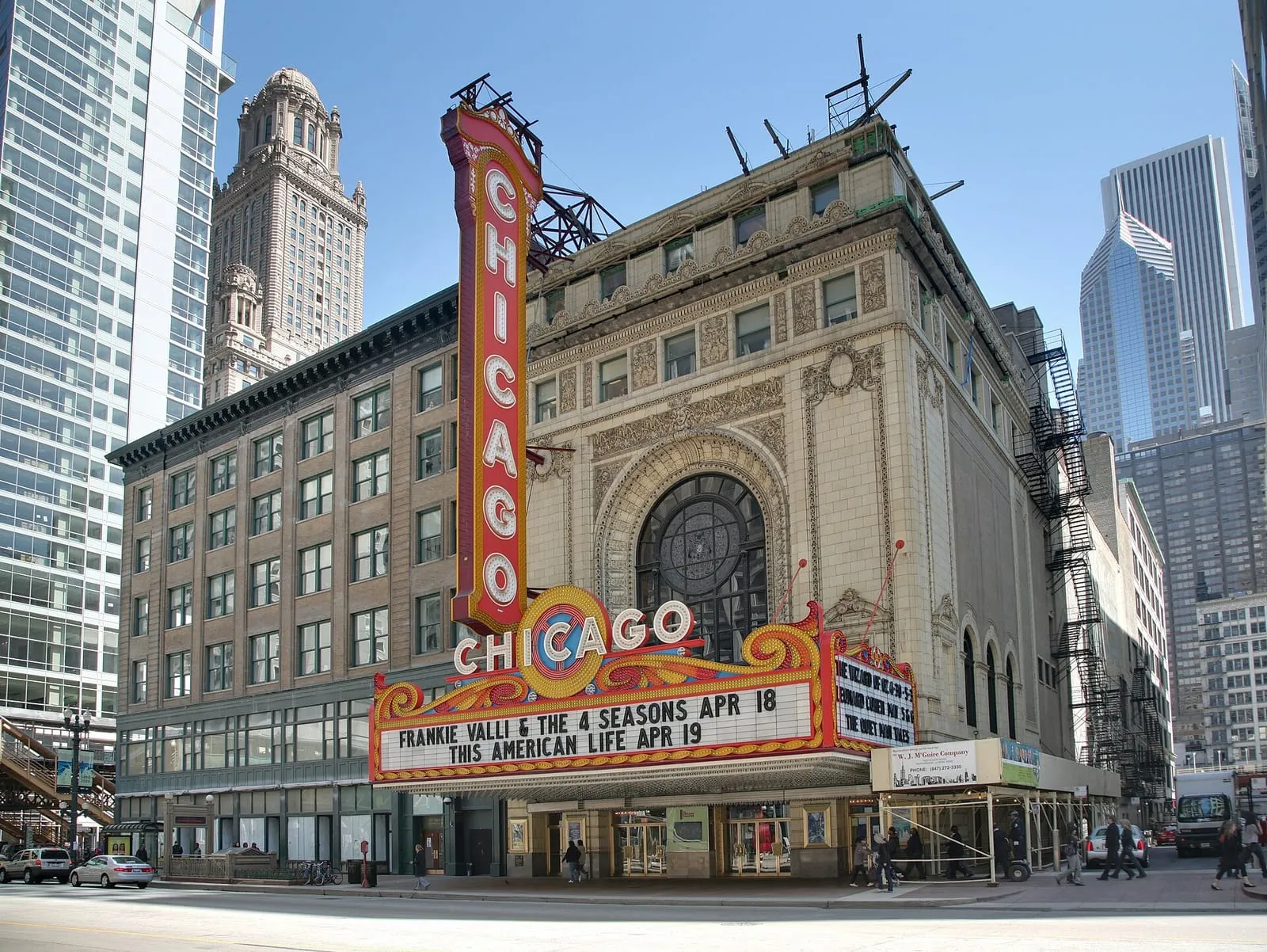
The Chicago Theatre. Photo: Daniel Schwen, Wikimedia Commons, CC BY-SA 4.0.
10. Chicago Cultural Center
Built in 1897 as the city’s first central public library, the Chicago Cultural Center (78 E. Washington Street) is decorated with mosaics, marble and bronze, and has two stained-glass domes by the Tiffany Glass and Decorating Company; the Tiffany dome is over Preston Bradley Hall. It is free and open 10:00 to 17:00 daily, closed on holidays, with free exhibitions and events.
11. Michigan Avenue Bridge
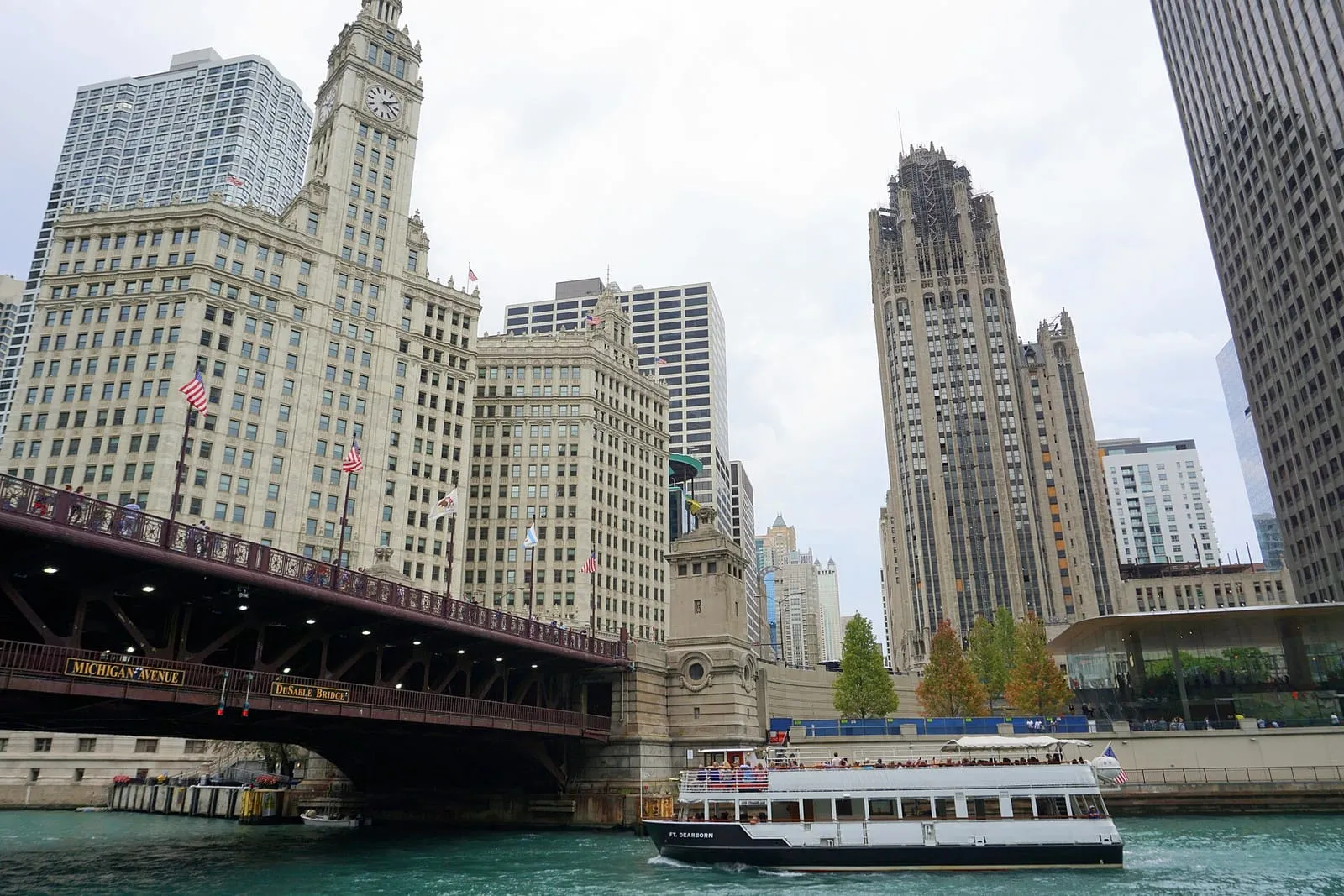
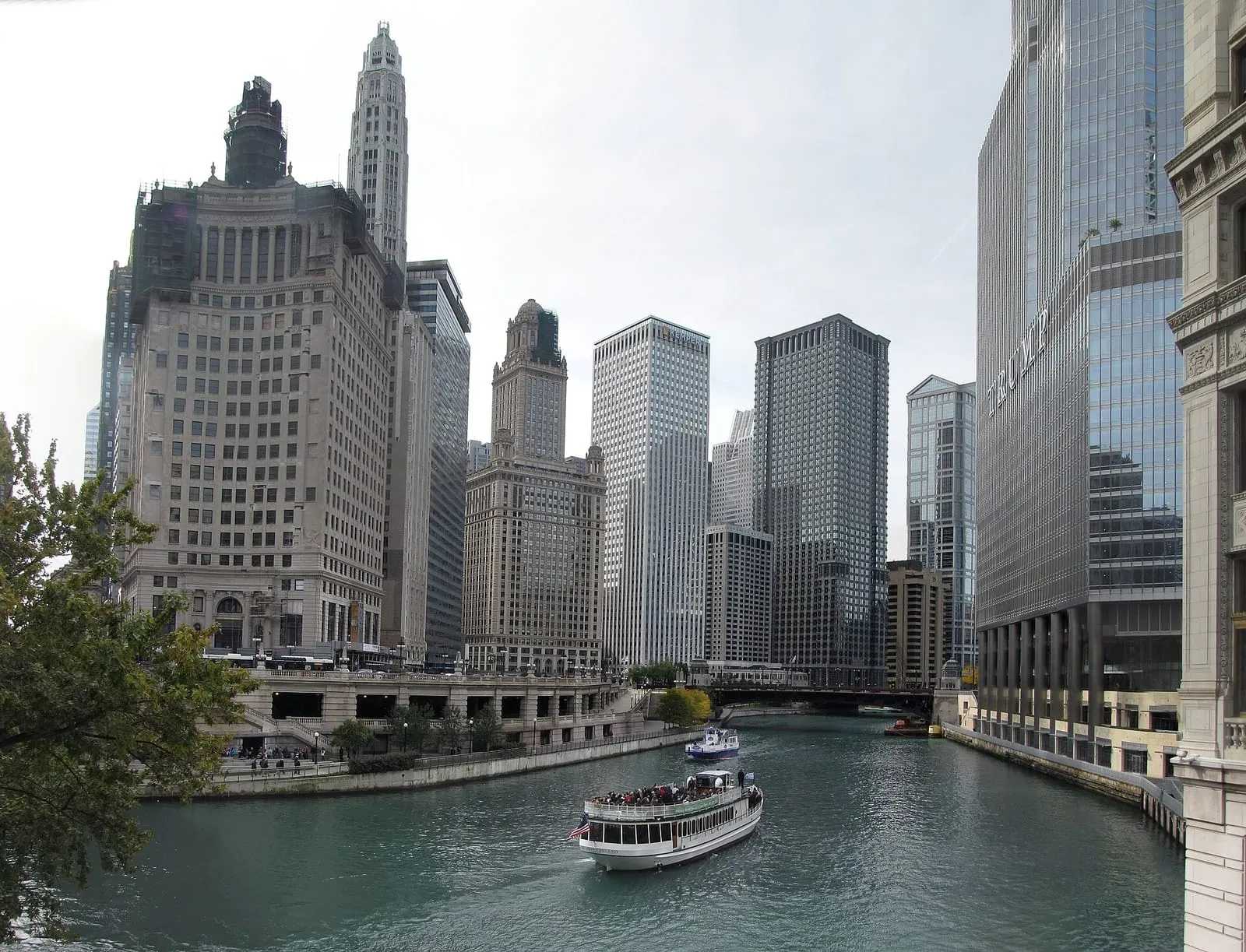
The Michigan Avenue Bridge of 1920 and the Wacker Drive esplanade (1926) were part of Daniel Burnham’s 1909 Plan of Chicago, and opened up North Michigan Avenue. Four 1920s buildings frame it: 333 N. Michigan (1928), Art Deco and set back so it appears to stand in the middle of the avenue; the London Guarantee Building (1923), on part of the site of Fort Dearborn; the Wrigley Building; and Tribune Tower.
A short walk west along Wacker Drive, 35 E. Wacker (1927), built as the Jewelers Building with a car park on floors 2 to 22, was the tallest building outside New York when it opened, and Mather Tower (75 E. Wacker, 1928) is the city’s most slender skyscraper. The Chicago Architecture Center at 111 E. Wacker Drive has exhibitions on how Chicago became “the city of architecture”: $15 for adults, free for children 5 and under, 10:00 to 17:00 Sunday to Thursday and to 19:00 on Fridays and Saturdays. The First Lady cruise dock is across the street at 112 E. Wacker.
Tours of the Loop
GetYourGuide sells guided walks that open the lobbies on this route:
Chicago: Secret Interiors Architecture Walking Tourad
From $31.10 · 4.8 stars from 723 reviews · 2 hours
A two-hour walk through Loop building lobbies and interiors.
Chicago: Treasures of the Golden Age Walking Tourad
From $35 · 4.8 stars from 225 reviews · 2 hours
A guided walk through the Loop buildings of the late 19th and early 20th centuries.
Chicago Architecture, History and Culture: Loop Walking Tourad
From $50 · 4.9 stars from 15 reviews · 3 hours
A longer guided Loop walk covering architecture, history and culture.
Where to go next
The Magnificent Mile walk starts on the Michigan Avenue Bridge, where this one ends, and runs north to Oak Street. The architecture river cruise leaves from the First Lady dock beside it, and shows the same buildings from the water. Skydeck is three blocks west of the Board of Trade, and Millennium Park and the Art Institute are across Michigan Avenue from stops 1 and 10. For Wright’s houses, see Frank Lloyd Wright in Chicago. The Reliance Building (stop 8) is now the Staypineapple hotel; see where to stay in the Loop, or where to stay in Chicago for the other areas. The Chicago hub has the rest.
Common questions
How long is the Loop architecture walk?
About 3 km between the 11 stops, measured on a map, and a little more on the street. Allow two to three hours, or longer with the Rookery tour and the Chicago Cultural Center.
Is the Loop architecture walk free?
The walk is free. The Chicago Cultural Center is free and open 10:00 to 17:00 daily. The Rookery's guided light court tour costs $15 and runs on weekdays between 10:00 and 13:00, and the Chicago Architecture Center at the end charges $15 for adults.
What day should I do the walk?
A weekday. The Rookery's tours run Monday to Friday only, and the Chicago Architecture Center's Marquette Hub on Dearborn Street opens Wednesday to Saturday.
Where does the walk finish?
At the Michigan Avenue Bridge over the Chicago River, beside the Chicago Architecture Center and the First Lady river cruise dock, and where the Magnificent Mile walk begins.