One of 2 self-guided walks in Chicago. See every walk.
In this guide
💡 The Short Version: The Magnificent Mile is Michigan Avenue from the Chicago River north to Oak Street, and this 9-stop walk covers it in about 1.7 km, measured between the stops. Start on the Michigan Avenue Bridge, between the Wrigley Building and Tribune Tower, whose base holds more than 120 stones from places like the Parthenon and the Taj Mahal; pass the 1869 Water Tower, which survived the Great Fire, and Fourth Presbyterian Church; go up 360 Chicago if you want the view; and finish at the Drake and Oak Street Beach. Everything but 360 Chicago is free.
Or book a tour: GetYourGuide sells guided walks of the avenue and the river from $35, and the 360 Chicago deck halfway up from $27. They are written up below.
⚠️ Walk it in daylight for the stones: Tribune Tower’s stones are small, set at eye level around the base, and labelled on little plaques. Each is easiest to find and read by day.
The route
Map of the walk numbered stops in walking order
Open the whole route in Google Maps
- Distance: about 1.7 km, measured between the stops’ map positions.
- Start: the Michigan Avenue Bridge at Wacker Drive, where the Loop architecture walk ends.
- Finish: Oak Street Beach. Chicago station on the Red Line is about ten minutes west along Chicago Avenue from the Water Tower.
| Stop | From start | Entry | Time to allow |
|---|---|---|---|
| 1. Michigan Avenue Bridge and the Wrigley Building | 0.0 km | Free | 15 minutes |
| 2. Tribune Tower | 0.2 km | Free | 20 minutes |
| 3. Allerton Hotel | 0.7 km | Free to look | 5 minutes |
| 4. Water Tower and Pumping Station | 0.9 km | Free | 20 minutes |
| 5. Fourth Presbyterian Church | 1.1 km | Free | 15 minutes |
| 6. 875 N. Michigan Avenue (360 Chicago) | 1.2 km | Deck from $27 | 1 hour |
| 7. Palmolive Building | 1.3 km | Free to look | 5 minutes |
| 8. The Drake | 1.4 km | Free to look | 10 minutes |
| 9. Oak Street Beach | 1.7 km | Free | As long as you like |
1. Michigan Avenue Bridge and the Wrigley Building
The bridge (1920) and the Wacker Drive esplanade were part of Daniel Burnham’s 1909 Plan of Chicago, and the city’s landmark designation credits them with turning North Michigan Avenue into one of its premier streets. The sculptures on the bridge towers were added in 1928. Four 1920s buildings stand round it, together one of the finest urban spaces in the country, in the city’s words: the white Wrigley Building and Tribune Tower on the north bank, and the London Guarantee Building (1923), built on part of the site of Fort Dearborn, and Art Deco 333 N. Michigan (1928) on the south. Because Michigan Avenue jogs at the bridge, 333 N. Michigan appears to stand in the middle of the avenue all the way from the north.
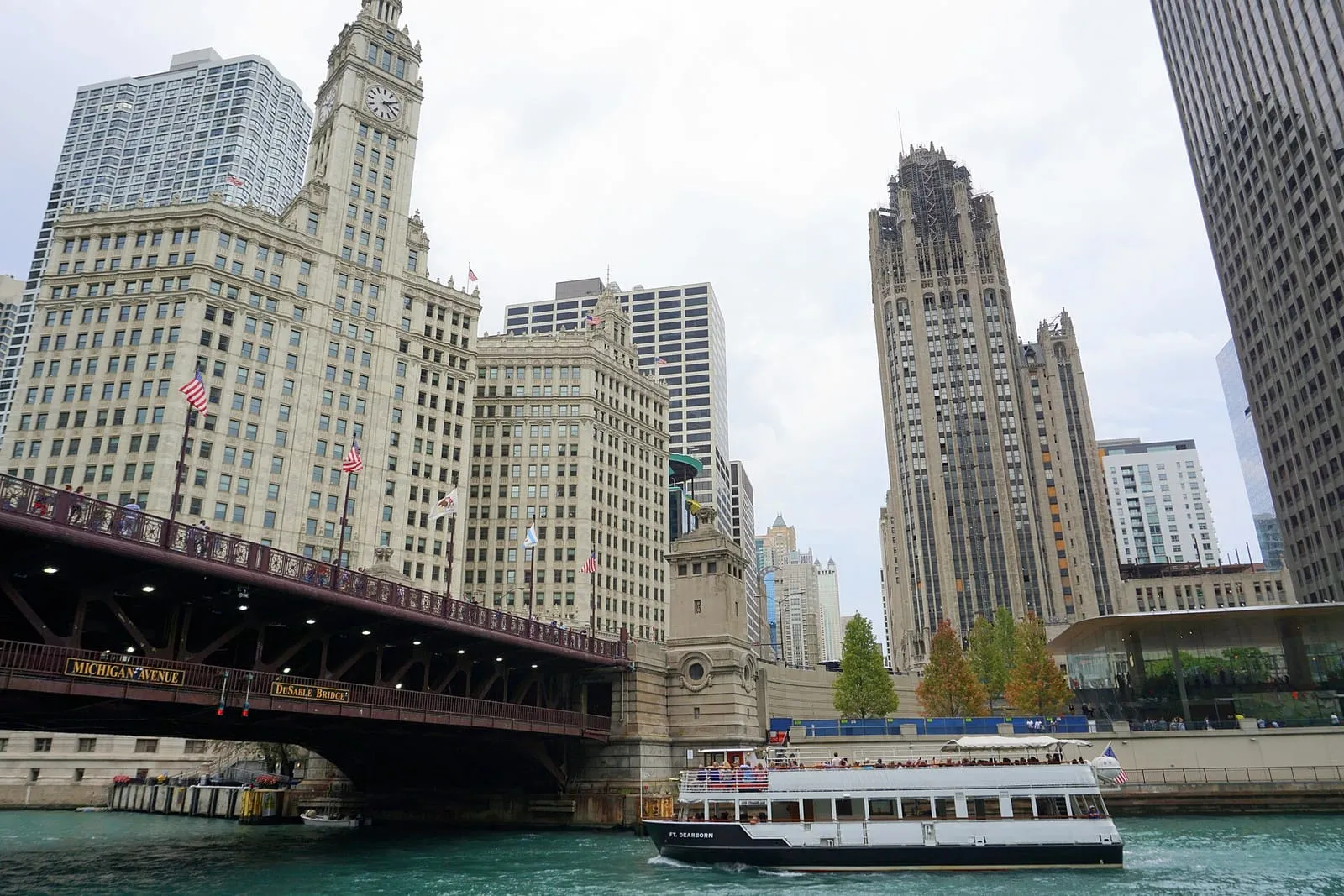
The Wrigley Building, Tribune Tower and the bridge. Photo: Matt Kieffer, Wikimedia Commons, CC BY-SA 2.0.
2. Tribune Tower
In 1922 the Chicago Tribune held an international competition for “the most beautiful office building in the world”. The winner, by Howells & Hood (1922 to 1925), crowns the tower with flying buttresses taken from Rouen Cathedral in France, and the city says the entries shaped skyscraper design through the 1920s. Walk round the base: it is set with more than 120 stones from famous sites in all 50 states and dozens of countries, from the Parthenon and the Taj Mahal to Bunker Hill and the “Injun Joe Cave” from Mark Twain’s Missouri. Each one has a small plaque naming where it came from.
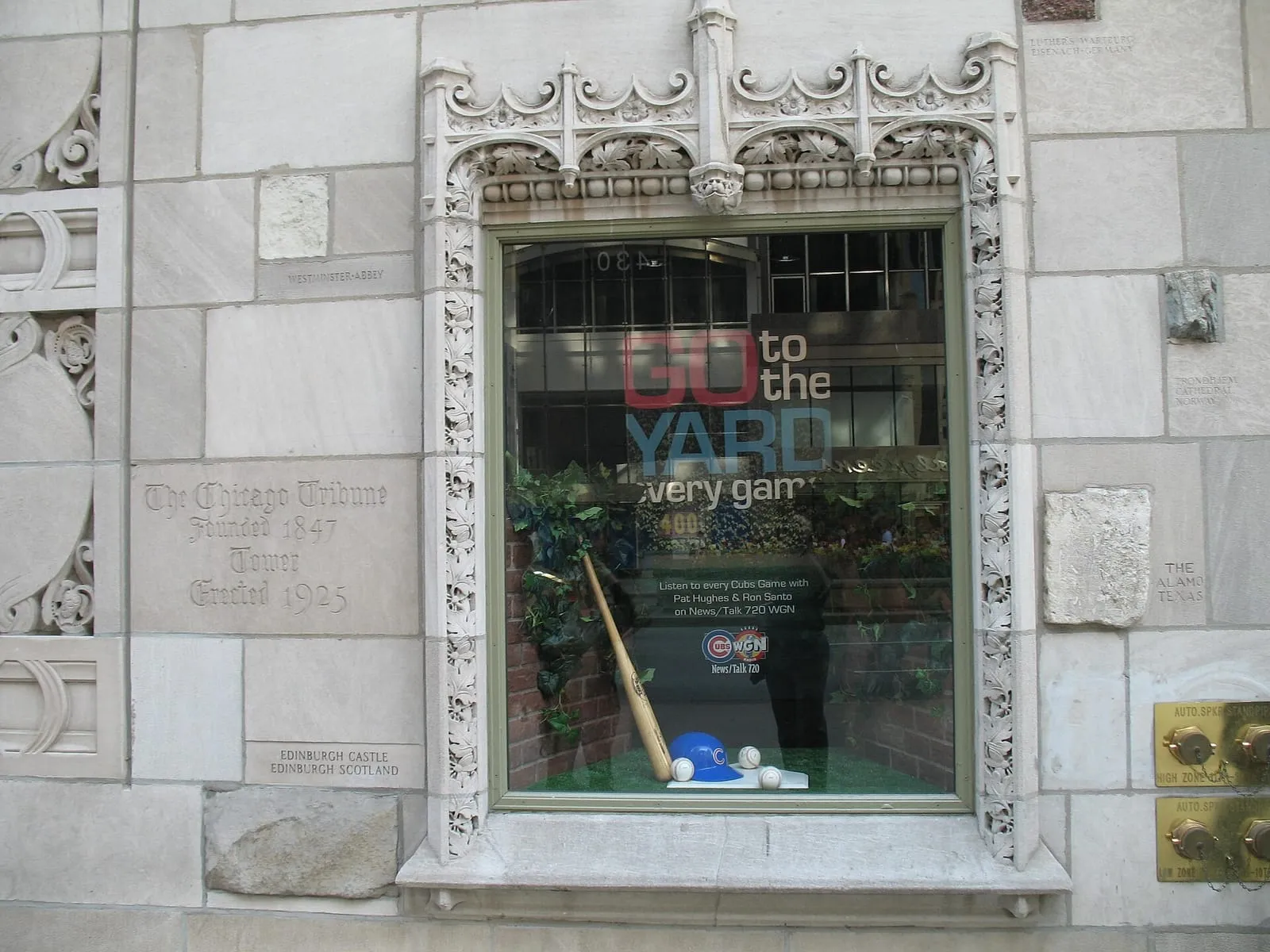
Stones in the base of Tribune Tower. Photo: TonyTheTiger, Wikimedia Commons, CC BY-SA 3.0.
3. Allerton Hotel
At 701 N. Michigan Avenue, the Allerton (1922 to 1924) is a rare Chicago example of North Italian Renaissance architecture, with decorative brickwork and a tower-topped roofline. The 25-storey building was the city’s first high-rise with pronounced setbacks, encouraged by the new zoning laws. It was built as a “club hotel” for young professionals, combining hotel service with a private club, and helped turn North Michigan Avenue into a street of exclusive shops, clubs, offices and hotels.
4. Water Tower and Pumping Station
The Water Tower at 806 N. Michigan Avenue was built in 1869 by William W. Boyington in a castellated Gothic style, to hide a 138-foot standpipe that evened out the water pressure from the pumping station across the street. It is one of the few buildings that survived the Great Chicago Fire of 1871, and became a symbol of the city’s rebuilding. Inside is the City Gallery, an art gallery run by the City of Chicago. The Pumping Station opposite, built at the same time to Boyington’s design, is still a working pumping station, supplying the city with water from Lake Michigan.
Behind the Water Tower, Water Tower Place is the avenue’s tall shopping mall.
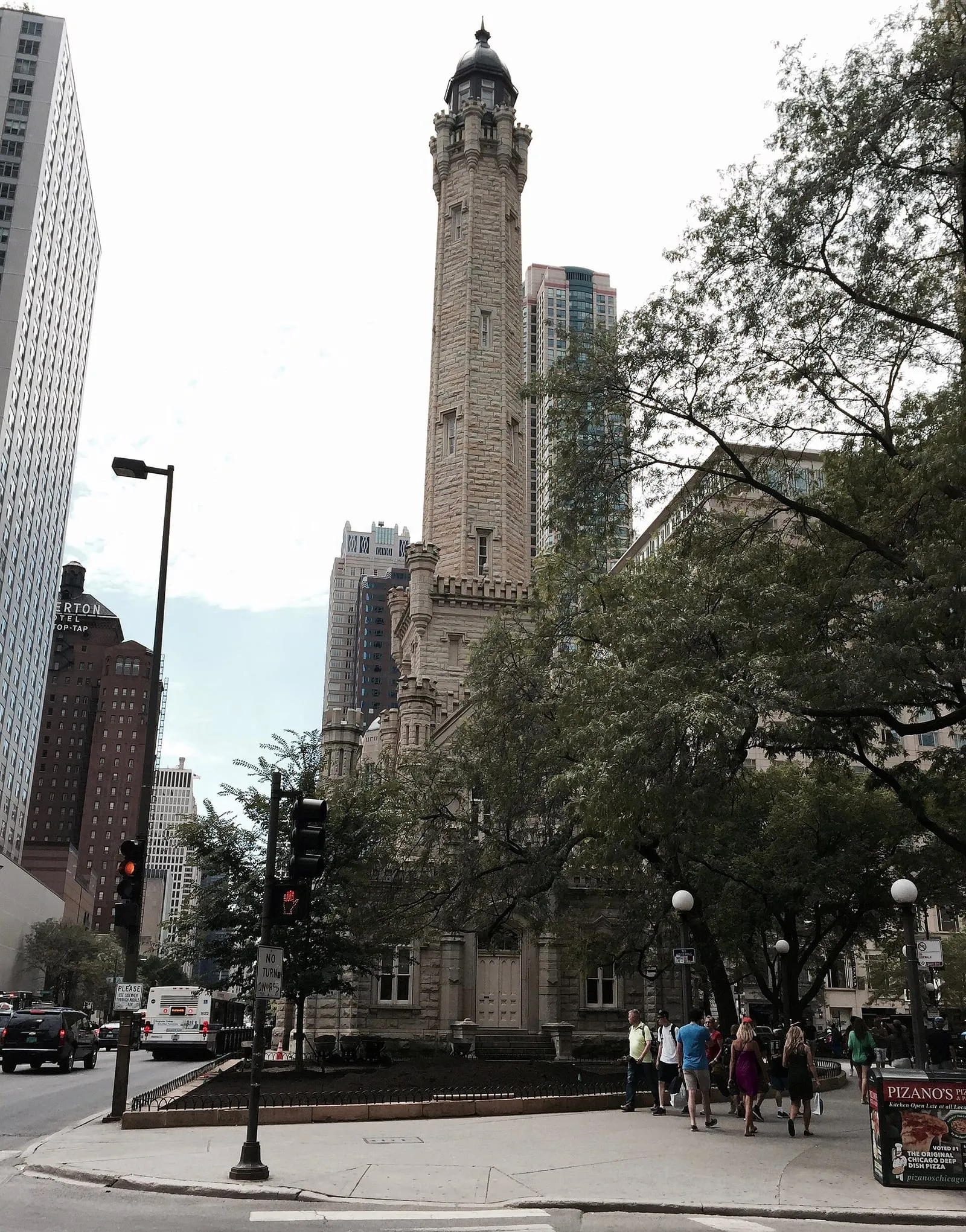
The Water Tower. Photo: w_lemay, Wikimedia Commons, CC0.
5. Fourth Presbyterian Church
Apart from the Water Tower, Fourth Presbyterian Church (126 E. Chestnut Street, on Michigan Avenue) is the oldest building on Michigan Avenue north of the river. Its cornerstone was laid in 1912 and it was dedicated in May 1914. The architect, Ralph Adams Cram, also worked on the Cathedral of St. John the Divine in New York, and combined English and French Gothic here. Howard Van Doren Shaw designed the Tudor-style parish buildings round the courtyard, a lawn with a fountain set back from the traffic; the 1995 Loggia on its north side gives step-free access to the Sanctuary. The church says more than 8 million people have walked in under the carved tympanum over the Michigan Avenue door since 1914. Charles Connick of Boston designed the stained glass.
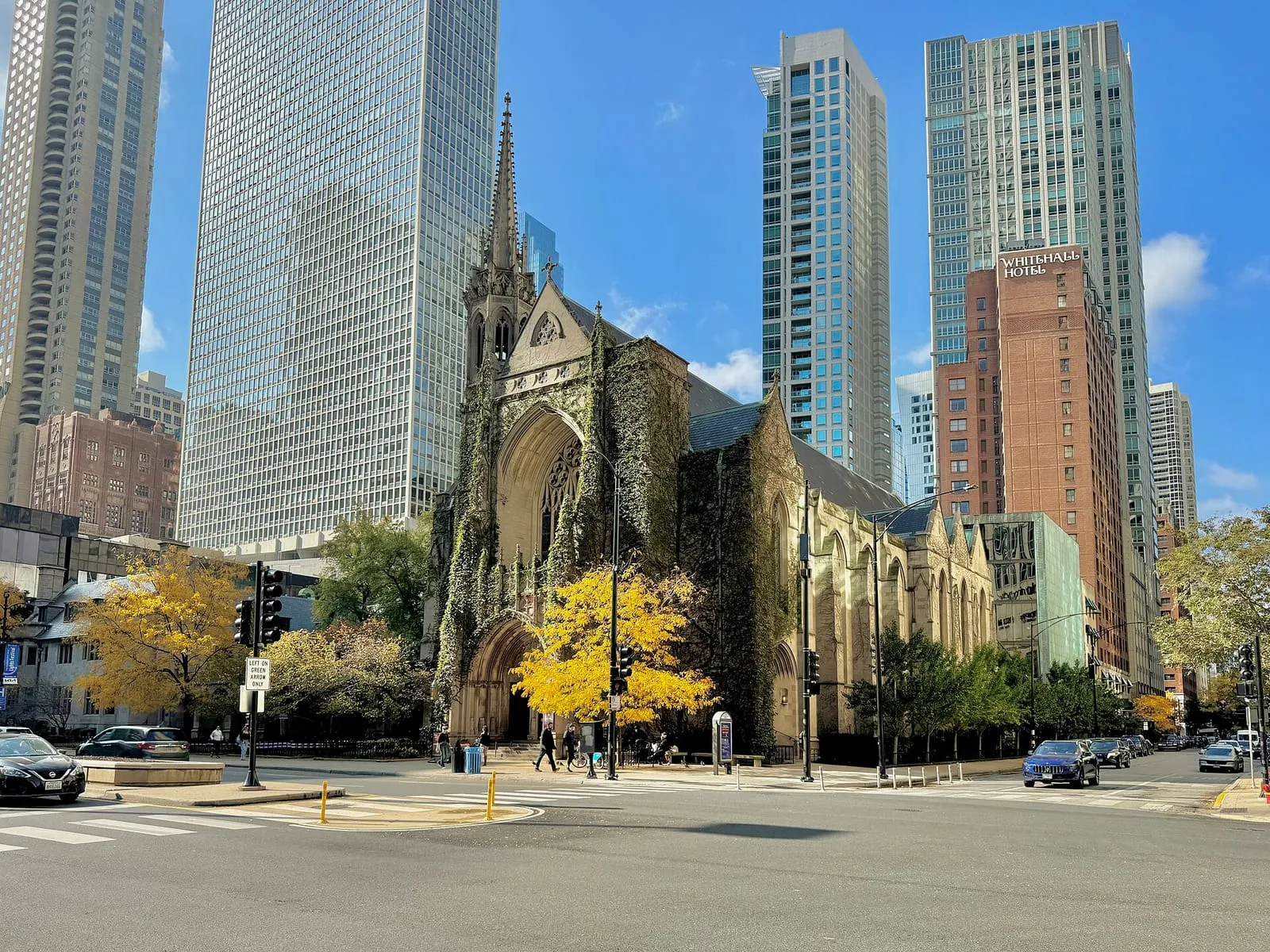
Fourth Presbyterian Church. Photo: w_lemay, Wikimedia Commons, CC BY-SA 2.0.
6. 875 N. Michigan Avenue (360 Chicago)
The black, tapering tower known until 2018 as the John Hancock Center has the 360 Chicago observation deck on its 94th floor, 1,030 feet up. It opens 9:00 to 23:00 daily; online tickets start at $27 for adults, and TILT, the windows that tip you out over the city, at $45. The entrance is on the concourse below street level. The 360 Chicago tickets page has the prices, the quiet hours and the bag rules.
7. Palmolive Building
Holabird & Root’s Palmolive Building (919 N. Michigan Avenue, 1927 to 1929), built for the soap company, was the first commercial skyscraper built far from the Loop. The city calls it one of the country’s best Art Deco “set-back” towers. The navigation beacon on top, which ran from 1930 to 1981, was restored in 2007.
8. The Drake
The Drake, at the top of Michigan Avenue where it meets Lake Shore Drive, was designed by Marshall and Fox, who also built the Blackstone Hotel and what is now the South Shore Cultural Center. It is still a hotel.
9. Oak Street Beach
At 1000 N. Lake Shore Drive, at Oak Street, the avenue ends at the lake. The beach is open 6:00 to 23:00, but swimming is only allowed in the beach season, from the Friday before Memorial Day to Labor Day, when lifeguards are on duty from 11:00 to 19:00. Look for Jeff Zimmermann’s mural You Know What You Should Do.
Doing the two walks as one
The Loop architecture walk ends on the Michigan Avenue Bridge, so the two join into a single walk of about 4.5 km from the Auditorium Building to Oak Street. On a weekday, start the Loop walk by 9:30 for the Rookery’s morning tours, eat in the Loop, and reach 360 Chicago in the late afternoon. 360 Chicago itself says its quietest hours are 12:00 to 14:00 and its busiest is sunset.
Guided walks
Chicago: Icons Guided Architecture Walking Tourad
From $35 · 4.6 stars from 5 reviews · 1.5 hours
A guided architecture walk past the city’s best-known buildings.
Chicago: Elevated Architecture Walking Tourad
From $35 · 4.4 stars from 5 reviews · 2 hours
A two-hour guided architecture walk.
Chicago: 360 CHICAGO Observation Deck Ticketad
From $27 · 4.4 stars from 3,934 reviews · timed entry
General admission to the 94th-floor deck at stop 6, with GetYourGuide’s cancellation terms.
Where to go next
The Loop architecture walk starts at the Auditorium Building and ends where this one begins. Navy Pier is about 20 minutes east along Grand Avenue from stop 2, and Lincoln Park and the zoo are a bus ride north up Lake Shore Drive from Oak Street. For hotels along the route, see where to stay in River North and on the Magnificent Mile. The Chicago hub has the rest.
Common questions
How long is the Magnificent Mile walk?
About 1.7 km between the nine stops, measured on a map. Allow 90 minutes without stops, or half a day with 360 Chicago and the shops.
Where does the Magnificent Mile start and end?
The Magnificent Mile is the stretch of Michigan Avenue from the Chicago River north to Oak Street. This walk starts on the Michigan Avenue Bridge and ends at Oak Street Beach.
What is free on the Magnificent Mile?
Everything on this walk except 360 Chicago: the bridge, Tribune Tower's stones, the Water Tower's City Gallery, Fourth Presbyterian Church's courtyard and Oak Street Beach. 360 Chicago starts at $27 online.
Which walk joins the Magnificent Mile walk?
The Loop architecture walk ends on the Michigan Avenue Bridge, where this one starts, so the two make a single walk of about 4.5 km from the Auditorium Building to Oak Street.