One of 2 self-guided walks in Bangkok. See every walk.
In this guide
💡 The Short Version: Start at MRT Wat Mangkon station and finish at River City Bangkok Pier: a 2.8-kilometre walk taking 2.5 to 4 hours. Begin in the afternoon so that you reach Yaowarat Road as the street food stalls set up from about 17:30. The Talat Noi alleys and street art are free; the Golden Buddha at Wat Traimit is paid at the gate. End at River City Pier to board river express boats or cross the river to Iconsiam. Or book a tour: the Chinatown food tour with a Michelin-recognised stallad (from ฿1,150, 4.8 stars from 446 reviews) takes up to eight people through Yaowarat with more than ten tastings, so you do not have to choose the stalls.
The route
Map of the walk numbered stops in walking order
Open the whole route in Google Maps - all eight stops in walking order on your phone.
Bangkok’s Chinatown (Yaowarat) and the neighbouring riverside enclave of Talat Noi form one of the oldest settled trading quarters in the city, established in 1782 when the Chinese merchant community was relocated from Rattanakosin to make way for the Grand Palace. The route combines grand commercial streets with intimate residential alleyways (troks) filled with mechanical scrap yards, historic shrines, and contemporary street art.
| Stop | Entry (adult) | Open | What to know |
|---|---|---|---|
| 1. Wat Mangkon Kamalawat | Free | Daytime | Bangkok’s central Chinese-Buddhist temple, also known as Leng Noei Yi |
| 2. Yaowarat Road | Free | Street food from about 17:30 | Gold traders and herbalists by day; neon signs and street food by night |
| 3. Wat Traimit (Golden Buddha) | Paid at the gate | Daytime | 5.5-tonne solid gold Sukhothai-era Buddha statue on the fourth floor |
| 4. Talat Noi Alleys and Street Art | Free | Open 24 hours (daylight best) | Automotive scrap workshops, murals, and an abandoned vintage orange car |
| 5. So Heng Tai Mansion | Cafe purchase | Daytime | 200-year-old Hokkien courtyard residence with a central diving pool |
| 6. Rong Kueak Shrine | Free | Daytime | Riverside Hakka Chinese shrine honouring Han Gaozu, dating to Rama V |
| 7. Holy Rosary Church | Free | Outside services | 1890s Neo-Gothic Catholic church on the riverbank founded by Portuguese settlers |
| 8. River City Bangkok Pier | Free | Daytime and evening | Art exhibitions, antique shops, and Chao Phraya express boat boarding |
Tours that cover this route
The walk is free and self-guided. A tour adds food stops and a guide who knows which stall is which. All of these are sold on GetYourGuide; Bangkok food tours compares more.
Food tour with a Michelin-recognised stall
From ฿1,150 · 4.8 stars from 446 reviews · 3 hours · groups of up to 8
Bangkok: Chinatown Food Tour with Michelin Food Stallad: a guided evening walk through Yaowarat with more than ten tastings, one of them at a Michelin-recognised stall, and bottled water. It ends at the Chinatown Gate. The listing says it is not suitable for vegetarians, vegans or children under ten.
Walking food tour with 10 to 12 tastings
From ฿1,140 · 4.9 stars from 1,257 reviews · 3 hours · walking
Bangkok: Authentic Thai Food Tasting Walking Tour in Yaowaratad: a guided walk through Chinatown with 10 to 12 tastings, Michelin Guide dishes among them, and bottled water. The listing says it cannot cater for vegetarians, vegans or gluten intolerance; hotel pick-up costs extra.
Guided walk through Chinatown and Talat Noi
From ฿1,200 · 5 stars from 4 reviews · 3 hours · private option
Bangkok: Chinatown and Talat Noi Guided Walking Tourad: a three-hour guided walk that stops at Wat Traimit’s Golden Buddha, the lanes and street art of Talat Noi and Wat Chakrawat, with a private group as an option. It is the closest to this route’s stops, with a guide instead of the map.
Bike tour through Chinatown to the flower market
From ฿1,300 · 4.9 stars from 83 reviews · 4 hours · cycling
Bangkok Bike Tour: Chinatown, Flower Market & Turtle Feedingad: a four-hour ride through Chinatown, the flower market and riverside temples, including feeding turtles at a temple across the Chao Phraya. For the flower market on foot, see the Rattanakosin old city walk.
1. Wat Mangkon Kamalawat
Charoen Krung Road, Pom Prap Sattru Phai
Step out of MRT Wat Mangkon Exit 3 into Charoen Krung Road to reach the temple entrance. Founded in 1871 as Wat Leng Noei Yi, this is a Mahayana Buddhist and Taoist temple of the Chinese community. The entrance features sweeping upturned ceramic roofs guarded by statues of the Four Heavenly Kings dressed in Chinese warrior armour.
Inside, the open-air courtyard is fragrant with burning incense coils and sandalwood candles. Local devotees come to pray for prosperity, health, and relief from bad astrological stars during Chinese New Year. Dress modestly, and take your shoes off before stepping into the central shrine hall.
2. Yaowarat Road
Free · Yaowarat Road, Samphanthawong
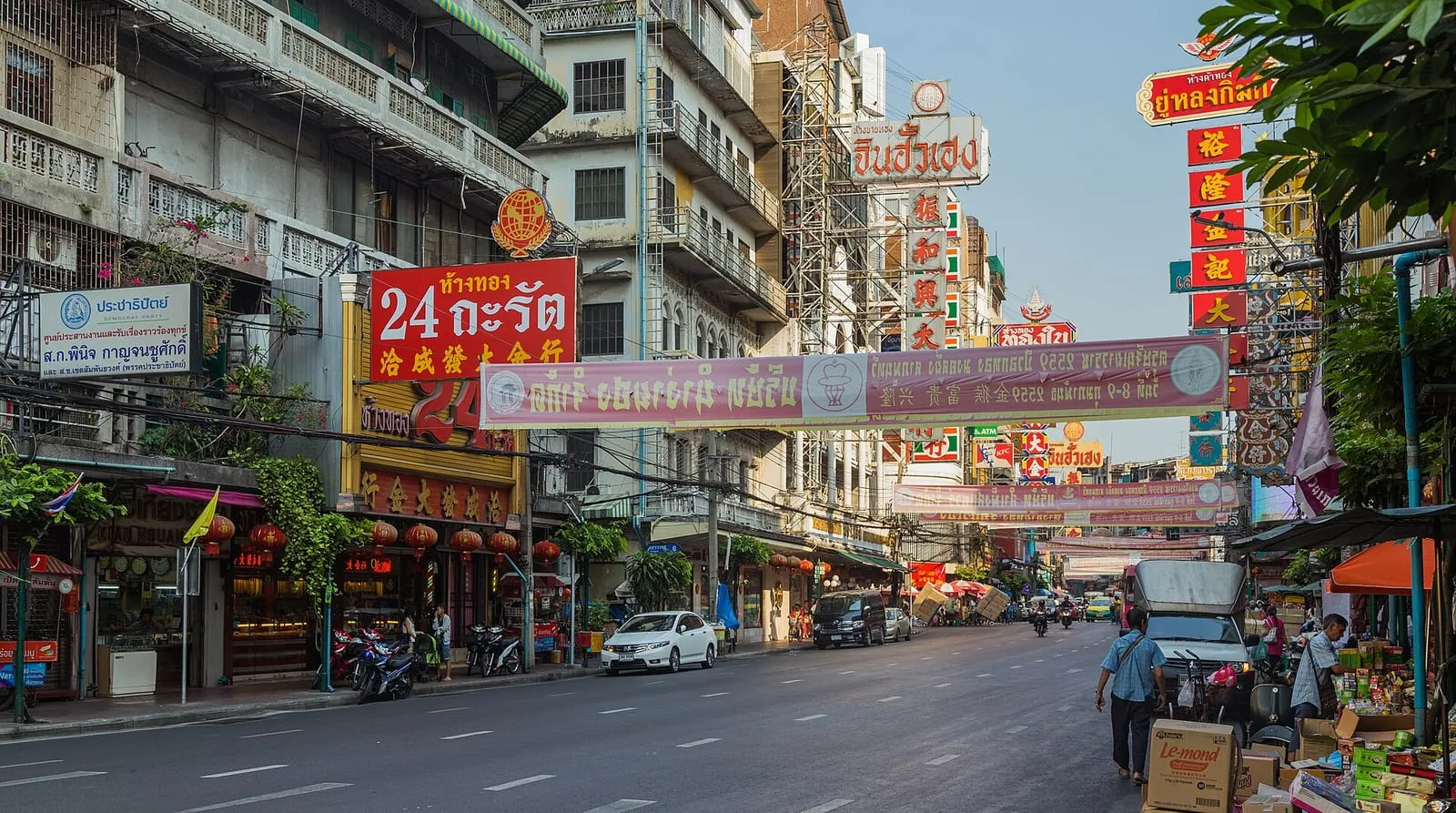
Walk 180 metres south down Plaeng Nam Road to meet Yaowarat Road, the 1.5-kilometre commercial artery of Chinatown. Built in 1891 during the reign of King Rama V, the avenue was named after the prince and deliberately designed with bends like a dragon’s spine to bring good feng shui.
During daylight hours, the street is a trading corridor of wholesale gold merchants with crimson storefronts, bird’s nest soup shops, and traditional Chinese herbal dispensaries displaying dried roots and ginseng. From 17:30 onward, the traffic lanes narrow as mobile street food carts set up stainless steel tables under towering, multi-storey neon signs.
3. Wat Traimit (Golden Buddha)
661 Charoen Krung Road, Samphanthawong
Follow Yaowarat Road south-east for 500 metres to the Odeon Circle, marked by the red Chinese Ceremonial Gateway built in 1999. Beside the circle stands Wat Traimit Wittayaram. The white marble mondop building houses the Phra Phuttha Maha Suwana Patimakon: a 5.5-tonne solid gold seated Buddha statue originating from the Sukhothai period (13th to 14th century).
For centuries, the statue was encased in stucco and coloured glass to protect it from invading Burmese armies, its true composition forgotten. In 1955, while being moved by crane to a new building, the hoisting ropes snapped; an overnight rainstorm washed away cracked plaster, exposing the solid gold surface underneath. Foreign visitors pay at the gate to see the statue, and a museum on the lower floors covers Chinatown’s migration history.
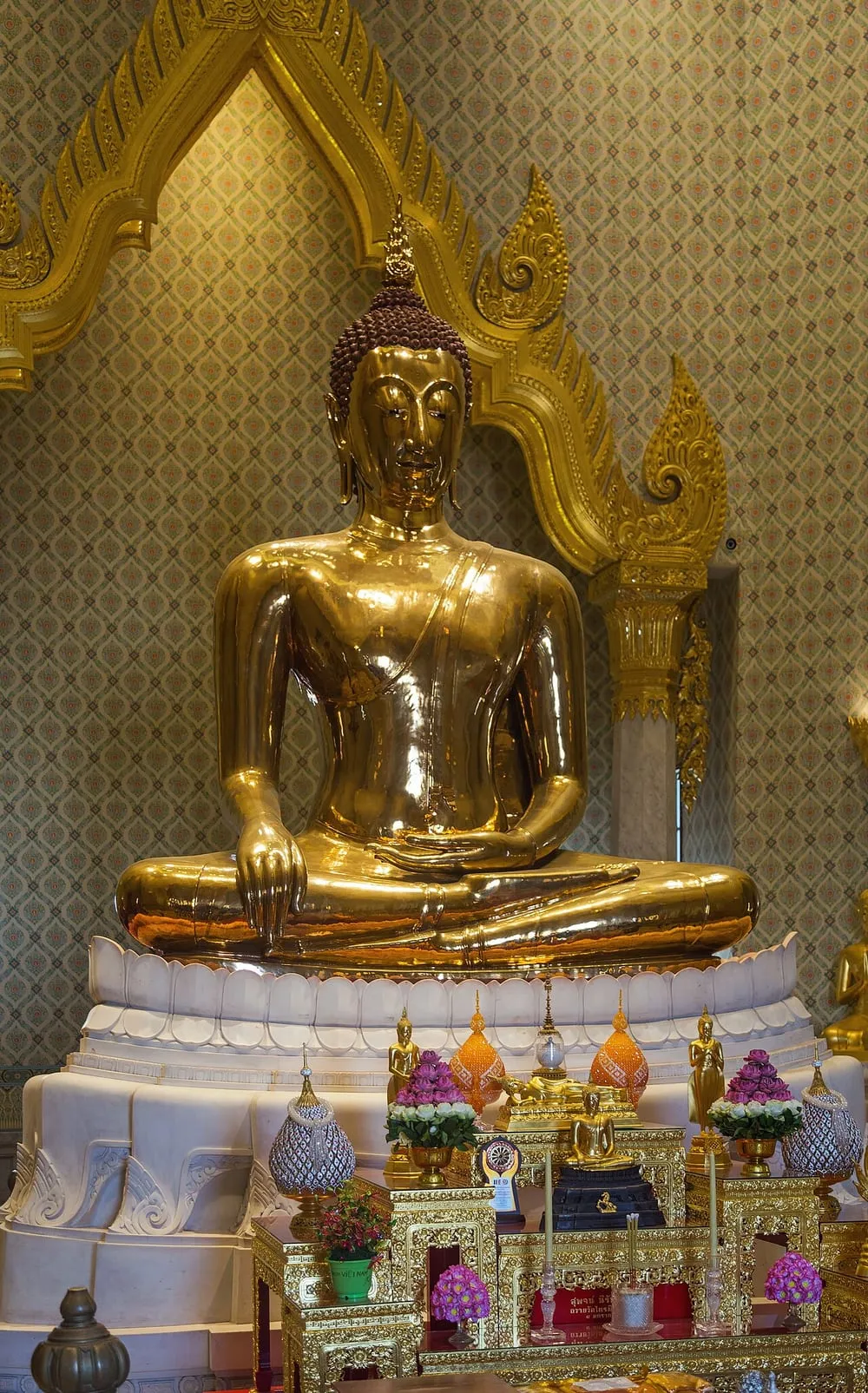
The Golden Buddha at Wat Traimit. Photo: Marcin Konsek, Wikimedia Commons, CC BY-SA 4.0.
4. Talat Noi Alleys and Street Art
Free · daylight recommended · Soi Wanit 2 and Trok San Chao Rong Kueak
Cross Charoen Krung Road and slip south into Soi Wanit 2, entering Talat Noi (meaning “Little Market”). Established in the late 18th century by Hokkien Chinese traders, this tranquil riverside enclave feels distinct from the traffic of Yaowarat.
The lanes of Trok San Chao Rong Kueak have two features: automotive scrap metal workshops (Sieng Kong), where mechanics stack rusted engine blocks, steering shafts, and gearboxes into precarious geometric sculptures; and colourful street art murals. Painted along peeling plaster walls, the murals depict Chinese opera performers, children playing, and elder residents preparing dim sum. A popular photo landmark along the river lane is a rust-encrusted vintage orange Fiat 500 permanently parked beside a brick wall.
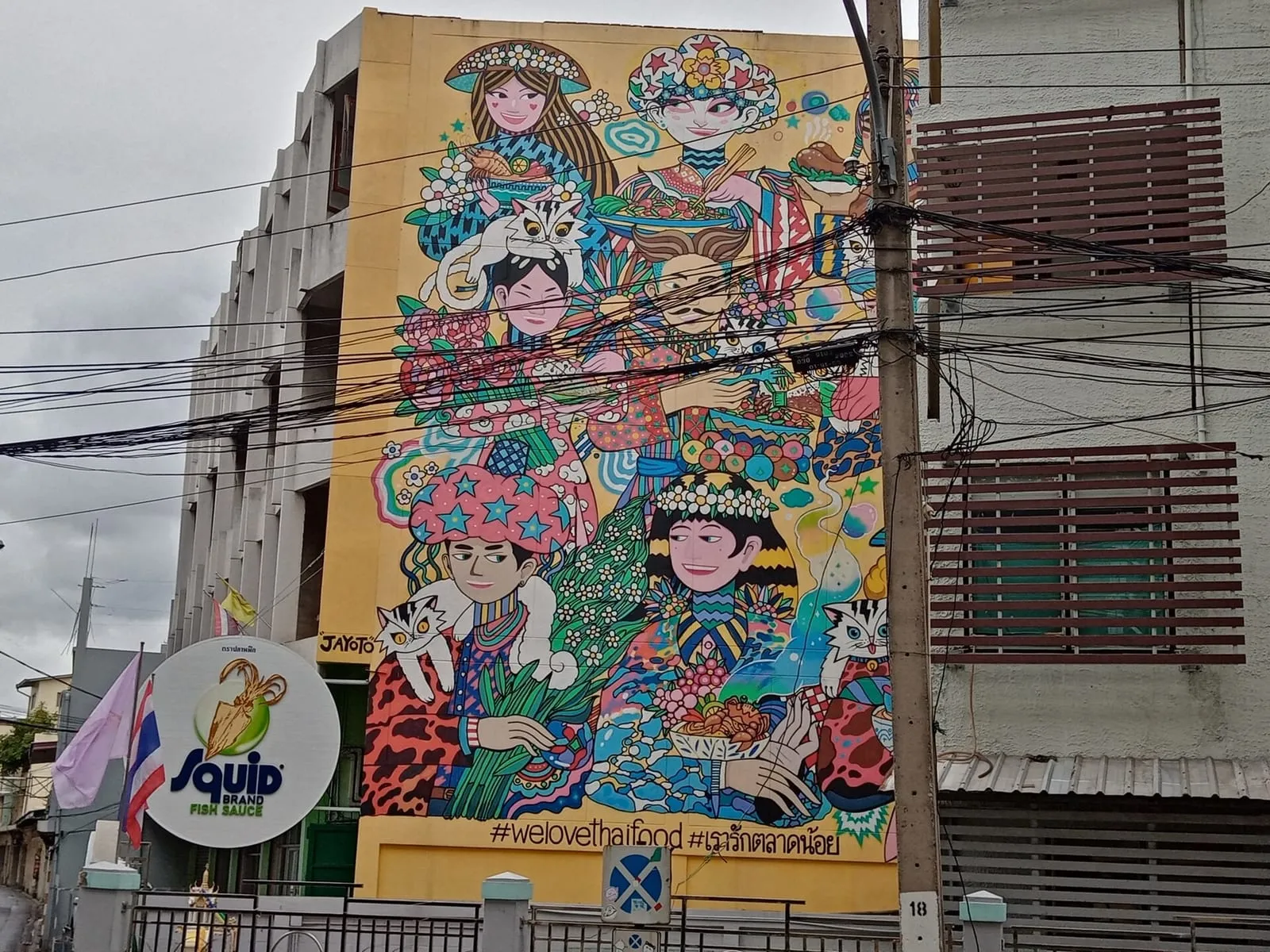
A mural in Talat Noi. Photo: Phoebus 28, Wikimedia Commons, CC BY-SA 4.0.
5. So Heng Tai Mansion
282 Soi Wanit 2, Talat Noi
Tucked along an alley off Soi Wanit 2 sits So Heng Tai Mansion, one of Bangkok’s last remaining traditional four-sided courtyard homes (Siheyuan). Constructed in the early 19th century by Phra Aphaivanich (Jat), a prosperous Hokkien tax farmer, the residence has remained in the custody of the same family for eight generations.
The two-storey teak residence surrounds an interior stone courtyard that was converted in 2004 into a 4-metre-deep scuba diving training pool by the owner, an authorized diving instructor. Visitors can walk the teak balustrades and view vintage family photographs and Qing-dynasty furniture on the ground level by ordering a drink (iced Thai tea, cold brew coffee, or plum soda) from the resident family’s small cafe counter.
6. Rong Kueak Shrine
Free · Trok San Chao Rong Kueak, Talat Noi
Follow the lane directly west toward the riverbank to reach Rong Kueak Shrine (San Chao Rong Kueak). Built during the reign of King Rama V by Hakka Chinese immigrants, the shrine honors the Han dynasty founder Han Gaozu.
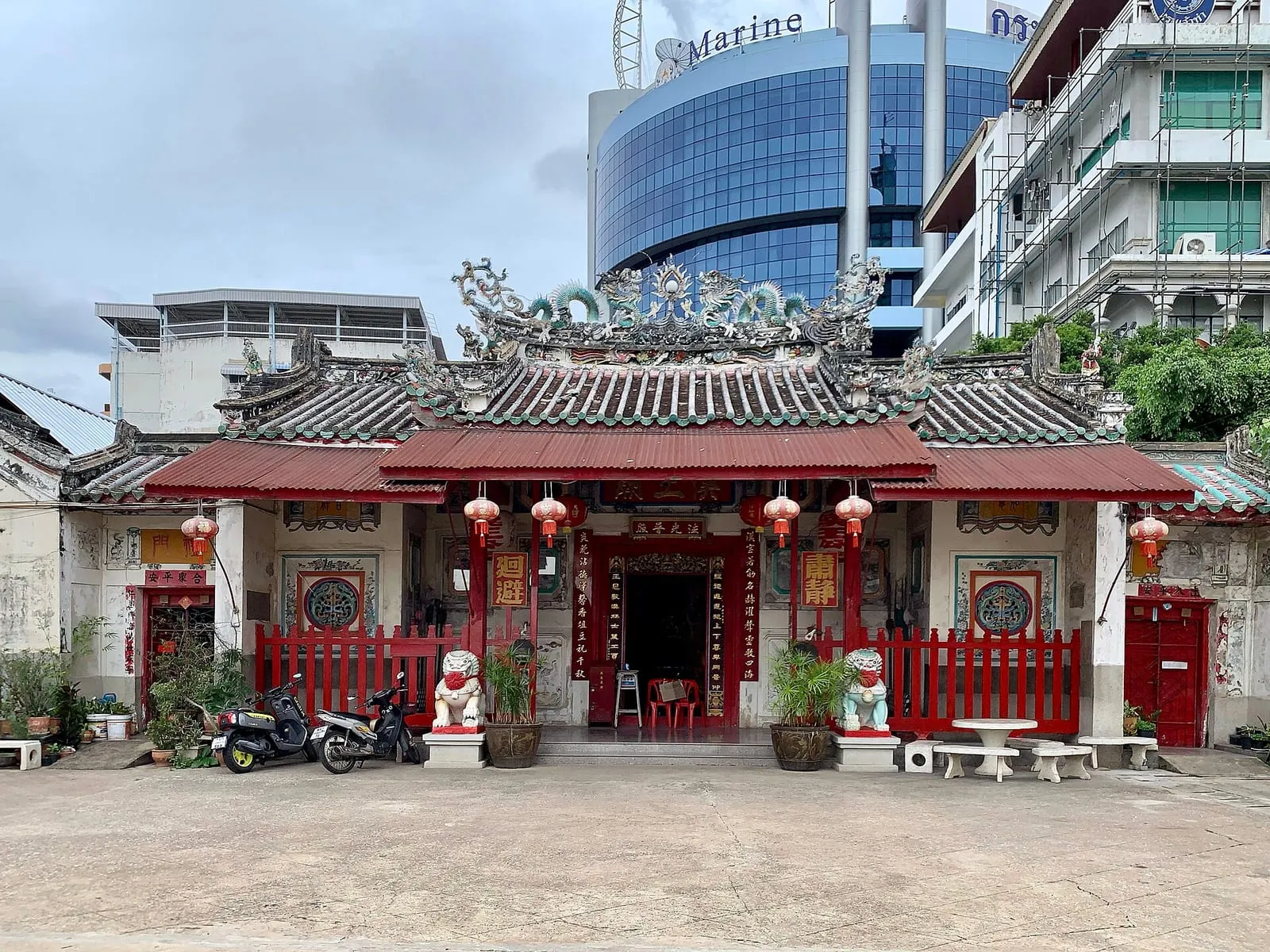
Rong Kueak Shrine. Photo: Chainwit., Wikimedia Commons, CC BY-SA 4.0.
The riverside building features detailed porcelain mosaic carvings of dragons and deities along the roof ridges. The open platform at the rear sits right at the water’s edge, offering clear, breeze-cooled vistas of river barges, commuter water taxis, and the historic wooden godowns on the Thonburi bank opposite.
7. Holy Rosary Church
Free · 1318 Soi Wanit 2, Samphanthawong
Continuing 250 metres south through the narrow paths brings you to Holy Rosary Church, locally known as Wat Kalawar (derived from the Portuguese Calvario). The first Catholic church on this site was established in 1786 by Portuguese traders and soldiers who relocated from Ayutthaya following its fall.
The present Neo-Gothic structure was completed in 1897. It features towering pointed-arch windows, intricate stained glass illustrating Old and New Testament narratives, and an 80-metre spire topped with a gilt cross that long served as a navigational landmark for European vessels sailing up the Chao Phraya River. Visitors may enter quietly outside scheduled services.
8. River City Bangkok Pier
Free · 23 Charoen Krung Soi 24, Samphanthawong
The walk concludes at River City Bangkok, a multi-level arts and antiques complex fronting the river. The air-conditioned centre houses contemporary art galleries, photography exhibitions, and curated antique showrooms featuring Southeast Asian ceramics, wood carvings, and bronze artefacts.
River City features a riverfront boardwalk with outdoor cafes. Directly adjacent are the Si Phraya express boat pier and the Marine Department Pier. Cross-river shuttle ferries run from Si Phraya to the Iconsiam shopping complex and Klongsan market.
The best day to go
Any day works for the temples and the Talat Noi alleys. Yaowarat Road is at its best after dark, when the street food stalls set up.
Recommended timing: Begin at MRT Wat Mangkon around 14:30. Spend 45 minutes at Wat Mangkon and exploring the medicine shops of Charoen Krung, arrive at Wat Traimit by 15:30, and spend 16:00 to 17:30 wandering the shady lanes, cafe stops, and murals of Talat Noi. By 17:30, you can conclude at River City Pier or backtrack 10 minutes to Yaowarat Road just as the evening street food stalls fire up their woks.
Getting there and back
- To the start: Take the MRT Blue Line to Wat Mangkon station. The temple is on Charoen Krung Road beside the station.
- From the end: From River City Bangkok, board the Chao Phraya Express Boat (Orange Flag, 19 THB flat fare) at Marine Department Pier or Si Phraya Pier northwards towards Tha Chang and the Grand Palace, or southwards to BTS Saphan Taksin. You can also take the river shuttle directly across to Iconsiam.
What to do next
-
Food tour: Explore Chinatown’s famous food stalls with a guided walk; see Bangkok food tours and our breakdown in where to eat in Bangkok.
-
Connect with Rattanakosin: Board the Orange Flag boat from Si Phraya Pier north to Tha Chang Pier to pick up the Rattanakosin old city walk.
-
Pad Thai nearby: Pad Thai places are in our guide to the best Pad Thai in Bangkok.
-
Practical guide: Check Bangkok airport to the city and the Bangkok travel guide for citywide transport maps.
-
Eat in Chinatown: Urai Braised Goose on Song Wat Road and the Old Town’s Bib Gourmand shops are in where to eat in Bangkok; Bangkok etiquette has the temple dress rules for Wat Mangkon and Wat Traimit.
Common questions
How long is the Chinatown and Talat Noi walk?
The walking route is 2.8 kilometres from MRT Wat Mangkon to River City Bangkok Pier. Walking time is roughly 40 minutes, but browsing the temples, alley street art, Chinese mansions, and riverside shrines takes 2.5 to 4 hours.
What is the best day of the week for this walk?
Start in the afternoon so that you reach Yaowarat Road as the evening street food stalls set up, from about 17:30. Wear shoes you can slip off for the temples.
What does it cost to enter the sights on this walk?
The Talat Noi street art alleys and the walk along Yaowarat Road cost nothing. Wat Traimit charges foreign visitors for the Golden Buddha at the gate.
Where does the walk start and finish?
The walk starts at MRT Wat Mangkon station (Exit 3) on Charoen Krung Road and finishes at River City Bangkok on Charoen Krung Soi 24, adjacent to the Si Phraya and Marine Department express boat piers.
Is the route suitable for prams or wheelchairs?
Talat Noi features narrow pedestrian lanes, raised door thresholds, uneven flagstones, and parked motorbikes that make prams and wheelchairs difficult to navigate. Walking on foot is recommended.