In this guide
💡 The Short Version: Tap in, tap once. The subway and local buses cost $3 a ride, and you pay by tapping a contactless credit or debit card, phone or watch on the OMNY reader (MTA). You do not tap when you leave. Tap the same card every time and you stop paying at $35 in seven days. The MetroCard is no longer sold. The subway runs 24 hours, the Staten Island Ferry is free, and NYC Ferry costs $4. Taxis add a $0.75 congestion toll for trips in Manhattan at or below 60th Street; app cars add $1.50.
What a ride costs
| Ride | Fare | Notes |
|---|---|---|
| Subway | $3 | One free transfer to a bus within two hours, on the same card |
| Local, limited, rush and Select Bus Service buses | $3 | Same transfer rule |
| Express bus | $7.25 | Subway or local bus to express: you pay the difference |
| Roosevelt Island Tram | OMNY accepted | Free transfer to and from subways and buses |
| NYC Ferry | $4 one way | Unlimited 2-day ticket $15 |
| Staten Island Ferry | Free | Every day, all year |
| OMNY single-ride ticket | $3.50 | Two hours; bus-to-bus transfer only, no subway-to-bus |
Fares are the MTA’s (subway and bus) and NYC Ferry’s (ferry.nyc). Up to three children under 44 inches tall ride free with a paying adult on the subway and local buses.
OMNY: how to pay
OMNY is the tap reader on every subway turnstile and bus. Four ways to use it:
- Contactless card: a credit, debit or prepaid card with the contactless symbol.
- Phone or wearable: Apple Pay, Google Wallet or Samsung Wallet on a phone, or a watch.
- OMNY Card: buy one at a vending machine in any station or at a shop, and load it with cash or a card. The MTA sells a new reloadable card for $1 as an introductory offer.
- Single-ride ticket: $3.50 from the same machines, valid for two hours.
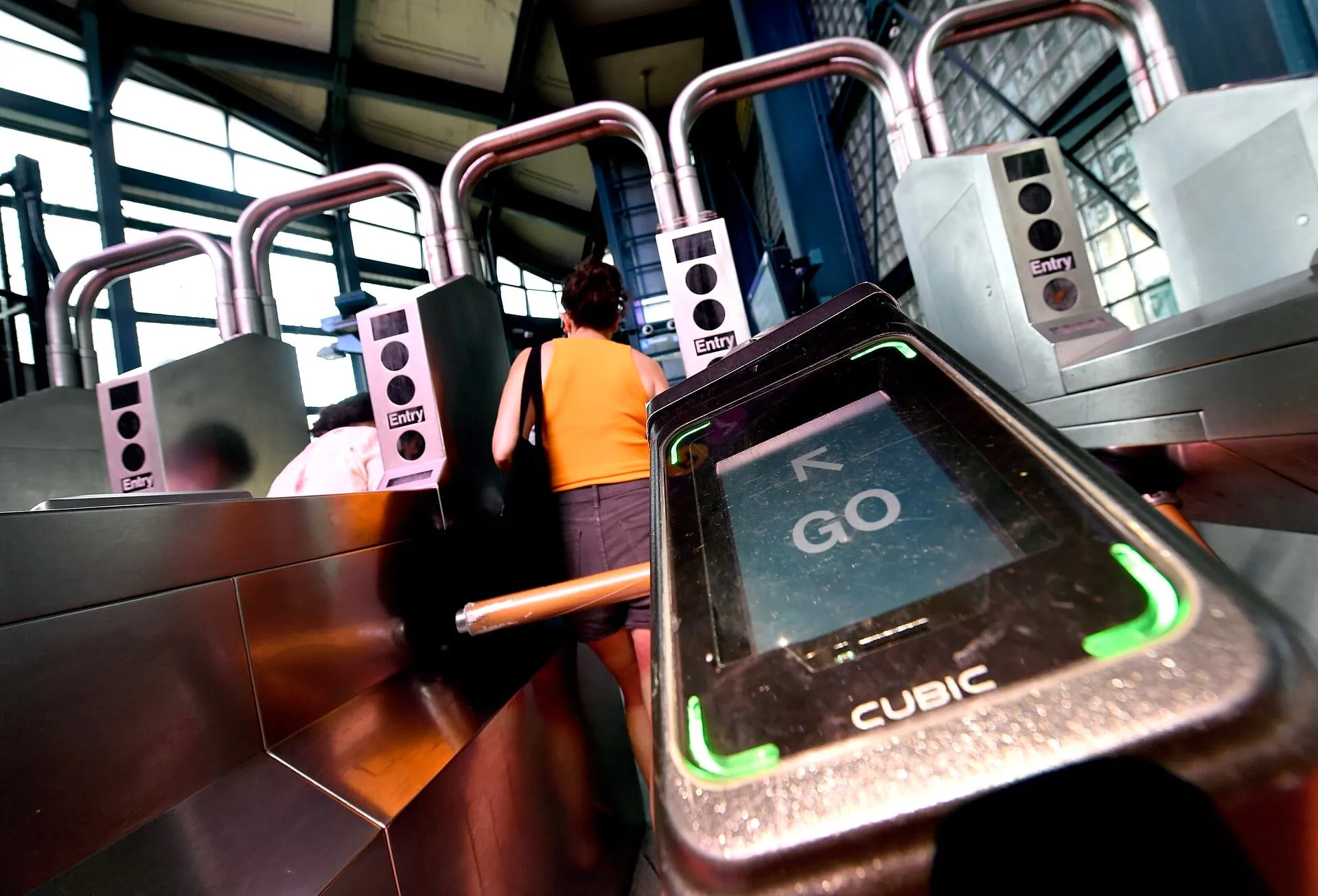
OMNY reader at a subway turnstile. Photo: Metropolitan Transportation Authority, Wikimedia Commons, CC BY 2.0.
Rules that catch visitors:
- Use the same card or phone for every tap. The fare cap and the free transfer both follow the card. A phone and the card inside its wallet count as one; a card and a different card do not.
- Your first tap cannot pay for other people. The bank has to approve the card first, which takes a few minutes. Pay for a group with separate cards on the first ride.
- Groups do not count towards the cap. Each person taps their own card to earn free rides.
- The cap is $35 in seven days on subways and local buses, or $67 if you add express buses. The count starts at your first tap and restarts at the next tap after seven days (MTA). A three-day visit rarely reaches it; a week might.
MetroCard: the MTA stopped selling and refilling it on 1 January 2026. Cash is still taken on local buses as exact coins, and the MTA has said it will stop at the same time as MetroCard acceptance ends. Cash still loads onto an OMNY Card at station machines.
The subway
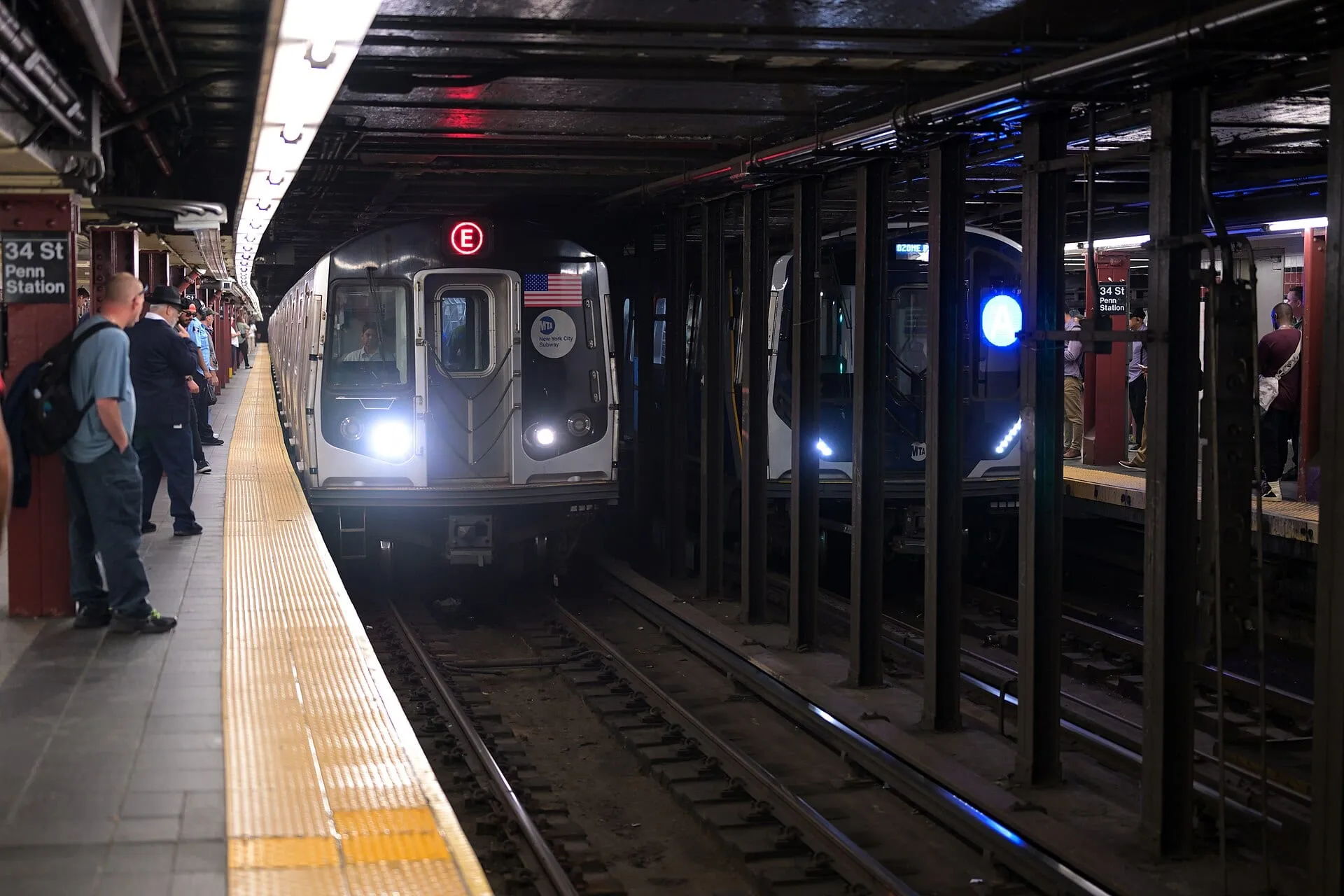
An E train and an A train at Penn Station. Photo: 4300streetcar, Wikimedia Commons, CC BY 4.0.
- It runs all day and night, every day. Service changes on weekends and overnight are routine: read the MTA’s weekend diagram before you set out.
- Uptown means north, Downtown means south. Local trains stop at every station, usually 8 to 10 blocks apart; express trains skip most of them, so check the sign before you board.
- One fare covers every transfer as long as you stay inside the turnstiles.
- Not every station has a lift. The MTA publishes an accessible-stations map (MTA accessibility).
- Staten Island has no subway. Take the free ferry, then the Staten Island Railway.
Buses
Buses go where the subway does not, including crosstown across Manhattan and to LaGuardia. Board at the front door and tap. On Select Bus Service routes you can use any door. Between 10pm and 5am, local and express drivers will drop you between stops on request if it is safe. To see when a bus arrives, text the six-digit stop code and the route to 511123 (NYC Tourism).
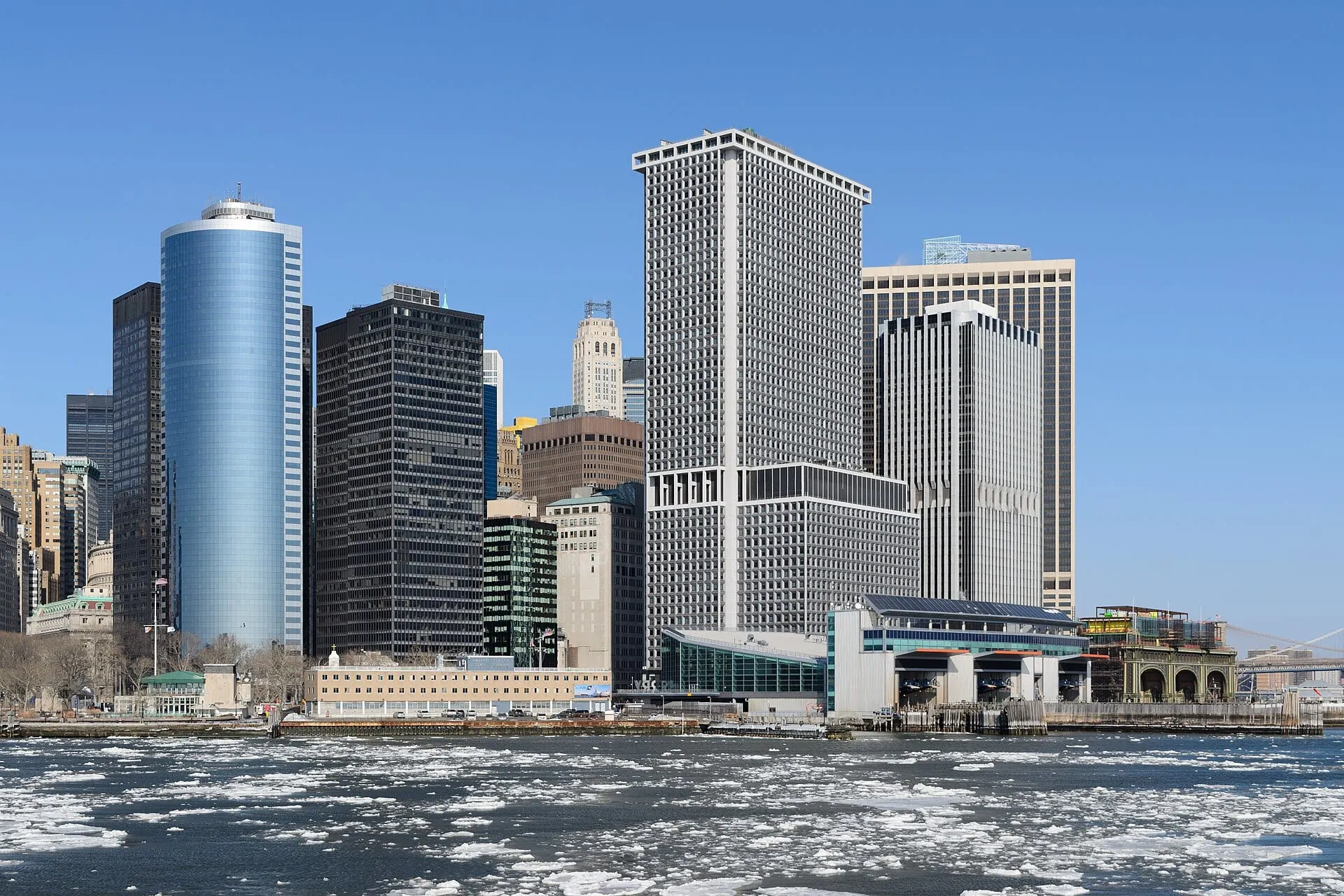
The Staten Island Ferry. Photo: King of Hearts, Wikimedia Commons, CC BY-SA 4.0.
Ferries, the tram and bikes
- Staten Island Ferry: free, every day of the year, between Lower Manhattan and St. George on Staten Island (NYC DOT). The route passes the Statue of Liberty; see harbour cruises and the Staten Island Ferry.
- NYC Ferry: $4 one way, or $15 for an unlimited two-day ticket (48 hours). Routes serve Brooklyn and Queens waterfront stops.
- Roosevelt Island Tram: runs from East 60th Street and Second Avenue, tap with OMNY. It leaves every 15 minutes, every 7.5 minutes at rush hour, from 6am to 2am Sunday to Thursday and to 3:30am Friday and Saturday (NYC Tourism).
- Citi Bike: a single ride is $4.99 for 30 minutes; a day pass is $25 and includes unlimited 30-minute rides on classic bikes for 24 hours. Rides past 30 minutes cost $0.41 a minute, and e-bikes cost $0.41 a minute on a single ride or day pass (Citi Bike).
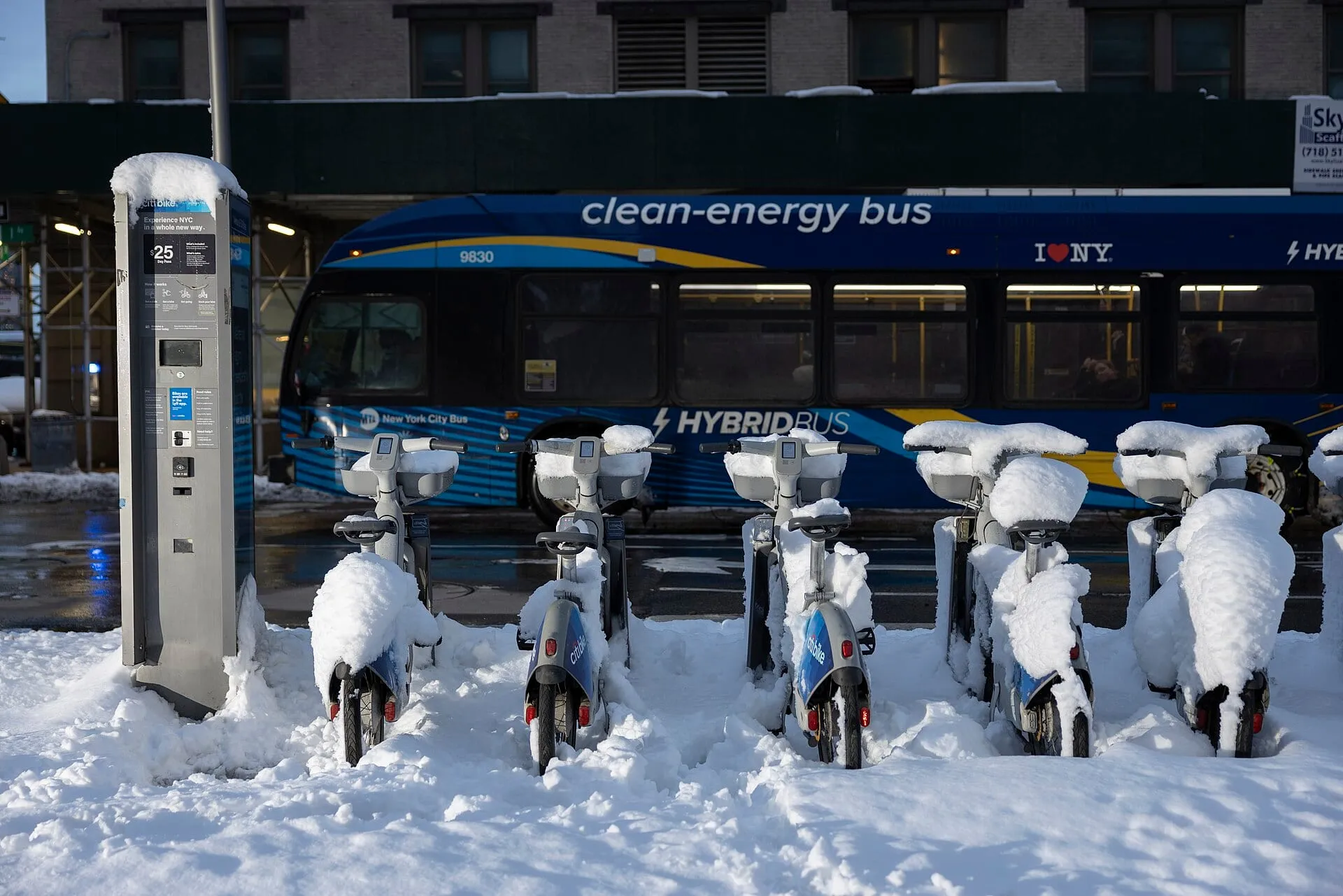
Citi Bike station. Photo: Tessa Bury, Wikimedia Commons, CC BY 4.0.
Taxis, app cars and the congestion toll
A yellow cab is the metered option; Uber and Lyft quote a fare in the app. Hail a cab whose number on the roof is lit: that means it is free to take you. The meter covers every passenger in the cab, up to four, and there is no charge for bags. Tip 15 to 20 per cent on the metered fare; hotel doormen who hail a cab for you expect $2 to $5 (NYC Tourism).
| Yellow cab charge | Amount |
|---|---|
| Starting fare | $3.00 |
| Per fifth of a mile above 12 mph, or per minute in slow traffic | $0.70 |
| MTA state surcharge | $0.50 |
| Improvement surcharge | $1.00 |
| Overnight, 8pm to 6am | $1.00 |
| Weekday rush hour, 4pm to 8pm | $2.50 |
| State congestion surcharge, trips that start, end or pass through Manhattan south of 96th Street | $2.50 |
| MTA congestion toll, south of and including 60th Street | $0.75 |
These are the Taxi & Limousine Commission’s rates (TLC). Tolls and the tip are extra. Uber, Lyft and other app cars pass on a $1.50 toll per trip instead.
Congestion pricing is the MTA’s toll on vehicles entering Manhattan at or below 60th Street, which has applied since January 2025. A private car or rental car pays $9 at peak with E-ZPass (5am to 9pm weekdays, 9am to 9pm weekends) and $2.25 overnight, and the peak toll rises to $12 in 2028 and $15 in 2031 (MTA). For a short visit, skip the rental car.
Which ticket for three days
There is no visitor pass to buy: tap one card for every ride and the cap does the work. Ten rides cost $30, and the twelfth ride in seven days reaches the $35 cap, after which rides are free until the seven days end. Keep the same card or phone for the whole visit.
Where next
From the airports, see JFK to Manhattan, Newark to Manhattan and LaGuardia to Manhattan. For tipping and cash, see money in New York; a map and data on your phone are covered in an eSIM for the USA. The subway after dark is covered in is New York safe?. To choose a base by subway line, see where to stay in New York, and for a route that links the sights see 3 days in New York.
Common questions
How much is a subway ride in New York?
$3 for one ride on the subway or a local bus, however far you go, and the same $3 on the subway, local bus and Select Bus Service. Express buses cost $7.25 (MTA).
Can I use my contactless bank card on the New York subway?
Yes. Tap a contactless credit or debit card, a phone or a wearable on the OMNY reader at the turnstile. You do not tap when you leave. If you have no contactless card, buy an OMNY Card at a vending machine in any station.
Is there a weekly cap on subway fares?
Yes. Tap the same card or device for every ride and you pay no more than $35 in seven days on the subway and local buses (or $67 if you also ride express buses). The seven days start with your first tap.
Does the New York subway run 24 hours?
Yes, 24 hours a day, seven days a week, though weekend and late-night service changes are common. Check the MTA's service page before a night journey.
Can I still buy a MetroCard?
No. The MTA stopped selling and refilling MetroCards on 1 January 2026. Use OMNY.
How much is a taxi in New York?
The meter starts at $3.00 and adds 70 cents per fifth of a mile or per minute in slow traffic, plus a $0.50 state surcharge, a $1.00 improvement surcharge, a $2.50 state congestion surcharge south of 96th Street and the MTA's 75 cent congestion toll south of 60th Street. Tolls and the tip are extra.