In this guide
💡 The Short Version: Hong Kong is hot, wet and humid from May to mid-September, and typhoon season runs from May to November; November to April is cooler (Hong Kong Tourism Board). The Observatory’s 1991 to 2020 averages put the mean daily maximum at 18.7 degrees in January and 31.6 in July, and the rain at 33.2 mm in January against 491.5 mm in June (Hong Kong Observatory). Signal No. 8 is the one that disrupts a trip: sustained winds of 63 to 117 km/h, and it averages 2.43 days a year, mostly July to September (Hong Kong Observatory). For warnings, call the Observatory’s line on +852 1878 200. Rain and humidity are why October to December is the usual answer to when to visit.
Climate by month
Monthly averages for 1991 to 2020 from the Hong Kong Observatory’s climatological normals. Temperature, humidity and rain are recorded at the Observatory in Tsim Sha Tsui, and sunshine at King’s Park.
| Month | Mean daily max | Mean daily min | Rain (mm) | Days with 0.1 mm or more | Relative humidity | Sunshine (hours) |
|---|---|---|---|---|---|---|
| January | 18.7°C | 14.6°C | 33.2 | 5.7 | 74% | 145.8 |
| February | 19.4°C | 15.3°C | 38.9 | 8.0 | 79% | 101.7 |
| March | 21.9°C | 17.6°C | 75.3 | 10.5 | 82% | 100.0 |
| April | 25.6°C | 21.1°C | 153.0 | 11.4 | 83% | 113.2 |
| May | 28.8°C | 24.5°C | 290.6 | 15.4 | 83% | 138.8 |
| June | 30.7°C | 26.5°C | 491.5 | 19.3 | 82% | 144.3 |
| July | 31.6°C | 26.9°C | 385.8 | 18.4 | 81% | 197.3 |
| August | 31.3°C | 26.7°C | 453.2 | 17.5 | 81% | 182.1 |
| September | 30.5°C | 26.1°C | 321.4 | 14.9 | 78% | 174.4 |
| October | 28.1°C | 23.9°C | 120.3 | 7.8 | 73% | 197.8 |
| November | 24.5°C | 20.3°C | 39.3 | 5.7 | 72% | 172.3 |
| December | 20.4°C | 16.2°C | 28.8 | 5.3 | 70% | 161.6 |
- Summer, May to September: June to September are the hottest months, with mean daily maximums of 30.5 to 31.6 degrees. June has the most rain, and every month from May to September has 15 or more days with some rain.
- October and November: rain drops from 321.4 mm in September to 120.3 mm in October and 39.3 mm in November, and October has the most sunshine of any month, 197.8 hours.
- Winter, December to February: the driest months, with mean daily maximums of 18.7 to 20.4 degrees. Hotel rooms and indoor places can feel cool, so bring a layer.
- Spring, March and April: humidity is 82% to 83%, and the Observatory logs fog on 1.47 days in March and 1.10 in February (visibility under 1,000 m). Cloud and mist on the Peak are why you should look at a forecast before buying Peak Tram tickets.
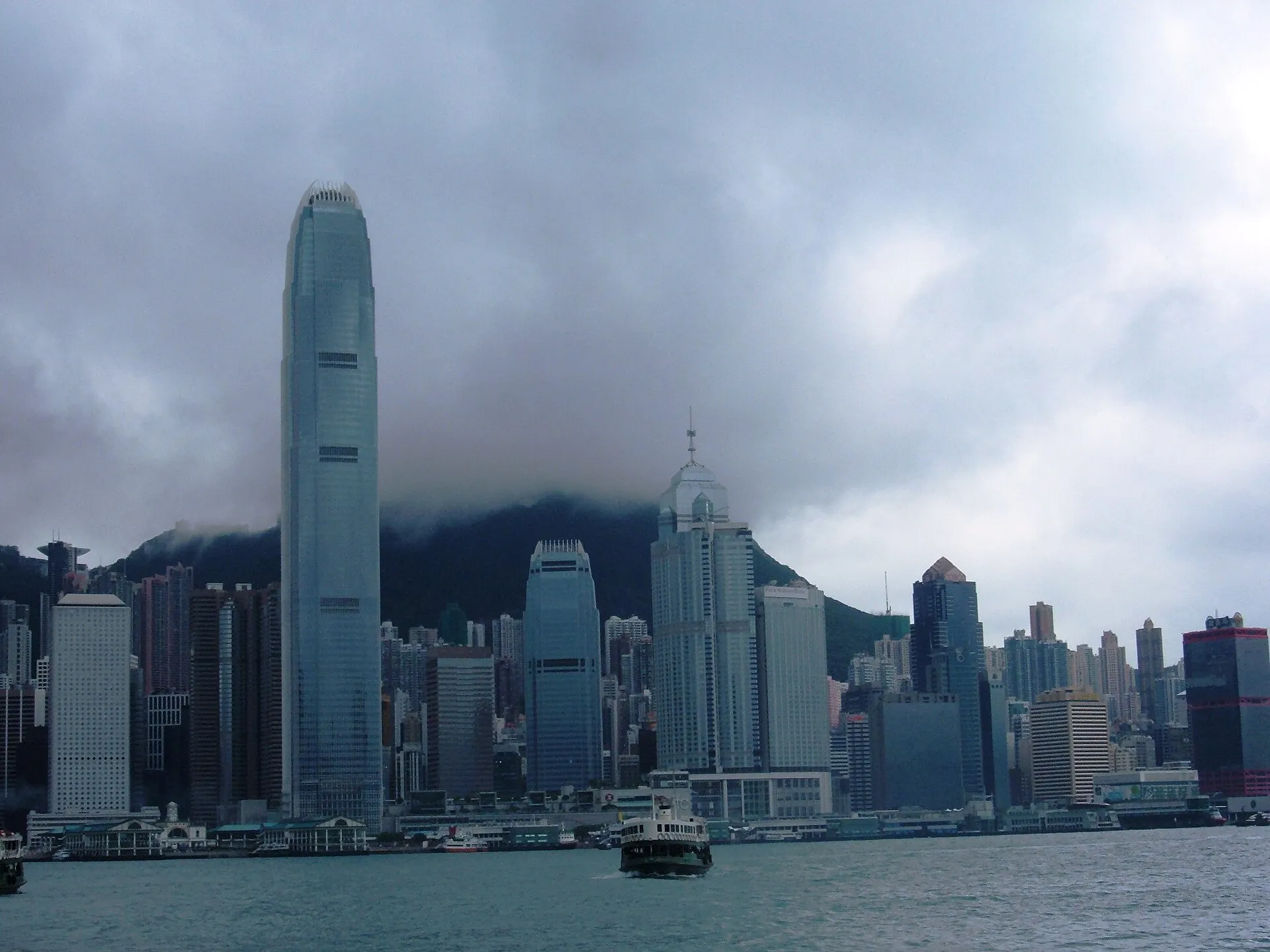
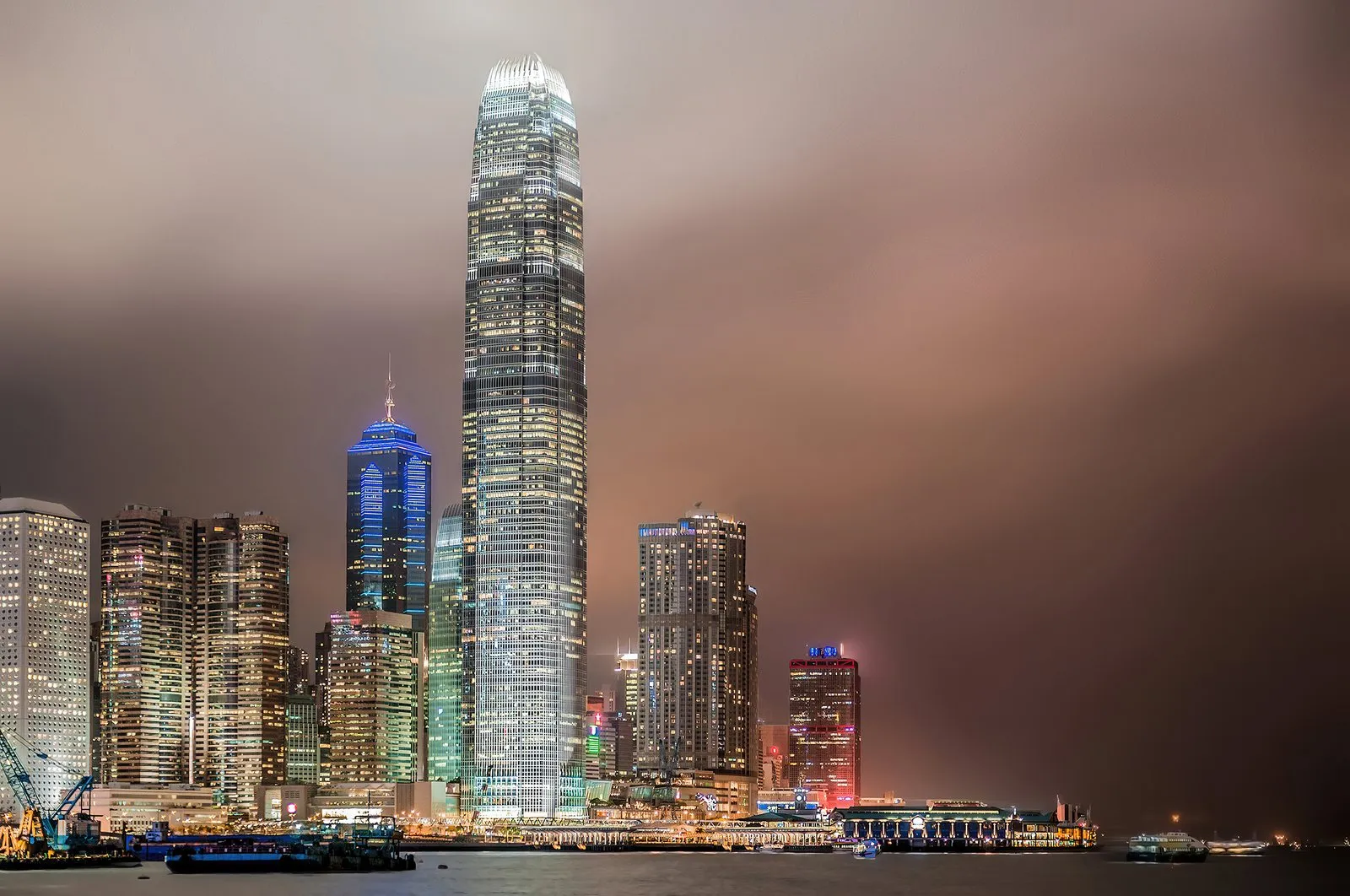
Cloud over Victoria Peak and the Central skyline, seen across Victoria Harbour. Photo: BrokenSphere, Wikimedia Commons, CC BY-SA 3.0.
Typhoon signals
The Observatory’s tropical cyclone warning signals leaflet defines five signals. They warn of wind only; the Observatory says the weather in different parts of Hong Kong cannot be inferred from the number alone, and that winds are often stronger offshore and on high ground.
| Signal | What the Observatory says it means |
|---|---|
| No. 1, Standby | A tropical cyclone is centred within about 800 km of Hong Kong and may affect the territory. |
| No. 3, Strong Wind | Strong wind blowing or expected generally near sea level, sustained 41 to 62 km/h, gusts which may exceed 110 km/h, and expected to persist. |
| No. 8, Gale or Storm | Gale or storm force wind blowing or expected generally near sea level, sustained 63 to 117 km/h from the quarter indicated (northeast, northwest, southeast or southwest), gusts which may exceed 180 km/h. |
| No. 9, Increasing Gale or Storm | Gale or storm force wind increasing or expected to increase significantly. |
| No. 10, Hurricane | Hurricane force wind blowing or expected, sustained 118 km/h or above, gusts which may exceed 220 km/h. |
What the Observatory tells the public to do at each level:
- No. 1: take the cyclone into account when planning activities, and beware of strong winds over offshore waters.
- No. 3: secure loose objects or take them indoors, and stay away from dangerous places. Low-lying areas may flood from storm surge. Winds are normally expected to become generally strong within 12 hours.
- No. 8: complete all precautions before the gales start. Winds normally reach gale force generally in Hong Kong within 12 hours after No. 8 replaces No. 3, and the Observatory makes a pre-No. 8 special announcement when No. 8 is expected within two hours.
- No. 9 or No. 10: stay indoors and away from exposed windows and doors to avoid flying debris, and beware of changes in wind direction.
For 1991 to 2020 the Observatory counts signals No. 3 or higher on 7.43 days a year and No. 8 or higher on 2.43 days. Signals No. 9 or No. 10 average 0.40 days a year.
| Month | Mean days with No. 3 or higher | Mean days with No. 8 or higher |
|---|---|---|
| May | 0.13 | 0.03 |
| June | 1.00 | 0.27 |
| July | 1.53 | 0.53 |
| August | 1.90 | 0.80 |
| September | 1.87 | 0.67 |
| October | 0.73 | 0.13 |
| Year | 7.43 | 2.43 |
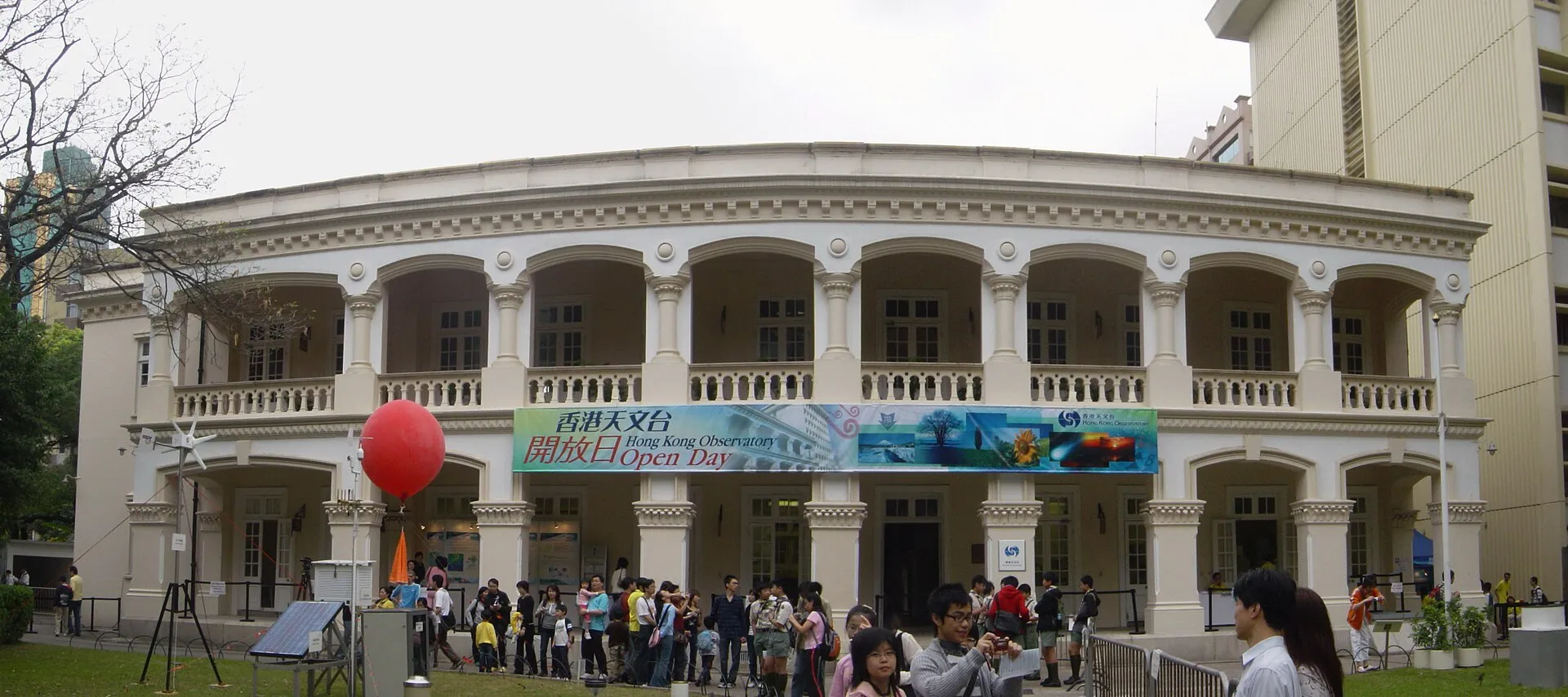
The 1883 Building at the Hong Kong Observatory headquarters in Tsim Sha Tsui. Photo: Stewart~惡龍, Wikimedia Commons, CC BY-SA 2.5.
Rainstorm warnings
The Observatory runs a separate rainstorm system with three levels, independent of the typhoon signals, described on its rainstorm warning page:
| Warning | Rain | What the Observatory advises |
|---|---|---|
| Amber | More than 30 mm in an hour has fallen or is expected generally over Hong Kong, and is likely to continue | Take precautions against flooding and avoid easily flooded watercourses. |
| Red | More than 50 mm in an hour | People who have to travel should consider weather and road conditions carefully; outdoor workers should suspend duties if conditions warrant. |
| Black | More than 70 mm in an hour | Stay indoors or shelter in a safe place until the rain has passed. People with no safe place to go may use the temporary shelters opened by the Home Affairs Department. |
The Observatory tries to issue Amber a couple of hours ahead of heavy rain, but says the lead time for Red and Black will generally be very short, and a Red can be issued without an Amber first. It counts the rainy season as April to September, with May and June the heaviest. The Observatory’s averages show 3.93 days a month with 25 mm or more in May and 6.03 in June, and 2.90 days with 50 mm or more in June. The year totals 2,431.2 mm of rain, and the Observatory reports thunderstorms on 42.27 days a year, most often in August (8.90 days), June (8.13) and July (7.97). Plan indoor days for these months, such as M+ and the Hong Kong Palace Museum or Tai Kwun and PMQ, and carry an umbrella.
What closes when a signal goes up
Each operator sets its own policy, so check the operator before you set out:
- Peak Tram and Sky Terrace 428: both close when Typhoon Signal No. 8 or higher, or a special inclement weather warning, is hoisted. If the tram stops, an unused or partly used on-the-day ticket can be exchanged at the Peak Tram terminus ticket office within 30 days (Peak Tram FAQ).
- TramOramic Tour: stops if Typhoon Signal No. 8 or above is issued, or the Observatory announces it will be issued within 2 hours, and resumes 2 hours after the signal comes down. It also stops for a Red or Black Rainstorm Warning issued before departure, and a missed tour can be rescheduled within 3 days by emailing tramoramic@hktramways.com (Hong Kong Tramways).
- Ngong Ping 360: the cable car may be suspended in a rainstorm or thunderstorm, depending on the circumstances. The guest services hotline is +852 3666 0606 (Ngong Ping 360). See the Ngong Ping 360 guide.
- Star Ferry: actual sailing times vary with sea and weather conditions (Star Ferry).
- Tai Hang Fire Dragon: the organisers’ guidelines for the 2026 festival cancelled the dance if, at 6pm, Signal No. 8 or above or a Black Rainstorm Warning was still in force (Tai Hang Fire Dragon). See the Mid-Autumn Festival guide.
Where to check
Look at the Observatory’s website, the MyObservatory app or the Dial-a-Weather line on +852 1878 200 for the latest signal and forecast; the Tourism Board points visitors to the same source (Hong Kong Tourism Board). Signals are broadcast on radio and television as well.
Where next
Month by month, what is on and what it costs is in best time to visit Hong Kong. Outdoor days are covered in Sai Kung and the Geopark and Cheung Chau and Lamma, and indoor days in things to do in Hong Kong. For safety and insurance see is Hong Kong safe, and for phone data and Wi-Fi, eSIM for Hong Kong.
Common questions
When is typhoon season in Hong Kong?
The Hong Kong Tourism Board puts it from May to November. The Observatory's 1991 to 2020 averages show signals No. 8 or higher on 2.43 days a year, most often in August (0.80 days), September (0.67) and July (0.53).
What does Typhoon Signal No. 8 mean?
Gale or storm force wind is blowing or expected to blow generally in Hong Kong near sea level, with a sustained speed of 63 to 117 km/h from the quarter indicated and gusts that may exceed 180 km/h. Complete precautions before the gales start (Hong Kong Observatory).
What is the difference between the amber, red and black rainstorm warnings?
Amber means rain exceeding 30 mm an hour has fallen or is expected generally over Hong Kong, red means more than 50 mm an hour and black more than 70 mm an hour. For a black warning the Observatory advises staying indoors or sheltering in a safe place (Hong Kong Observatory).
What is the hottest and wettest time in Hong Kong?
June to September. Over 1991 to 2020 the Observatory recorded mean daily maximums of 30.5 to 31.6 degrees Celsius in these months, and June has the most rain, 491.5 mm.
Where do I get official weather warnings?
From the Hong Kong Observatory: its website hko.gov.hk, the MyObservatory app and the Dial-a-Weather line on +852 1878 200.
What happens to attractions when a typhoon signal is raised?
It depends on the operator. The Peak Tram and Sky Terrace 428 close when Signal No. 8 or higher is hoisted, and Hong Kong Tramways stops its TramOramic Tour if Signal No. 8 or above is issued, or the Observatory says it will be issued within 2 hours, and if a Red or Black Rainstorm Warning is in force.