In this guide
💡 The Short Version: The elevated BTS Skytrain and underground MRT Subway are the fastest ways to cross Bangkok without sitting in traffic. The MRT takes contactless bank cards at the gates. On the BTS, buy a single-journey ticket at the station machines or a Rabbit card (a 120 THB issue fee, then stored value from 100 THB) at any station ticket office; you do not need your passport to buy one. On the water, the orange-flag Chao Phraya Express boat is a flat 19 THB between Sathorn pier and the historic temples, and the Khlong Saen Saep canal boat cuts east-west through the city centre. For street taxis, insist on the meter or book via Grab or Bolt to avoid negotiated fares. Fares: the MRT Blue Line is 17 to 44 THB by the number of stations, the Airport Rail Link 15 to 45 THB (45 THB to Phaya Thai), and the BTS from 17 THB by distance. Or book a tour: the Chao Phraya hop-on hop-off boat day passad (from ฿150, 4.5 stars from 3,540 reviews) is an unlimited all-day ticket between the main sights, against 19 THB a ride on the orange-flag express.
Bangkok transport systems compared
Bangkok operates several distinct transit networks run by separate companies, meaning tickets do not transfer between systems.
| System | Payment options | Route highlights |
|---|---|---|
| BTS Skytrain | Single-journey ticket from station machines (coins, notes or QR payment), Rabbit card | Sukhumvit corridor, Silom, Siam shopping malls, Chatuchak Market |
| MRT Subway | Contactless bank card (EMV), single-journey token | Blue Line circle route: Chinatown, Old Town, Hua Lamphong, Sukhumvit |
| Chao Phraya Express Boat | Cash on board or at the pier counter; orange flag 19 THB flat | Orange flag: Sathorn (BTS), Iconsiam, Wat Pho, Grand Palace |
| Tourist Boat (Blue Flag) | Day pass or ticket from the operator and its sellers | Hop-on hop-off catamaran with open deck between major riverside sights |
| Khlong Saen Saep Canal Boat | Cash to the conductor on the boat | Express canal commuter route linking Old Town, Jim Thompson House and Pratunam |
| Metered Street Taxi | Cash | Citywide street hailing; meter mandatory by regulation |
| Grab / Bolt Ride-Hailing | App payment by credit card or cash | On-demand private cars and taxis with fixed upfront pricing |
River and canal boat tickets
The orange-flag express boat is the cheapest way along the river, and the tourist boat and the canal tours are paid extras. GetYourGuide prices are its lowest “from” prices, in baht.
Chao Phraya hop-on hop-off day pass
From ฿150 · 4.5 stars from 3,540 reviews · all-day ticket
Bangkok: Chao Phraya River Hop-on/hop-off Boatad is an unlimited all-day pass for a hop-on, hop-off boat, with the Grand Palace, Wat Arun and Chinatown among the sights it reaches. Bangkok hop-on hop-off compares the river passes with the city tourist buses.
Long-tail boat on the canals
From ฿585 · 4.5 stars from 5,673 reviews · 1 to 2 hours
Bangkok Long-tail Boat Canal Tour Wat Arun & Big Buddha Viewsad is a two-hour trip by long-tail boat, the narrow open boat with its engine on a long pole, through the canals of Thonburi on the river’s west bank.
Teak boat on the old canals
From ฿700 · 4.3 stars from 2,725 reviews · 2 hours
Bangkok: 2-Hour Canal Tour by Teak Boatad runs along the narrow canals of old Bangkok past Wat Arun, on a wooden teak boat.
Fares
| Journey | Fare | Notes |
|---|---|---|
| MRT Blue Line | 17 THB for 1 station, 44 THB for 12 or more | Since 3 July 2026, for tokens and contactless cards alike (Thai PBS Verify, citing the MRTA) |
| BTS Skytrain | 17 to 47 THB by distance | Chulalongkorn University’s guide for international students (Chulalongkorn); the ticket machine shows the fare |
| Airport Rail Link, City Line | 15 to 45 THB by distance | 45 THB from Suvarnabhumi to Phaya Thai and 35 THB to Makkasan (Chulalongkorn) |
| SRT Dark Red Line | 33 THB from Don Mueang to Krung Thep Aphiwat | The network runs from 12 to 42 THB, per the operator’s fare table in force from 1 November 2026 (SRT Electric Train) |
| Orange-flag Chao Phraya Express Boat | 19 THB flat for the whole line | From the operator (Chao Phraya Express Boat) |
| Taxi from Suvarnabhumi | Meter, plus a 50 THB airport charge and any tolls | From the airport’s own taxi page (Suvarnabhumi Airport) |
MRT Blue Line fares by number of stations
| Stations | 1 | 2 | 3 | 4 | 5 | 6 | 7 | 8 | 9 | 10 | 11 | 12 or more |
|---|---|---|---|---|---|---|---|---|---|---|---|---|
| THB | 17 | 20 | 22 | 25 | 27 | 29 | 32 | 34 | 37 | 39 | 42 | 44 |
BTS Skytrain
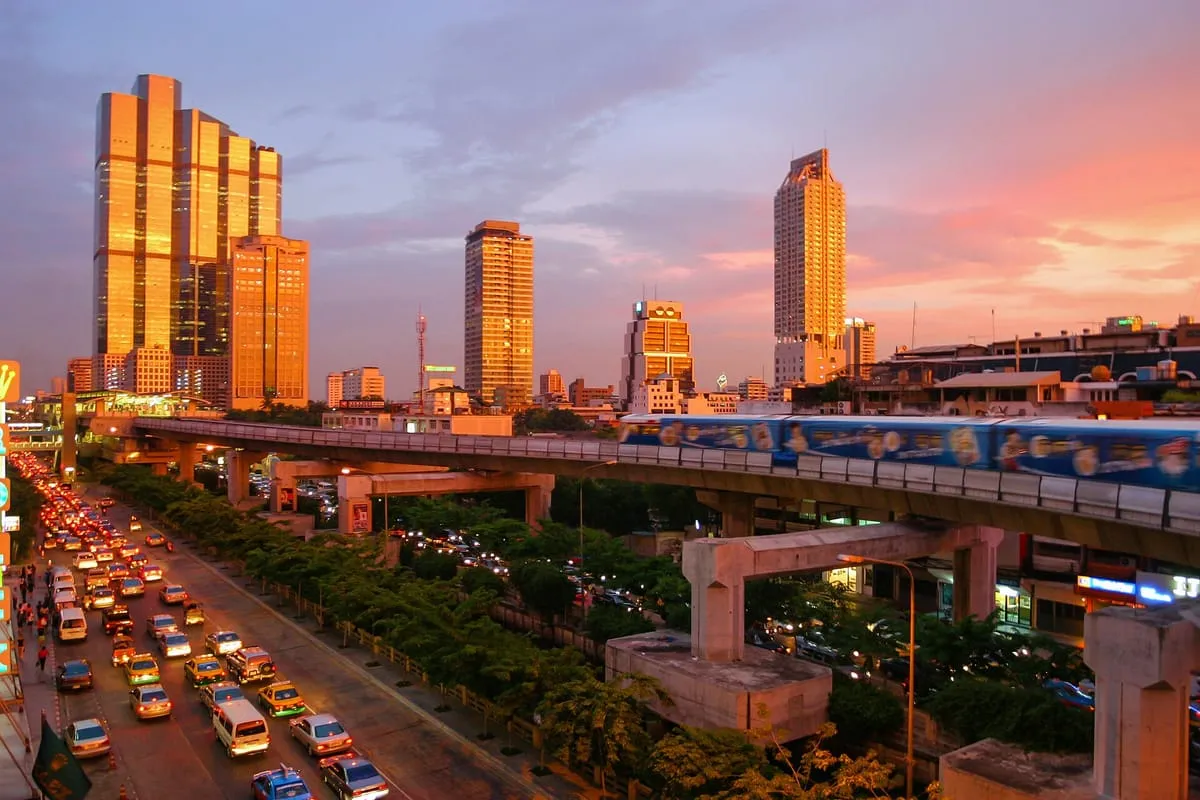
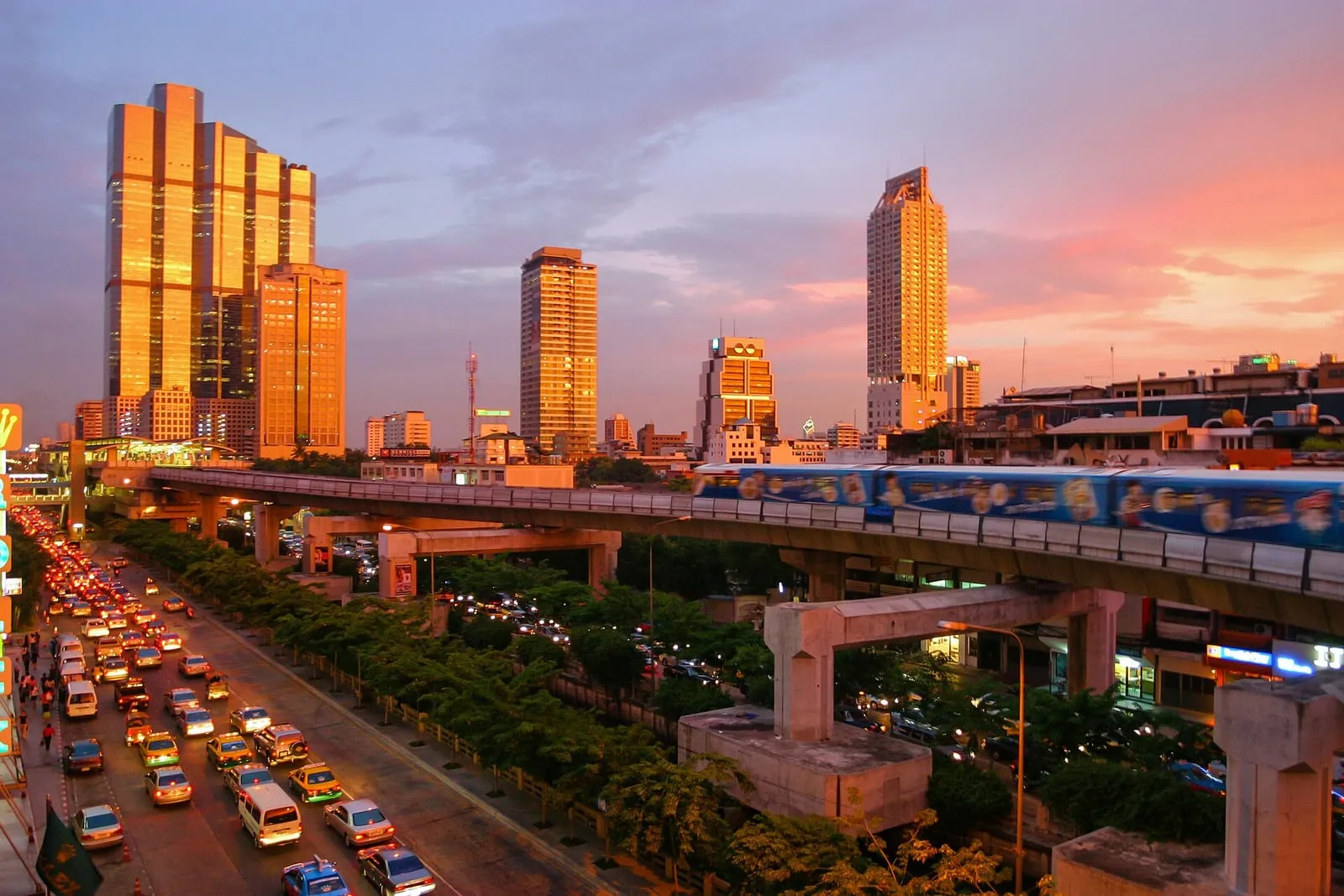
The BTS Skytrain on its viaduct. Photo: Diliff, Wikimedia Commons, CC BY-SA 3.0.
The BTS Skytrain runs on elevated viaducts above Bangkok’s primary avenues. Trains are air-conditioned and frequent.
The network consists of two main lines and one automated people mover:
- Sukhumvit Line (Light Green): runs from Khu Khot in the north to Kheha in the south, stopping at Mo Chit (Chatuchak Weekend Market), Phaya Thai (Airport Rail Link interchange), Siam, Asok, Phrom Phong and Thong Lo.
- Silom Line (Dark Green): runs from National Stadium to Bang Wa, passing through Siam, Sala Daeng (Silom nightlife), Chong Nonsi (Mahanakhon SkyWalk tickets) and Saphan Taksin (Chao Phraya river piers).
- Gold Line: an automated monorail connecting Krung Thon Buri BTS station to Iconsiam and Khlong San.
Siam station serves as the central interchange where both main lines meet.
BTS tickets and the Rabbit card
The BTS sells single-journey tickets and one-day passes at the station ticket machines, which take coins, banknotes and QR payment, and accepts Rabbit cards. Fares depend on distance; the BTS route and fare search gives the price between two stations.
- Rabbit card: a rechargeable stored-value card, useful for several days on the BTS. It is sold at any BTS station ticket office for a 120 THB issue fee, with no deposit, and you add stored value from 100 THB up to 4,000 THB (BTS).
- One-day pass: 150 THB, valid for unlimited rides on the Sukhumvit and Silom lines on the day it is issued, sold at BTS ticket offices (Chulalongkorn University).
- Registration: optional. Registering a card protects the balance if it is lost or stolen, and foreigners register by showing their original passport at Phaya Thai station’s Rabbit service centre or at a BTS station, daily from 09:00 to 19:00 (Rabbit Group).
MRT Subway
The MRT subway runs underground across central Bangkok and connects to the BTS at key hubs.
The system features two lines:
- MRT Blue Line: a complete loop of 38 stations. It serves Krung Thep Aphiwat Central Terminal (Bang Sue), Chatuchak Park, Sukhumvit (interchange with BTS Asok), Silom (interchange with BTS Sala Daeng), Hua Lamphong, Wat Mangkon (Chinatown), Sam Yot (historic Old Town) and Sanam Chai (near Wat Pho and the river).
- MRT Purple Line: an elevated commuter route running from Tao Poon northwest into Nonthaburi province.
MRT payment
The operator lists EMV contactless payment on its site, and its contactless system has been fully in place on the Blue and Purple lines since 1 June 2026 (MRTA), so a contactless bank card or phone wallet can be tapped at the gates on entry and exit. Single-journey tokens are sold at the station machines; tap the token at the entry gate and drop it into the slot at the exit.
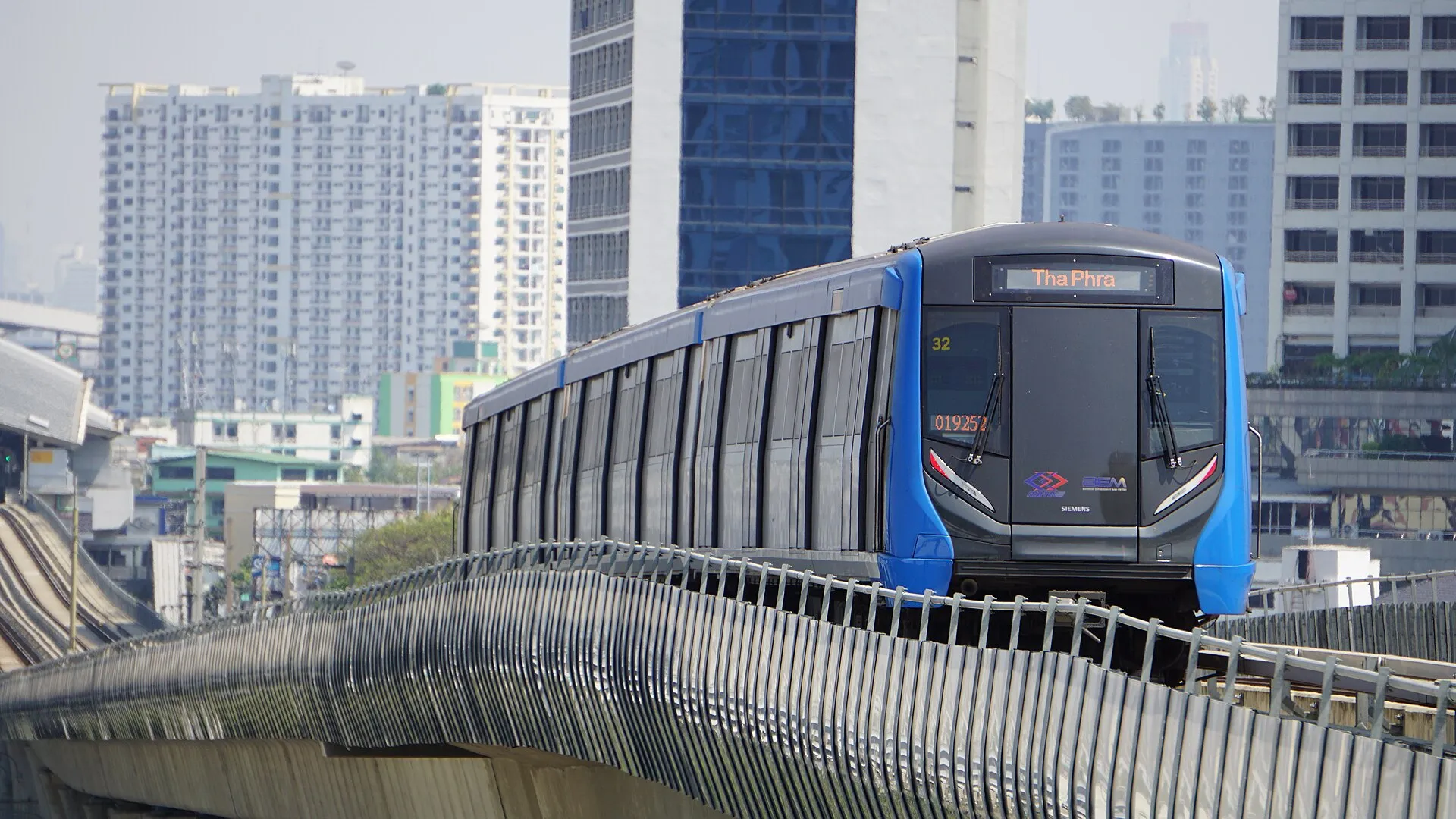
An MRT Blue Line train on the elevated stretch near Bang Wa. Photo: Phornlert.gp, Wikimedia Commons, CC BY-SA 4.0.
Chao Phraya River Boats
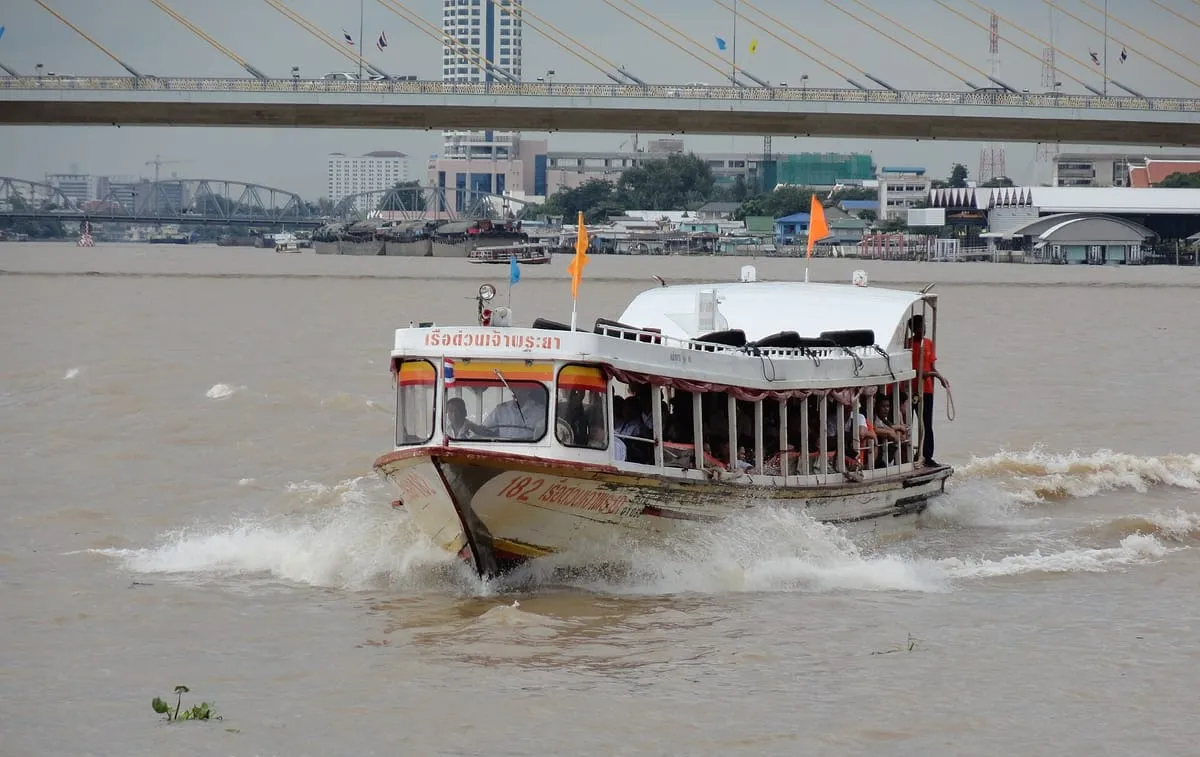
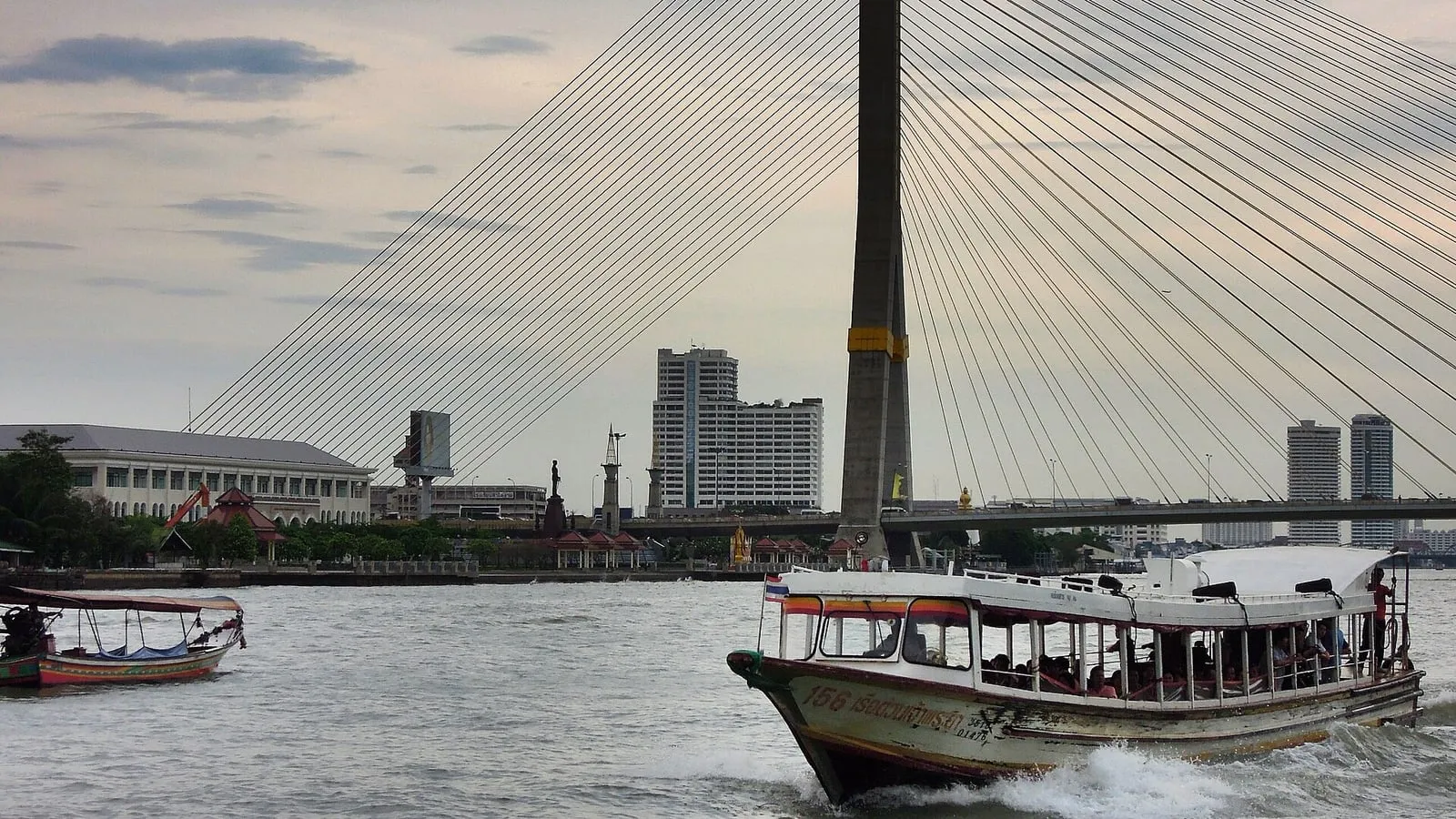
A Chao Phraya Express boat. Photo: Fabio Achilli, Wikimedia Commons, CC BY 2.0.
The Chao Phraya River serves as a major north-south transport artery. Travelling by boat avoids road bottlenecks and passes the historic riverside temples.
Sathorn Pier (Taksin Bridge) sits beside BTS Saphan Taksin station (exit 2) and is the main transfer point between the Skytrain and the river services.
Orange-flag Express Boat
The orange-flag Chao Phraya Express Boat runs between Nonthaburi and Wat Rajsingkorn.
- Fare: a flat 19 THB for the whole line, per the operator.
- Payment: pay the conductor on board or buy a ticket at the pier counter.
- Key piers: Sathorn (BTS connection), Ratchawong (Chinatown), Tha Tien (N8, for Wat Pho), Tha Chang (N9, for the Grand Palace) and Phra Arthit (Khao San Road).
Blue Flag Tourist Boat
The Chao Phraya Tourist Boat is a separate hop-on hop-off catamaran service with an all-day river pass, sold by the operator and by sellers such as Klookad.
- Hours: daily from 08:30 to 19:30. From Sathorn the first boat is at 08:30 and the last at 19:15; from Phra Arthit the first is at 09:00 and the last at 18:30, and after 15:30 the route from Phra Arthit is extended to Asiatique.
- Piers: it stops at Sathorn, Wat Arun, Tha Chang, Iconsiam and Asiatique, among others. For a comparison of river passes versus city tourist buses, see the Bangkok hop-on hop-off guide.
Cross-river ferries
Small passenger shuttles run back and forth between opposite river banks, paid in cash at the turnstile:
- Tha Tien to Wat Arun: connects the east bank beside Wat Pho with the foot of Wat Arun on the west bank.
- River City to Iconsiam: connects the Charoen Krung art district with the Iconsiam shopping terminal.
Khlong Saen Saep Canal Boats
For journeys between the historic Old Town and modern central shopping districts, the Khlong Saen Saep canal express boat runs along the east-west canal.
- Fare: collected in cash by the conductor on the boat, by distance.
- Speed: canal boats bypass the street-level traffic lights.
- How to ride: boats pause at the piers for a few seconds; step aboard briskly. Pull up the canvas curtains along the side of the hull to keep off canal spray.
- Key stops: Phan Fa Lilat (western terminus, near Wat Saket and Rajadamnern Stadium), Saphan Hua Chang (near Jim Thompson House and BTS National Stadium), and Pratunam (CentralWorld and Platinum Fashion Mall).
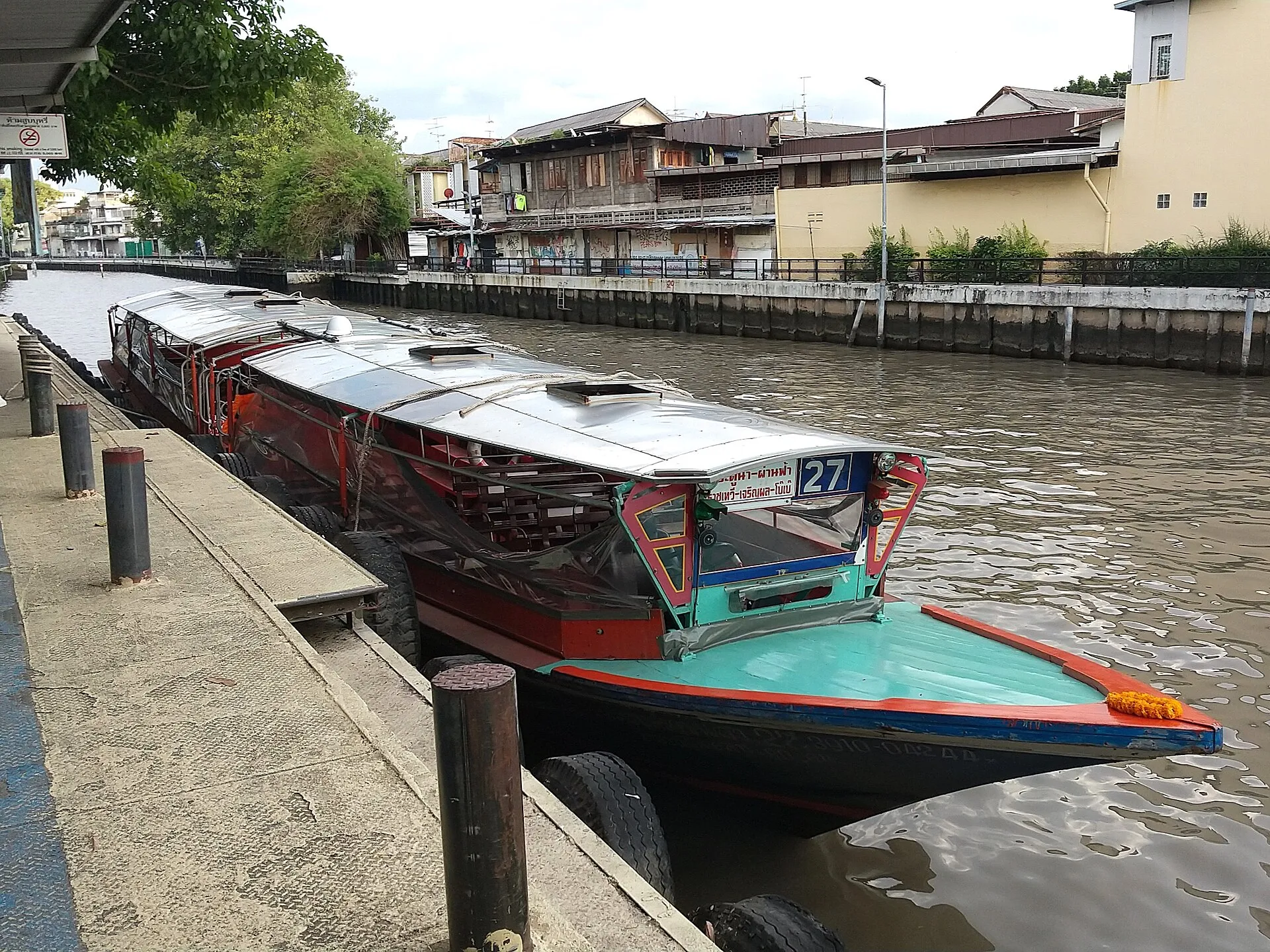
A Khlong Saen Saep express boat at Phan Fa Lilat pier. Photo: Suikotei, Wikimedia Commons, CC BY-SA 4.0.
Taxis, ride-hailing and tuk-tuks
Metered street taxis
Bangkok’s metered taxis come in yellow-green, pink, blue or orange:
- The meter rule: make sure the driver switches on the meter before pulling away. If a driver insists on a flat rate, decline, step out and hail the next cab.
- Expressway tolls: if you take the elevated tollway to skip surface jams, you pay the toll booths directly in cash.
Grab and Bolt ride-hailing
Ride-hailing apps give an upfront fare without a language barrier:
- Grab: offers standard cars, metered taxis (GrabTaxi) and motorcycle rides. Fares can be linked to international credit cards.
- Bolt: a second app with a similar service.
Tuk-tuks
Open-air three-wheeled tuk-tuks do not run on meters:
- Fares: agree the fare with the driver before getting in.
- Scam awareness: tuk-tuk drivers parked near major sights who offer a nominal fare for a tour will make stops at commission-paying gem stores, silk warehouses or tailors. For straightforward transit, a metered air-conditioned taxi is more comfortable. Disputes with taxi and tuk-tuk drivers have occasionally turned to intimidation; if you feel threatened, ask the local police to settle it (Government of Canada).
For details on arriving from the city’s international terminals, read Bangkok airport to the city. For opening hours and regulations at major riverside monuments, see Grand Palace tickets, Wat Pho tickets and Wat Arun tickets. Area recommendations and neighbourhood transit links are detailed in where to stay in Bangkok. For the overarching city overview, see the Bangkok travel guide.
Money in Bangkok covers cash, ATM fees and the MRT’s contactless payment, is Bangkok safe the taxi and tuk-tuk scams, and an eSIM for Thailand the data plan for the ride-hailing apps.
Common questions
What is the best way to travel around Bangkok?
The BTS Skytrain and MRT subway are the fastest options because they bypass Bangkok's notorious surface road congestion. For riverside temples like the Grand Palace, Wat Pho and Wat Arun, Chao Phraya river express boats provide quick access.
Can I pay for Bangkok public transport with a contactless bank card?
The MRT lists contactless bank-card (EMV) payment at its ticket gates. On the BTS, buy a single-journey ticket at the station machines or a Rabbit card at any station ticket office.
How much is a Rabbit card and do I need my passport?
A standard Rabbit card costs 200 THB at any BTS station ticket office: 120 THB is the card fee and 80 THB is stored value. Buying one does not need a passport. Registering the card, which protects the balance if you lose it, does: foreign visitors show the original passport.
How do Chao Phraya river boats work in Bangkok?
The orange-flag Chao Phraya Express Boat charges a flat 19 THB for the whole line and stops at Sathorn (BTS Saphan Taksin), Tha Tien (Wat Pho) and Tha Chang (Grand Palace). The Blue Flag Tourist Boat is a separate hop-on hop-off service, running from 08:30 to 19:30.
Do Bangkok taxis use the meter?
Official metered taxis must use the meter. If a driver refuses and proposes a flat rate, step out and hail another taxi, or use the Grab or Bolt ride-hailing app.