One of 2 self-guided walks in Salzburg. See every walk.
In this guide
💡 The Short Version: Start at the Mirabellplatz stop and finish at the Mozartsteg/Imbergstraße bus stop: 2.9 km on the right bank of the Salzach, about 40 minutes of walking and three to four hours with the visits. Walk it Monday, Wednesday or Thursday: the Mirabell Palace and its Marble Hall are shut on Sundays and holidays, and the Marble Hall opens only at 13:00 on Tuesdays and Fridays. Be at St Sebastian’s Cemetery before 16:00, when it shuts from November to March, and on the Kapuzinerberg in daylight: the sun sets at about 16:20 in December. The Mozart Residence costs €18; the gardens, the churches, the Calvary path, the Hettwerbastei viewpoint and the Steingasse are free. Or book a tour: the Mozart sites and old town walkad starts at Mirabell Palace and is from €45 (2.5 hours, GetYourGuide).
The route
Map of the walk numbered stops in walking order
Open the whole route in Google Maps - all the stops in walking order, set to walking directions, which is the version to put on your phone.
The walk crosses the Mirabell Gardens to Makartplatz, passes Holy Trinity Church, goes up the Linzergasse to St Sebastian’s Cemetery, climbs the Kapuzinerberg by the Calvary chapels to the Capuchin monastery and the Hettwerbastei viewpoint, and comes down the Imbergstiege to the Steingasse. The old town walk covers the other bank; the Mozartsteg joins the two. Prices are the adult rate in euros from each operator.
| Stop | Entry (adult) | Open |
|---|---|---|
| 1. Mirabell Palace and Gardens | Free | Gardens daily from about 6:00 to dusk; palace Monday to Saturday about 8:00 to 18:00 |
| 2. Makartplatz and the Mozart Residence | €18; €25 with the Birthplace | Daily 9:00 to 17:30 |
| 3. Holy Trinity Church | Free | Mass Monday, Tuesday, Thursday and Friday 7:00; Wednesday 18:15 |
| 4. Platzl and Linzergasse | Free | Always |
| 5. St Sebastian’s Church and Cemetery | Free | Cemetery daily 9:00 to 16:00 from November to March |
| 6. The Franziskustor and the Calvary path | Free | Public path; go in daylight |
| 7. The Capuchin monastery and the Hettwerbastei | Free | Church Monday to Saturday 6:00 to 18:00; Sunday 8:00 to 18:00 |
| Detour: the Franziskischlössl | Free | Public path; go in daylight |
| 8. The Imbergstiege | Free | Public steps; go in daylight |
| 9. The Steingasse and the Mozartsteg | Free | Always |
Walk it with a guide
A guide adds the stories and the order. Both walks below start at or beside Mirabell Palace, pass the Mozart Residence and then cross to the old town, so the Kapuzinerberg is yours on foot, and neither includes entry to the Residence. Prices are GetYourGuide’s lowest “from” prices, per person.
- Salzburg 2.5-Hour Walking Tour: Mozart, Old Town & Moread, by MELODY Salzburg Tours&Travel: from €45, 4.2 stars from 1,149 reviews, 2.5 hours. It starts at Mirabell Palace, passes the Residence on Makartplatz, crosses the Marko-Feingold-Steg to Getreidegasse and ends with an optional view from the Mönchsberg.
- Salzburg: Old Town, Mozart, & Mirabell Gardens Walking Tourad, by Rosotravel Austria Tours & Experiences: from €40, 4.7 stars from 752 reviews, 2 hours. It starts at Rainerstraße 3, near the palace, and ends at the Kapitelplatz.
- Salzburg: Mozart Concert at Mirabell Palacead: from €39, 4.8 stars from 4,373 reviews, 1.5 hours, in the Marble Hall of stop 1. Mozart concerts in Salzburg compares it with the fortress and dinner concerts.
Salzburg walking tours compares the paid walks with the free one.
1. Mirabell Palace and Gardens
Gardens free, daily from about 6:00 to dusk · palace and Angel Staircase free, Monday to Saturday about 8:00 to 18:00 · Mirabellplatz
The walk starts at the Mirabellplatz bus stop, in front of the palace that Prince-Archbishop Wolf Dietrich built in 1606 and that now holds the mayor’s offices. Visitors can enter the Angel Staircase and, on set weekdays, the Marble Hall; both are shut on Sundays and holidays. Walk through the gardens to the Pegasus fountain, cast in 1661 and in the garden since 1913, then follow the garden’s main path to the gate on Makartplatz, beside the Landestheater. In winter the Hedge Theatre and the Dwarf Garden are shut, and the Orangery garden stays closed for redesign until December 2026. Mirabell Palace and Gardens has the Marble Hall’s hours and the Do-Re-Mi steps. From 19 November to 31 December a Christmas market stands on Mirabellplatz: see Salzburg Christmas markets 2026.
Walk to Makartplatz: 850 m, through the gardens and out by the gate on Makartplatz.
2. Makartplatz and the Mozart Residence
€18, €25 with the Birthplace · daily 9:00 to 17:30, last admission 17:00 · Makartplatz 8
The Mozart family moved into an eight-room apartment on the second floor of the Tanzmeisterhaus, the dancing master’s house, in 1773, and Wolfgang lived there until the end of 1780. The house was partly destroyed in the Second World War and reopened as a museum in 1996. A visit takes about an hour. A special exhibition on The Magic Flute, Cosmos Magic Flute, runs there until 6 January 2027.
- Tickets: only from the Mozarteum, at the webshop or the box office; the combined ticket with the Birthplace is valid for 48 hours. Mozart’s Birthplace and Residence has every price.
- The Marko-Feingold-Steg, the footbridge to the old town, is 150 m south-west of the Residence. It was the Makartsteg until the city renamed it in 2021.
Walk to Holy Trinity Church: 80 m, across Makartplatz.
3. Holy Trinity Church
Free · Mass Monday, Tuesday, Thursday and Friday at 7:00, Wednesday at 18:15 · Dreifaltigkeitsgasse 14
Johann Bernhard Fischer von Erlach designed the church for the seminary of Prince-Archbishop Johann Ernst von Thun, and it was built between 1694 and 1702. It was among his first buildings in Salzburg. Its twin towers and wings close the top of Makartplatz. Inside, the dome carries a fresco by Johann Michael Rottmayr of the Coronation of Mary by the Holy Trinity, painted between 1697 and 1700. Opposite the church stands the house where Christian Doppler was born, with a plaque on the street side.
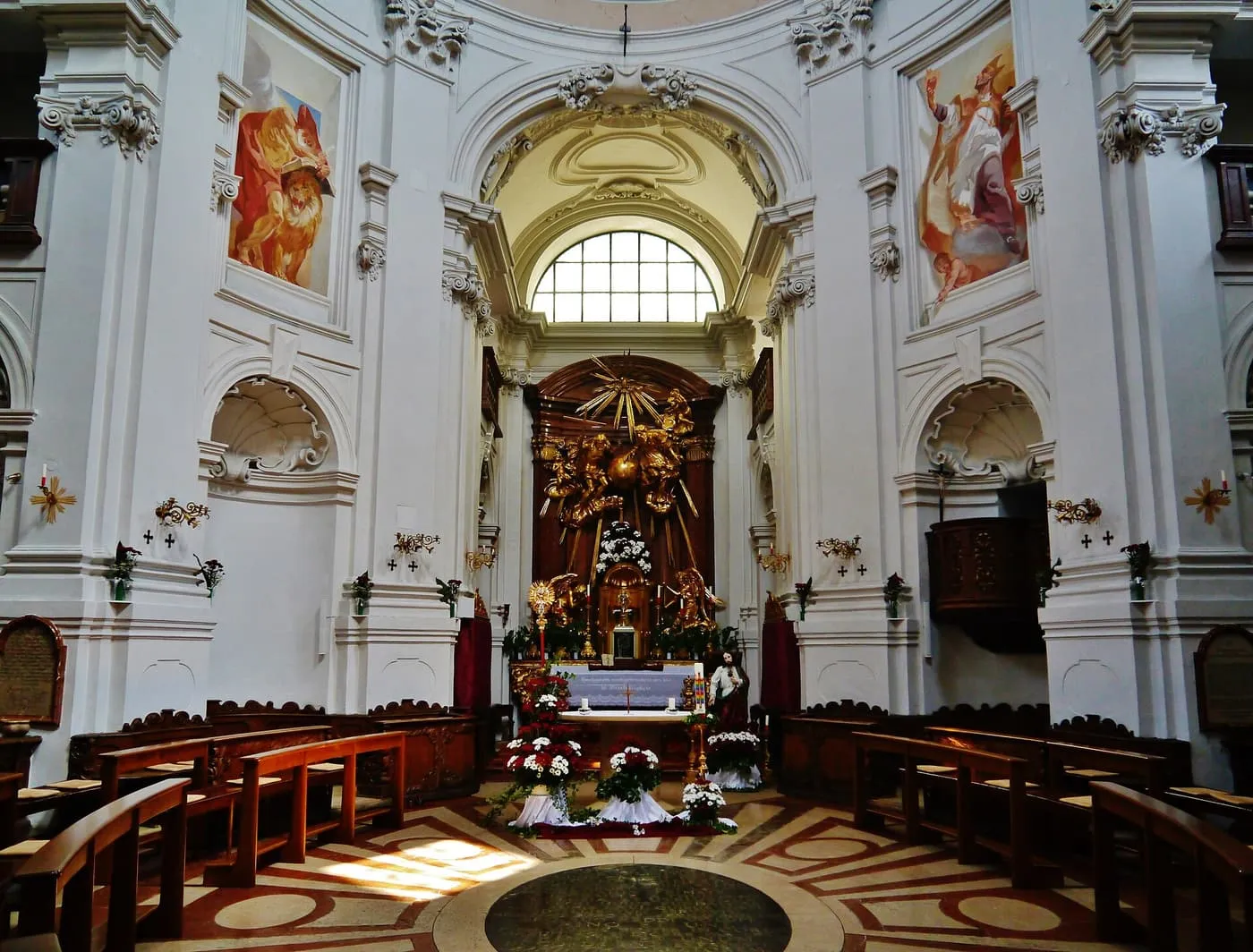
The high altar of Holy Trinity Church. Photo: Zairon, Wikimedia Commons, CC BY-SA 4.0.
Walk to the Platzl: 170 m, down the Dreifaltigkeitsgasse.
4. Platzl and Linzergasse
Free · always open · the Platzl is at the right-bank end of the Staatsbrücke
The Linzergasse is the right bank’s main pedestrian street. It leaves the Platzl and runs parallel to the Kapuzinerberg, and from Roman times it was the road out of Salzburg towards Linz and Vienna. Paracelsus lived at No. 3 in 1540 and 1541. The Engel-Apotheke at No. 7 has been a pharmacy since 1809, and the poet Georg Trakl, born in Salzburg in 1887, worked there as an assistant. The fire of 1818 spared none of the 14th- and 15th-century houses, and the merchants’ houses were restored almost in full.
Walk to St Sebastian’s: 340 m up the Linzergasse. The gate to the Kapuzinerberg at No. 14 is on the way; leave it for the climb in a few minutes.
5. St Sebastian’s Church and Cemetery
Free · cemetery daily 9:00 to 16:00 from November to March, 9:00 to 18:00 from April to October · Linzer Gasse 41
Wolf Dietrich had the cemetery laid out between 1595 and 1600 on the model of the Camposanto in Pisa: arcades round the burial ground, with his mausoleum, the Gabrielskapelle, in the middle. Leopold Mozart, Constanze Mozart and her second husband, Georg Nikolaus Nissen, are buried here, and the tomb of Paracelsus stands in the passage to the cemetery. The church beside it was rebuilt in the baroque style in 1749 to 1753, on a church of 1505 to 1512. The fire of 1818 destroyed its ceiling fresco and altarpiece by Paul Troger, and its wrought-iron screen of 1752 is by Philipp Hinterseer.
- Services: Mass is Monday to Friday at 18:00, Saturday at 8:00 and Sundays and holidays at 8:00 and 9:30, and the tourist board says the cemetery cannot be visited during a service.
- In winter the tourist board gives the way in as the Bruderhof, which adjoins the church.
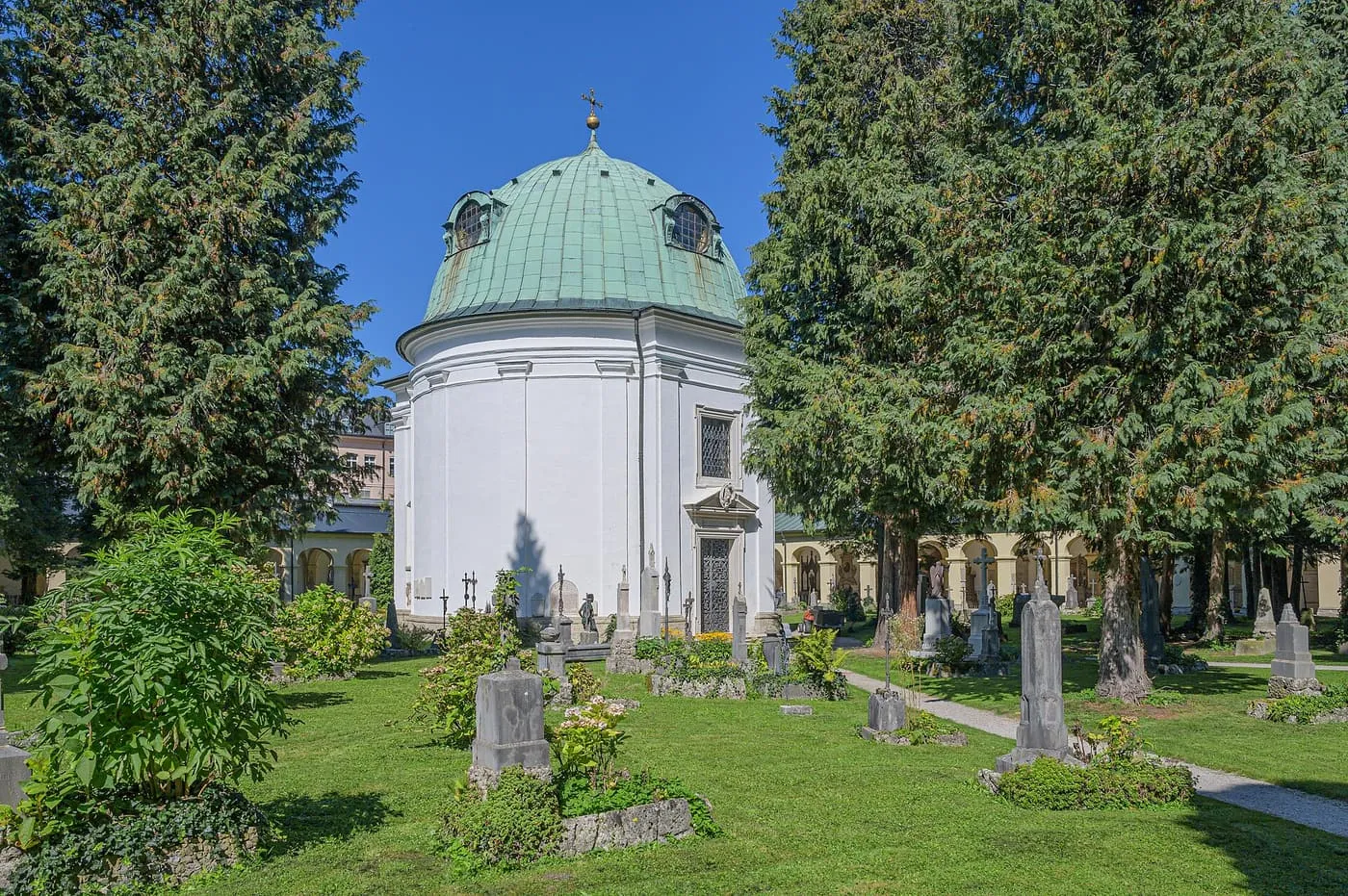
The Gabrielskapelle, Wolf Dietrich’s mausoleum, in St Sebastian’s Cemetery. Photo: Isiwal, Wikimedia Commons, CC BY-SA 4.0.
Walk to the Franziskustor: 250 m back down the Linzergasse, to No. 14.
6. The Franziskustor and the Calvary path
Free · a public path, best in daylight · Linzer Gasse 14
The Franziskustor is the gate from which the Stefan-Zweig-Weg climbs the Kapuzinerberg. Wolf Dietrich had a better road built up the mountain in 1596, to reach the future monastery, and the steps and the Calvary chapels beside it date from after 1744. There are eleven chapels, with life-size figures made after 1740, from the first scenes of the Passion to the prison scene in the Felixpforte and a large open chapel of the Crucifixion. The first stretch is steep: wear shoes with non-slip soles.
Walk to the monastery: 270 m up the path, past the chapels and through the Felixpforte.
7. The Capuchin monastery and the Hettwerbastei
Church free · Monday to Saturday 6:00 to 18:00, Sunday 8:00 to 18:00 · Kapuzinerberg 6
Wolf Dietrich turned a medieval tower into the monastery for the Capuchins, and the church was consecrated in 1602. It is plain inside; its Gothic oak door, carved in 1450 with twelve panels, comes from the old cathedral. Today the monastery is the joint noviciate of the German-speaking Capuchin provinces. The order lists Mass on Sundays and holidays at 17:00 and on Thursdays at 18:00. Stefan Zweig lived at the Paschinger Schlössl, Kapuzinerberg 5, from 1919 to 1934, and a bust of him stands above the house. A few metres further up the path stands a bust of Mozart, carved with the words “Jung groß, spät erkannt, nie erreicht”: young and great, recognised late, never equalled. It is 140 m beyond the monastery; walk there and back.
The Hettwerbastei, the bastion below the monastery, is the viewpoint: it looks over the roofs of the old town to the fortress and across to the Mönchsberg. It is free.
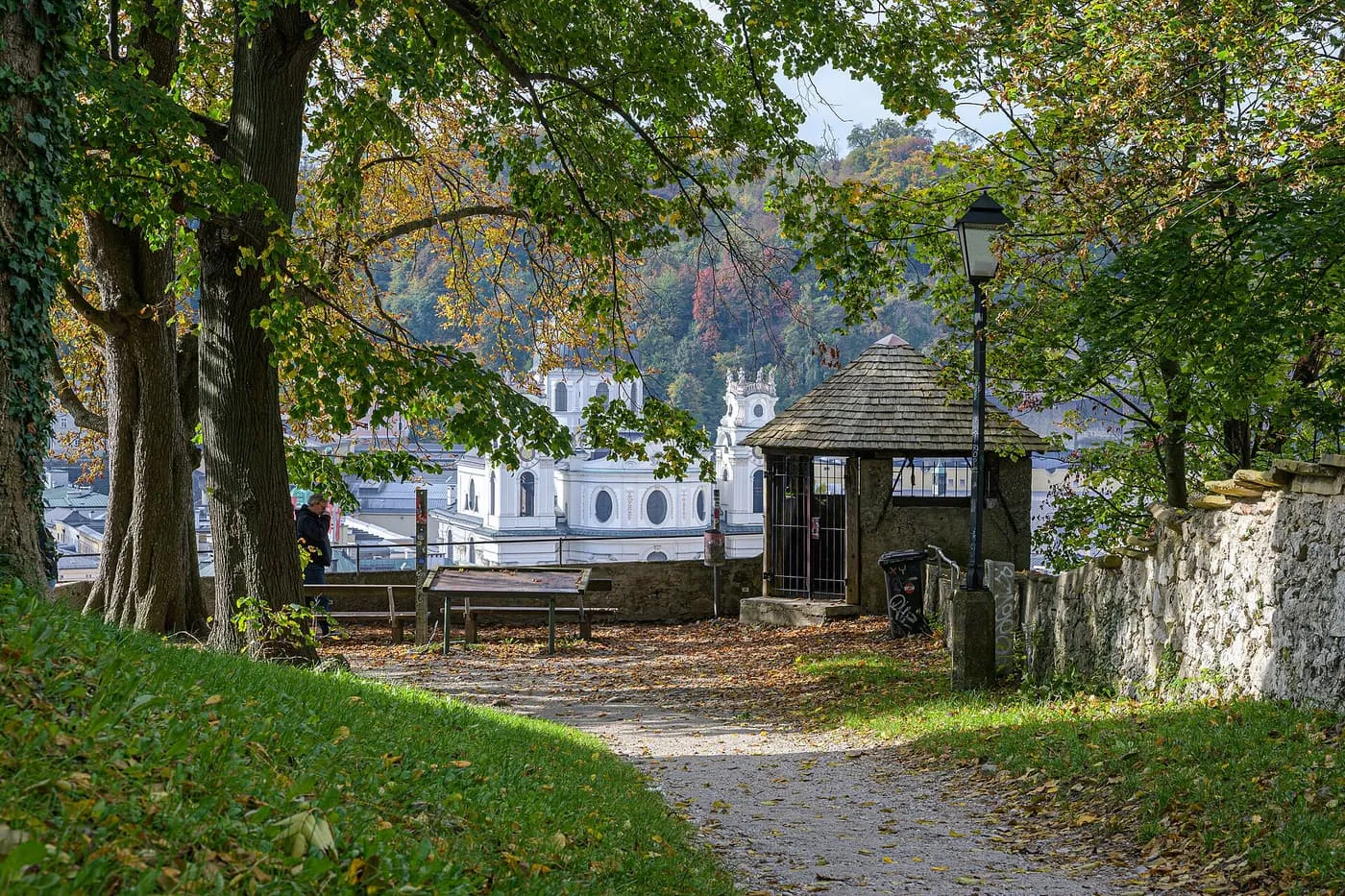
The path to the Hettwerbastei viewpoint on the Kapuzinerberg. Photo: Isiwal, Wikimedia Commons, CC BY-SA 4.0.
Walk to the Imbergstiege: 240 m, down past the Hettwerbastei. For the Franziskischlössl, take the detour first.
Detour: the Franziskischlössl
Free · about 1.3 km from the Mozart bust along the ridge · adds about 2.5 km to the walk
Prince-Archbishop Paris Lodron had the Franziskischlössl built in 1629, in the middle of the Thirty Years’ War, as the largest of the mountain’s fortifications; it was turned into an inn in 1849. The path runs through beech forest, with views of Hohensalzburg Fortress and the Untersberg behind it, and about a dozen chamois live on the mountain. The way back down to the Imbergstiege is about 1.6 km, and the detour takes about an hour.
- Work on the north face: the city is fixing rockfall nets above the Schallmooser Hauptstraße from 17 August to about mid-December 2026, and closes the footpath between the Franziskischlössl and the Schweizerhäusl during the helicopter flights. Go back the way you came.
Walk back to the monastery and on to the Imbergstiege: 1.6 km.
8. The Imbergstiege
Free · public steps, best in daylight · from the Kapuzinerberg down to the Steingasse
The Imbergstiege has existed since the Middle Ages. Prince-Archbishop Max Gandolf rebuilt it in 1671 as a wooden stair with a roof, and pilgrims climbed it to the monastery at Easter, Christmas and Ascension. A plaque records that the stair gave way in 1756 under the weight of pilgrims and killed six people. Halfway down, in a corner, stands the small church of St Johann am Imberg, first mentioned in 1319, which the Mozart children often visited.
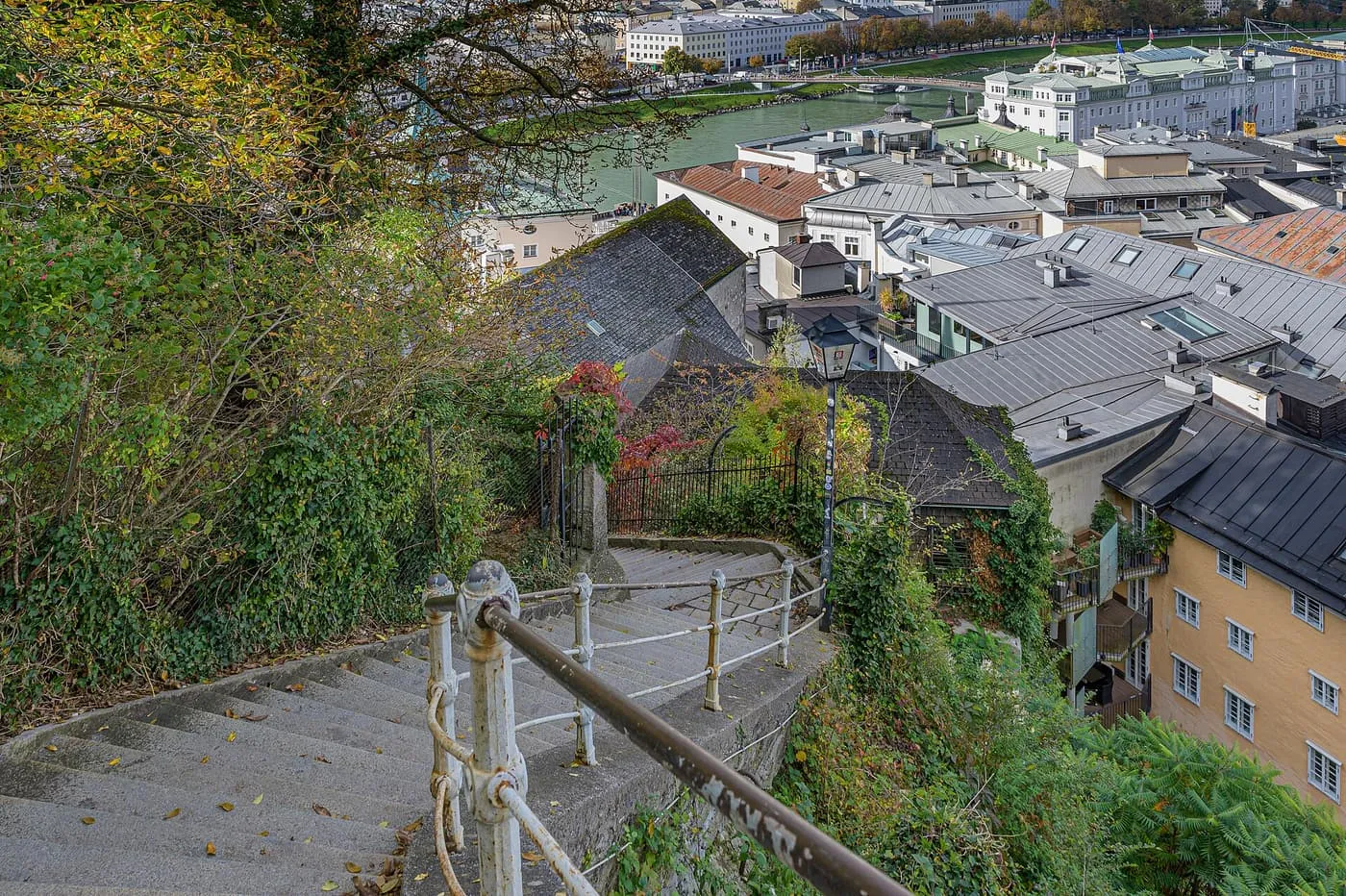
The Imbergstiege above the Steingasse, with the Salzach beyond. Photo: Isiwal, Wikimedia Commons, CC BY-SA 4.0.
Walk down the steps and along the Steingasse: 410 m, to the bus stop.
9. The Steingasse and the Mozartsteg
Free · always open · the Mozartsteg/Imbergstraße bus stop at the end
The Steingasse is one of the oldest streets on the right bank. It runs along the foot of the Kapuzinerberg, parallel to the Salzach, and was the medieval road south to the mountains and Italy. Potters, dyers and tanners worked here, and until the river was regulated in 1862 the houses had gardens running down to the water. Few shops remain: the houses are homes. Joseph Mohr, who wrote the words of Silent Night, lived at No. 31. The street ends about 400 m beyond the bus stop at the Engelwirtsbrunnen, a marble wall fountain.
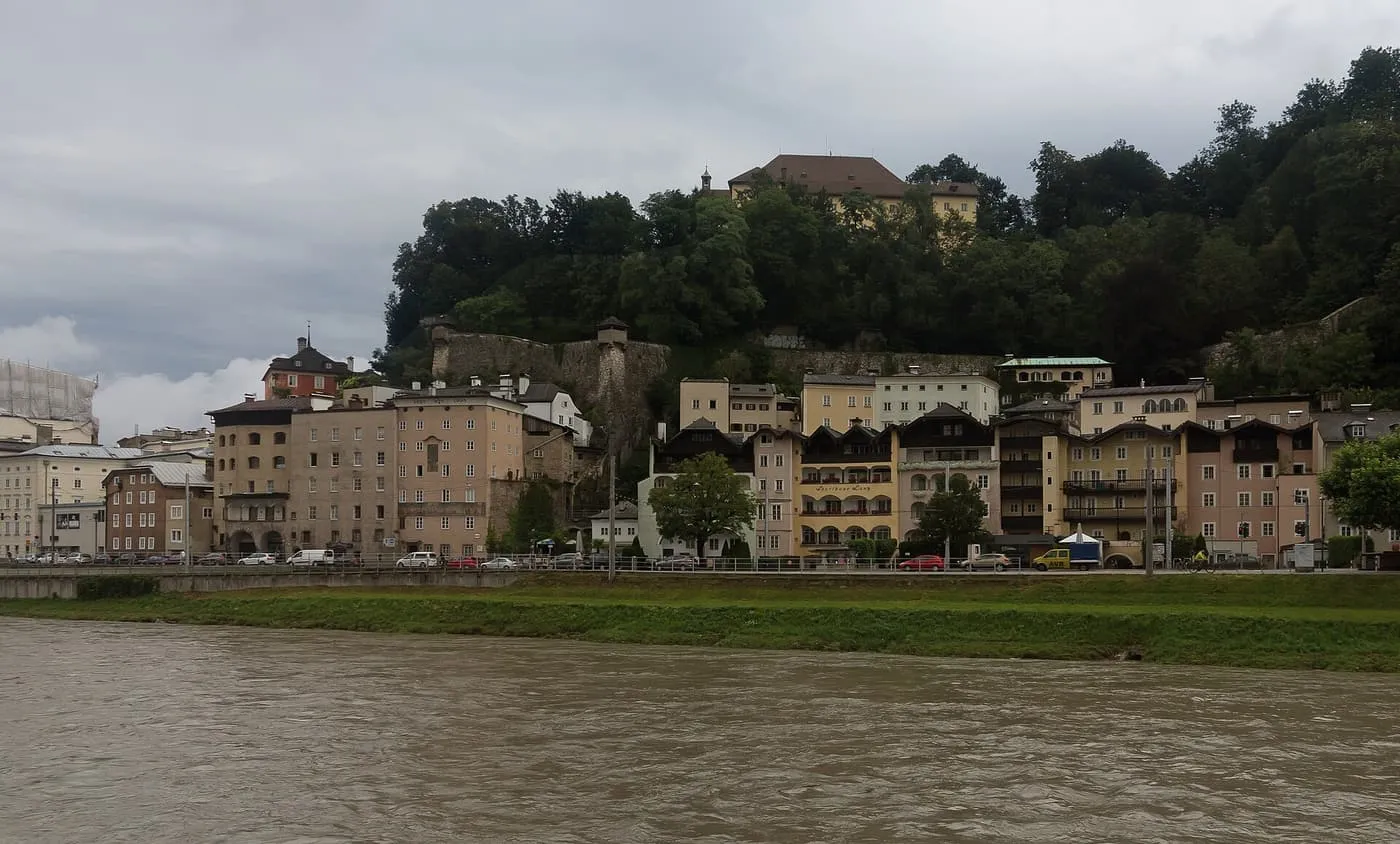
The Steingasse houses below the Capuchin monastery, across the Salzach. Photo: Michielverbeek, Wikimedia Commons, CC BY-SA 4.0.
The walk ends at the Mozartsteg/Imbergstraße bus stop, beside the footbridge. The Mozartsteg leads across to Rudolfskai; Mozart’s Birthplace on Getreidegasse, where the old town walk starts, is 540 m from the bus stop.
Where to eat
Café Fürst
Mirabellplatz 5 · Thursday 8:30 to 18:00, other weekdays and Saturday 9:30 to 18:00, Sunday and holidays 10:00 to 17:00
The confectioner that makes the Original Salzburger Mozartkugel, at the start of the walk. Salzburg’s coffee houses compares it with the others.
Café Bazar
Schwarzstraße 3 · Monday to Saturday 7:30 to 19:30, Sunday and holidays 9:00 to 18:00 · no reservations
A coffee house opened in 1909, a short walk from the Residence, with a terrace that looks over the river to the old town and the fortress. It serves breakfast all day.
Café Sacher
Schwarzstraße 5-7 · daily 8:30 to 22:00
The Hotel Sacher’s café, also on Schwarzstraße, serves the Original Sacher-Torte.
The best day to go
| Day | What changes on the route |
|---|---|
| Monday | All open; the Marble Hall 8:00 to 16:00 |
| Tuesday | The Marble Hall opens only from 13:00 |
| Wednesday | All open; the Marble Hall 8:00 to 16:00 |
| Thursday | All open; the Marble Hall 8:00 to 16:00 |
| Friday | The Marble Hall opens only from 13:00 |
| Saturday | The palace is open; no Marble Hall hours are listed |
| Sunday | The palace and the Marble Hall are shut. Mass at St Sebastian’s is at 8:00 and 9:30, and the Capuchin church opens at 8:00 |
The timing that works, from November to March: the Mirabellplatz stop at 9:00, the Residence by 10:00 (it opens at 9:00), Holy Trinity and the Linzergasse at 11:15, St Sebastian’s at noon, the climb at 12:30, the monastery and the Hettwerbastei at 13:00 and the Steingasse by 14:00. That leaves time for the Franziskischlössl before the sun sets, at about 16:50 on 1 November and 16:20 in December. What closes:
- Sundays and holidays: the palace, the Angel Staircase and the Marble Hall. The holidays are 8 December, 25 and 26 December and 1 and 6 January.
- After 16:00: St Sebastian’s Cemetery, from November to March. It stays open to 18:00 from April to October.
- 24 December and 1 January: the Residence closes at 13:00 on 24 December and opens at 12:00 on 1 January.
- 1 and 2 November 2026: on All Saints’ Day, Sunday 1 November, St Sebastian’s Cemetery is open from 9:00 to 21:00. On Monday 2 November a Mass at 18:00 in the church is followed by a procession through the cemetery.
- In winter: the Hedge Theatre and the Dwarf Garden at Mirabell. The Orangery garden stays closed until December 2026.
What does not close: the Platzl, the Linzergasse and the Steingasse. The gardens, the Calvary path, the Hettwerbastei and the Imbergstiege are open in daylight.
Getting there and back
- To the start: from the Hauptbahnhof, trolleybuses 3, 5 and 6 run to Mirabellplatz; the walk is 880 m. Salzburg public transport has the fares, and a guest with a Guest Mobility Ticket rides free. Salzburg airport to the city covers the trolleybus from the airport.
- From the end: the Mozartsteg/Imbergstraße stop is on the Steingasse. Trolleybuses 3, 5 and 6 run from there back to Mirabellplatz; the Salzburg Verkehr app shows the next departures.
- In reverse: start at the Mozartsteg and climb the Imbergstiege first. The cemetery then comes last, and it shuts at 16:00 from November to March, so the direction above is safer in winter.
What to do with the rest of the day
- The other bank: the old town walk starts at Getreidegasse 9, 540 m from the end of this walk across the Mozartsteg, and finishes at Nonnberg Abbey. Do it on another day.
- The sights: Mirabell Palace and Gardens and Mozart’s Birthplace and Residence have the tickets, and Sound of Music locations in Salzburg says which scenes were filmed in the gardens.
- More views: best views in Salzburg covers the Mönchsberg, the fortress and the Untersberg.
- Free: free things to do in Salzburg lists what costs nothing.
- The days: 3 days in Salzburg fits the walk into a plan, and what to book in Salzburg lists the closed day of every sight.
- Guided walks: Salzburg walking tours compares the operators.
- Where to sleep: where to stay in Salzburg compares the areas.
Common questions
How long is the Salzburg Kapuzinerberg walk?
2.9 km from Mirabellplatz to the Mozartsteg/Imbergstraße bus stop, measured along the paths: about 40 minutes of walking, and three to four hours with the Mozart Residence, St Sebastian's Cemetery and the climb. The detour to the Franziskischlössl adds about 2.5 km.
How much does the walk cost?
Only the Mozart Residence costs anything: €18, or €25 with the Birthplace. The Mirabell Gardens, the churches, the cemetery, the Calvary path, the Hettwerbastei viewpoint and the Steingasse are free.
Which day is best for the walk?
Monday, Wednesday or Thursday. The Mirabell Palace and its Marble Hall are shut on Sundays and holidays, and the Marble Hall opens only at 13:00 on Tuesdays and Fridays.
Where does the climb up the Kapuzinerberg start?
At the Franziskustor, a gate at Linzer Gasse 14, about 100 m up the street from the Platzl. The Calvary path climbs from it to the Capuchin monastery. The Imbergstiege, a flight of steps from the Steingasse, is the other way up.
Is the Marko-Feingold-Steg the same bridge as the Makartsteg?
Yes. The footbridge opposite the Hotel Sacher was the Makartsteg until the city renamed it after Marko Feingold in 2021. The walk passes 150 m from it, at Makartplatz.
Can I combine it with the old town walk?
The Mozartsteg at the end of this walk leads to Getreidegasse 9, where the old town walk starts, 540 m away. From November to March the daylight and the cemetery's 16:00 closing make one walk a day.