In this guide
💡 The Short Version: Siu mei shops hang roast goose, duck, char siu, crisp pork belly and soy chicken in the window and chop them to order over rice or noodles. For goose, go to Kam’s Roast Goose in Wan Chai (11:30 to 21:30, 30 seats, queues), Yat Lok on Stanley Street in Central or Yung Kee on Wellington Street (11:00 to 22:30). Ask for half-fat, half-lean (pun fei sau) char siu, order roast goose with plum sauce, and try siu yuk (crisp roast pork belly) with mustard. Find a shop by looking for the window. Or book a tour: the Gems food tour with dim sum, goose and 7+ tastingsad (from HK$833, 4.9 stars from 81 reviews) puts roast goose in a three-hour tasting walk. For the other dishes, see the dim sum guide and the cha chaan teng guide.
The meats
Siu mei (燒味) is the Cantonese name for roast meats hung in a shop window. Wikipedia reports that the average person in Hong Kong eats it once every four days, with char siu the most popular, crisp roast pork second and roast goose third (Wikipedia). The shops are often called siu laap (燒臘) because they sell preserved laap mei sausages and cured meats beside the roast ones.
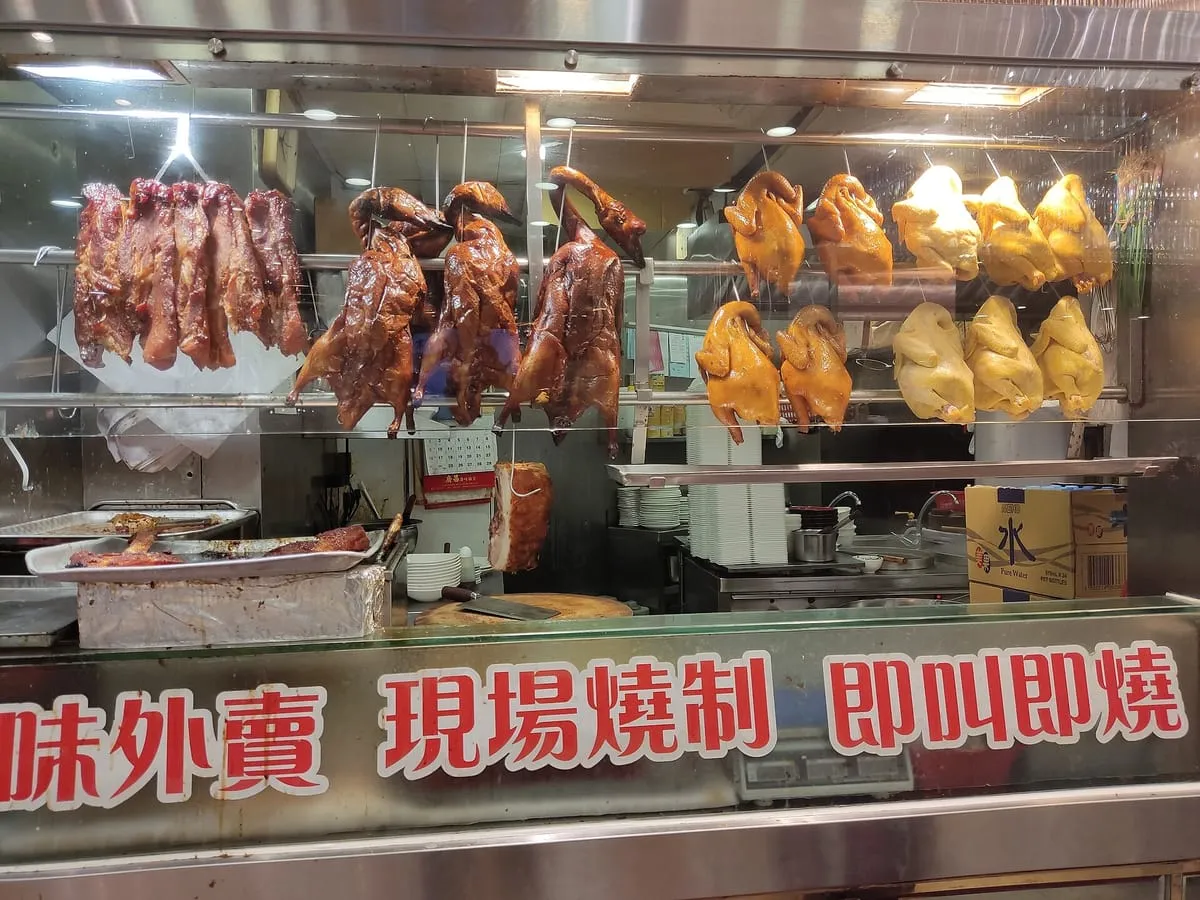
A siu mei window. Photo: Micsornu SZUMLLBP, Wikimedia Commons, CC BY-SA 4.0.
| Meat | Cantonese | What it is | Usual condiment |
|---|---|---|---|
| Roast goose | 燒鵝 (siu ngo) | Crisp skin over rich dark meat, chopped on the bone | Plum sauce |
| Char siu | 叉燒 | Pork roasted with a sweet glaze | Its own glaze |
| Crisp roast pork belly | 燒肉 (siu yuk) | Blistered skin over meat and fat, in cubes | Mustard |
| Soy chicken | 豉油雞 | Chicken cooked in soy sauce | Ginger and spring onion oil |
Goose is larger and richer than duck, with a thicker layer of fat under the skin.
- Roast goose is roasted at high heat, often in a charcoal furnace, for crisp skin over tender meat, and is normally served with plum sauce (Wikipedia).
- Char siu is usually boneless pork shoulder (mui tau) marinated in hoisin sauce, soy sauce, rose wine and five-spice powder, then glazed with maltose or honey. Pork belly gives a fattier slice, pork butt a leaner one and the neck end a marbled one (Wikipedia).
- Siu yuk is roast pig, sold in small pieces with the skin on. It is served plain or with mustard, soy sauce or hoisin sauce (Wikipedia).
- Soy sauce chicken and white cut chicken are siu mei too, although they are cooked in liquid and not roasted.
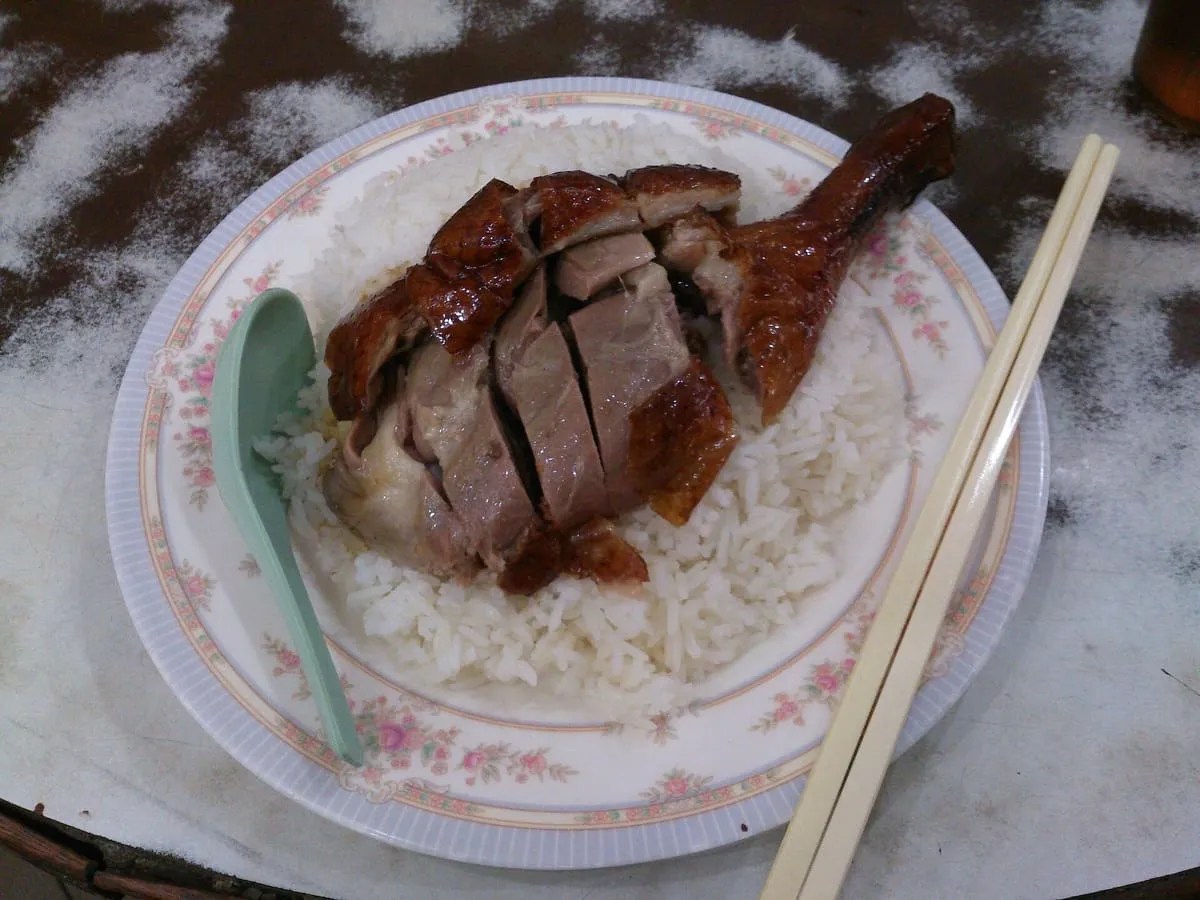
Roast goose on rice. Photo: Ceeseven, Wikimedia Commons, CC BY-SA 3.0.
Where to eat roast goose
Three places on Hong Kong Island, from a 30-seat counter to a sit-down restaurant. Kam’s Roast Goose and Yat Lok both hold one Michelin star in the 2026 guide, and both have held it every year since the 2015 guide (Wikipedia). Kam’s and Yung Kee are a short ride apart by MTR or tram; the 3-day itinerary shows where they fit, and where to eat covers the rest of the island.
Kam’s Roast Goose
Wan Chai · G/F, Po Wah Commercial Centre, 226 Hennessy Road · 11:30 to 21:30 (Kam’s Roast Goose) · goose over rice or noodles
Order the roast goose, then the goose blood pudding or the noodles blanched in goose fat that the Hong Kong Tourism Board singles out. The shop is a narrow counter with a dining room of 30 seats, run by the Kam family, who have been cooking for more than 70 years according to the tourism board. The deciding fact is the queue: it forms outside the door, so arrive before noon or after the lunch rush.
Yat Lok
Central · G/F, Conwell House, 34-38 Stanley Street · 10:00 to 20:30, public holidays 10:00 to 17:30 · about HK$51 to 100 a head · cash or Octopus (OpenRice) · goose over lai fun noodles
Yat Lok opened in the 1950s and the family-run kitchen follows a 20-step procedure for each goose before it is roasted, giving a thin, crisp skin (Hong Kong Tourism Board). Order the goose over lai fun (thick rice noodles) with a spoonful of goose fat, the way the tourism board recommends. Char siu and crisp pork belly are on the same counter.
Yung Kee
Central · 32-40 Wellington Street · 11:00 to 22:30, every day (Yung Kee) · sit-down restaurant
Yung Kee describes itself as offering casual and fine dining under one roof, and says it is the only restaurant in Hong Kong that makes its roast meats over charcoal (a translation of the Chinese text on its site). Founded in 1942, it has stood on Wellington Street since 1964 (Wikipedia), and its own menu lists a signature charcoal-roasted goose alongside goose web rolled with giblets and barbecued pork, and stewed goose in a casserole. The restaurant takes reservations through its site, and also runs a casual dining and takeaway counter.
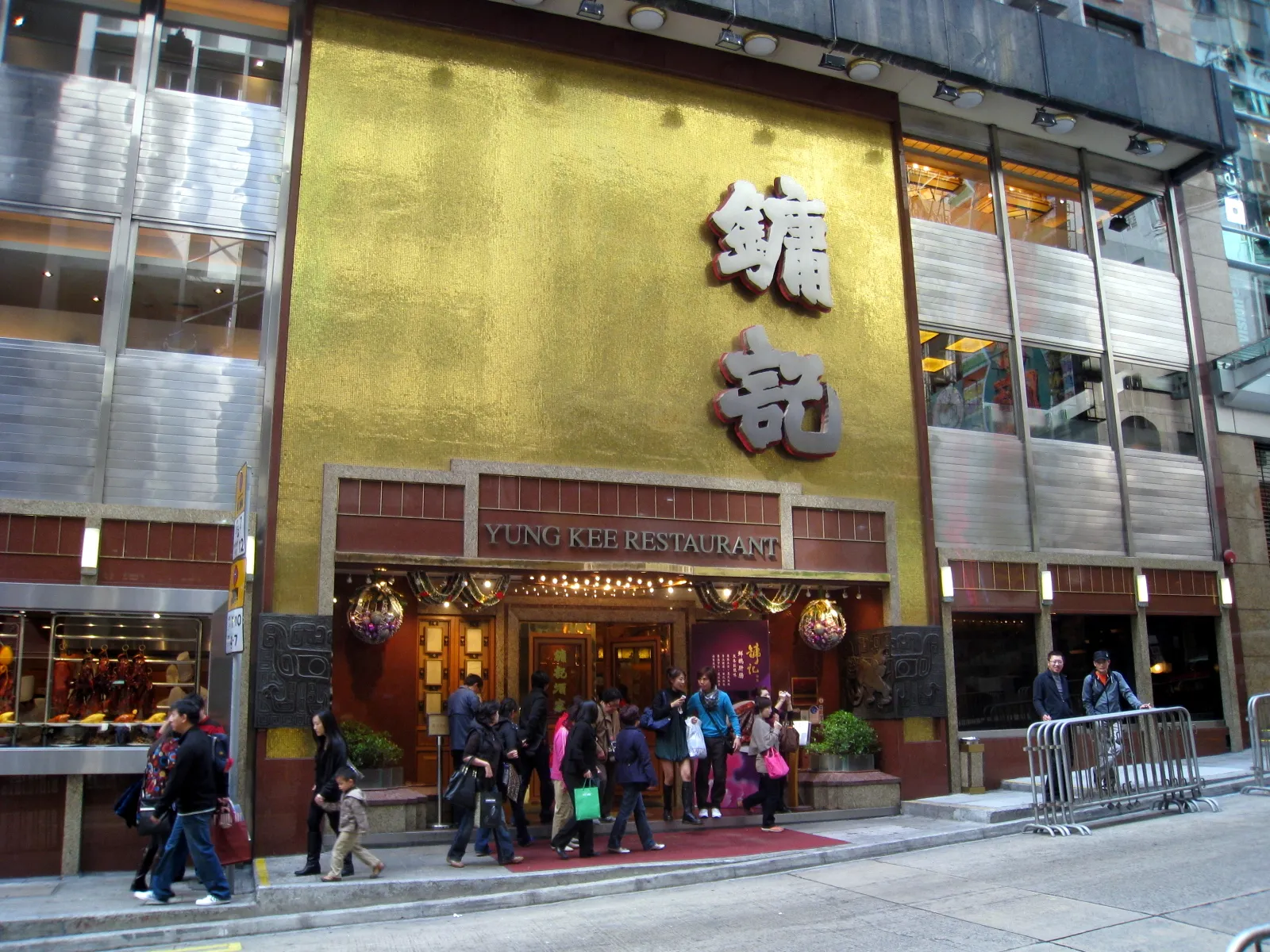
Yung Kee on Wellington Street, Central. Photo: WiNG, Wikimedia Commons, CC BY-SA 3.0.
How to order
- Choose a base. Rice (faan) or noodles; lai fun, a thick rice noodle, is the usual pairing with goose in soup.
- Combine. A seung pin faan is two meats over rice with greens.
- Name the cut. For char siu, say pun fei sau (half-fat) or sau yuk (lean).
- Check the price. Prices are on the menu board; ask the price of goose by the portion before it is chopped.
- Take away. Shops will pack meat by weight to take away. Roast meat keeps its flavour through the day, so it suits a picnic or a hotel-room dinner; Peking-style duck, by contrast, has to be eaten at once (Wikipedia).
- Choose a vegetable. A plate usually comes with choy sum or gai lan (Chinese broccoli), and a restaurant will sell a half or whole goose à la carte.
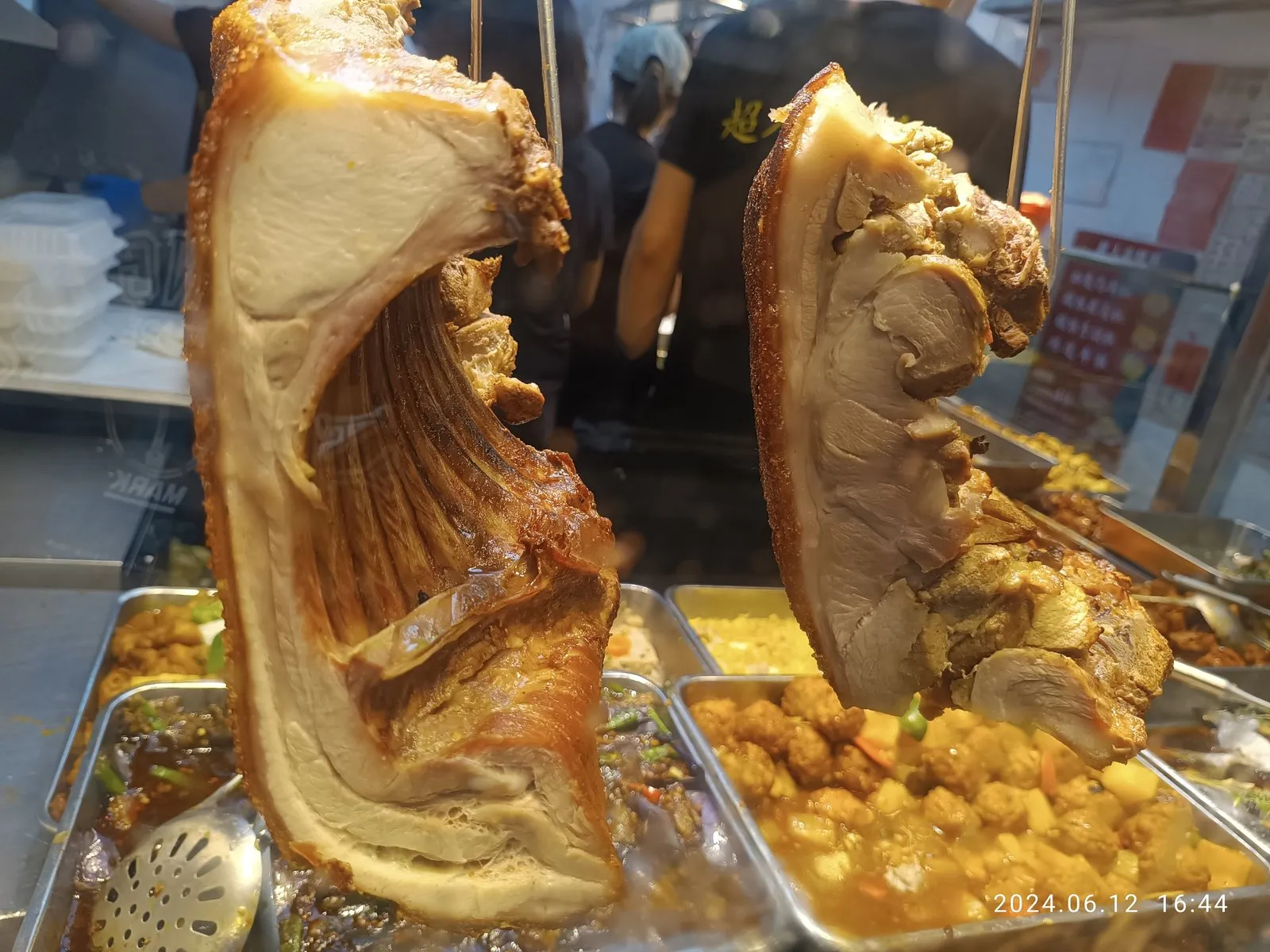
Roast pork belly (siu yuk) behind glass. Photo: Lioobd HAOEU minga, Wikimedia Commons, CC0.
Tours
A guided tasting is the easiest way to get goose and char siu in one outing.
Gems food tour with dim sum and goose
From HK$833 · 4.9 stars from 81 reviews · 3 hours
Hong Kong: Gems Food Tour with Dim Sum, Goose & 7+ Tastingsad covers six or more dishes including dim sum, beef brisket soup, roast goose and local sweets. Cancellation is free, the booking closes two hours before the start, and the tour is run in English.
Street and restaurant tour
From HK$450 · 4.9 stars from 1,153 reviews · 3 hours
Hong Kong: 7-Course Hong Kong Street & Restaurant Food Tourad tastes more than ten classics, including dim sum and barbecued pork. It is weather dependent, with a refund or new date if it is cancelled for poor weather, and a booking takes up to 15 people. More are on the food tours page.
For where to eat in each area, see where to eat in Hong Kong.
Common questions
Where can I eat roast goose in Hong Kong?
Kam's Roast Goose at 226 Hennessy Road in Wan Chai (11:30 to 21:30), Yat Lok at 34-38 Stanley Street in Central and Yung Kee at 32-40 Wellington Street in Central (11:00 to 22:30). Kam's has 30 seats and a queue outside.
What is siu mei?
Siu mei is the Cantonese name for roasted meats: roast goose and duck, char siu (barbecued pork), siu yuk (crisp roast pork belly) and soy-sauce chicken. Shops hang the meat in a window and chop it to order.
What is the difference between roast goose and roast duck?
Goose is larger and richer than duck, with a thicker layer of fat under the skin. It is usually served with a sweet and sour plum sauce, over rice or in a noodle soup.
What should I ask for when ordering char siu?
Ask for half-fat, half-lean (pun fei sau) for a juicier cut with caramelised edges, or lean (sau yuk) if you want no visible fat.
How do I order a roast meat rice plate?
Point at the meat in the window and name the base: rice (faan) or noodles (min or lai fun). A combination plate (seung pin faan) gives two meats over rice with greens. Prices are on the menu board, so check them before you order.