In this guide
💡 The Short Version: The Plaza Mayor and the Puerta del Sol are free and open all hours, about five minutes apart on foot. The Plaza Mayor was rebuilt after the fire of 1790 with nine arches and buildings of two storeys; look for the statue of Philip III, the frescoed Casa de la Panadería and the steep steps of the Arco de Cuchilleros. The Puerta del Sol has the Kilometre 0 slab, the clock for the twelve New Year grapes and the bear and strawberry tree statue. Or book a tour: the Welcome to Madrid walking tourad starts beside the Plaza Mayor and is from €25.11 (GetYourGuide).
The Plaza Mayor
The Plaza Mayor stands on the former Plaza del Arrabal, where Madrid’s busiest market was held until the late 16th century. Philip III had it built to a design by Juan Gómez de Mora, and it hosted festivities, bullfights, coronations and, on occasion, autos-da-fé of the Spanish Inquisition. Fires swept it several times, and the worst, in 1790, practically destroyed it. Juan de Villanueva, the architect of the Prado, rebuilt it, cut the buildings to two storeys and closed the corners with nine arches.
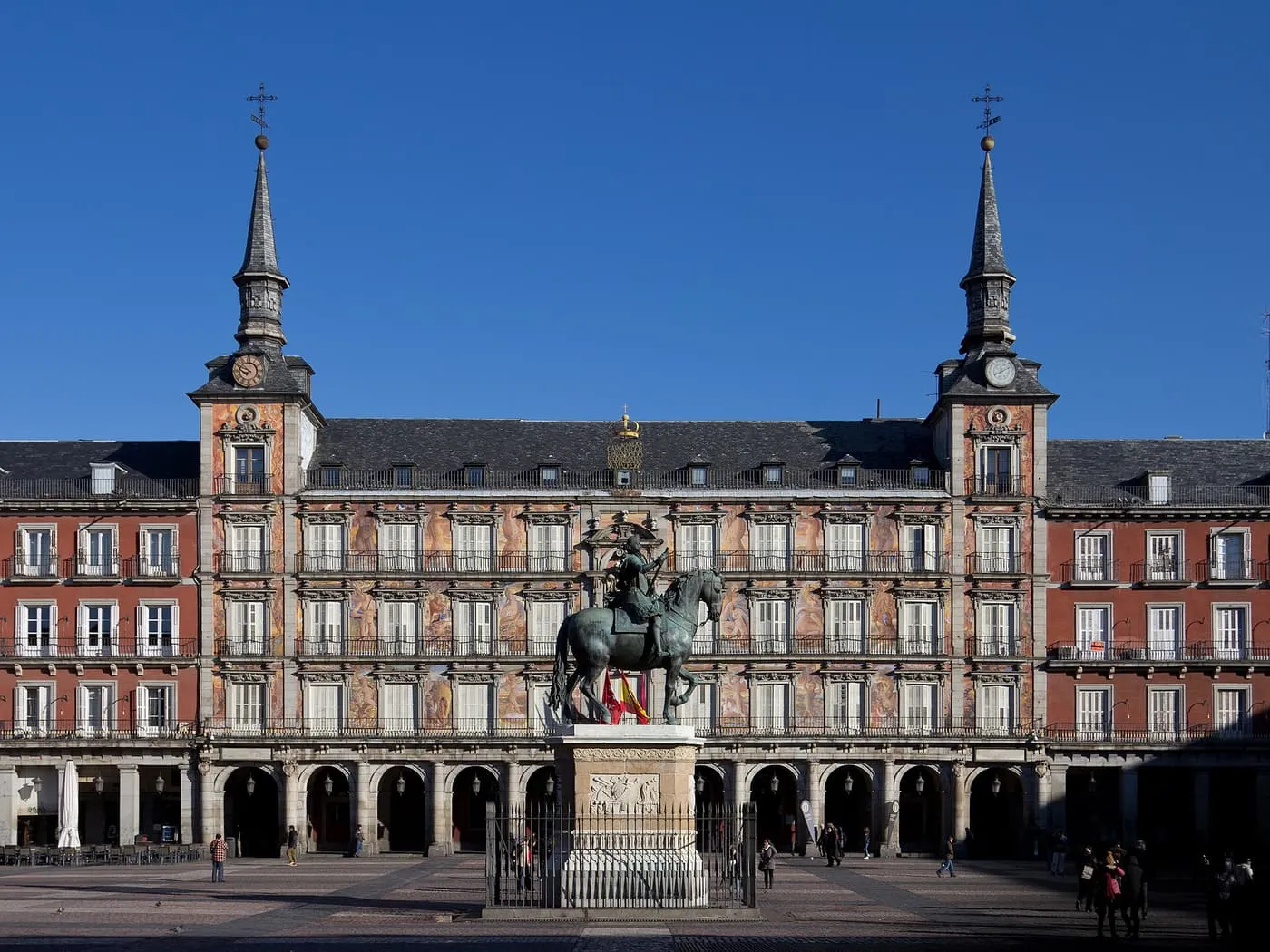
Philip III and the Casa de la Panadería in the Plaza Mayor. Photo: Carlos Delgado, Wikimedia Commons, CC BY-SA 3.0.
What to look for:
- The statue of Philip III in the centre, started by Giambologna and finished by Pietro Tacca in 1616. It stood at the entrance of the Casa de Campo until Isabella II moved it here in 1848.
- The Casa de la Panadería, the building with the frescoes. It was the town’s bakery, which set the price of bread. The frescoes, painted by Carlos Franco in 1992, show mythological figures linked to Madrid’s history, including the goddess Cybele. It holds the Plaza Mayor Tourist Information Centre and a shop selling souvenirs made by local artisans.
- The Casa de la Carnicería, opposite, whose design almost copies the Panadería’s. It was the butchers’ guild and is now a hotel.
- The Arco de Cuchilleros, the best-known of the nine arches, whose steep steps lead down to Calle de los Cuchilleros. The street takes its name from the knife makers who worked there, and its tall buildings have slanted façades because they served as buttresses.
The square hosts the Easter drum parade, concerts and the city’s Christmas market in December: see Christmas in Madrid.
The Puerta del Sol
The Puerta del Sol is a semicircle at the junction of Calle Mayor, Calle del Arenal, Calle de Alcalá and Calle de Preciados. It was the site of one of the city’s gates.
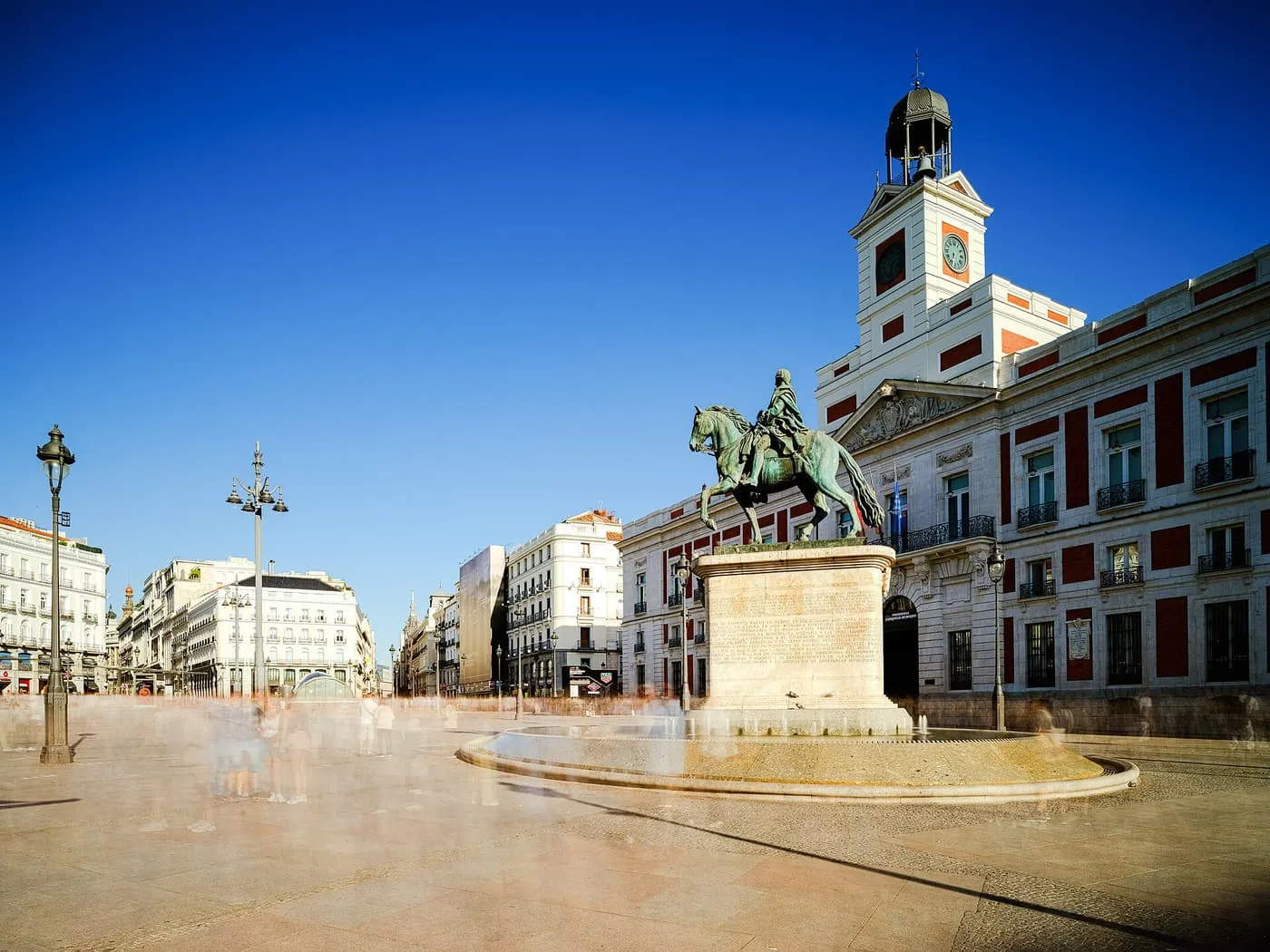
The clock tower of the Casa de Correos and the statue of Charles III in the Puerta del Sol. Photo: Matt Joseph, Wikimedia Commons, CC BY-SA 4.0.
- The clock on the Casa de Correos, now the headquarters of the regional government. On the last night of the year, people eat twelve grapes as it strikes the twelve chimes of midnight, a tradition of over a century. New Year’s Eve in Madrid has the rules for the night.
- Kilometre 0. A stone slab on the pavement in front of the main entrance of the Casa de Correos marks the starting point of all major radial roads in Spain.
- The Oso y Madroño. The bear nuzzling a strawberry tree, at the start of Calle de Alcalá, is the city’s official symbol and a popular meeting spot.
- La Mariblanca. A copy of a 17th-century statue stands at the start of Calle del Arenal, which leads to the Teatro Real. The original is kept in the Casa de la Villa.
- Charles III on horseback, the largest statue, in the fountain at the centre of the square. Charles III made so many reforms that he was called Madrid’s best mayor.
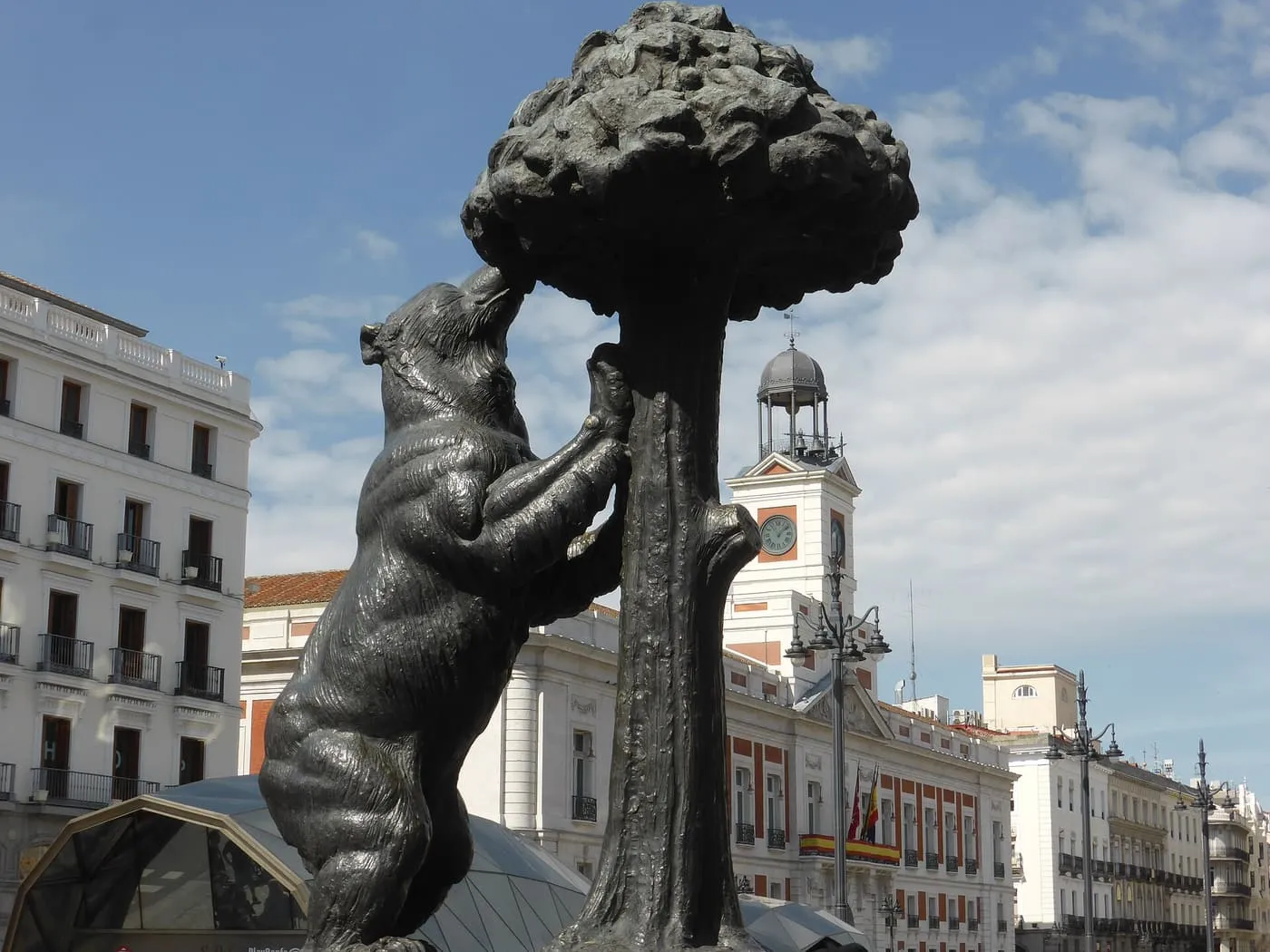
The Oso y Madroño in the Puerta del Sol. Photo: Carlos Teixidor Cadenas, Wikimedia Commons, CC BY-SA 4.0.
A short walk between them
The Plaza Mayor is in the Austrias, the oldest part of Madrid, as is the Royal Palace; the Puerta del Sol belongs to the Sol and Gran Vía district. A walk from the Puerta del Sol to the Plaza Mayor takes about five minutes, and the Royal Palace is in the same part of the old city.
Tours worth paying for
Two tours on GetYourGuide start in the Austrias. Prices are GetYourGuide’s lowest “from” prices, per person.
Welcome to Madrid walking tour
From €25.11 · 2.5 hours · 2,397 reviews
Madrid: Welcome to Madrid Guided Walking Tourad is run by Lexi Walking Tours in English or Portuguese, led by a history graduate, and starts next to the Fountain of Orpheus, a short walk from the Plaza Mayor. It covers the old town and ends near the Royal Palace; a private tour is also offered from €295. Cancel up to 24 hours ahead for a full refund.
Spanish Inquisition and legends evening walk
From €18 · 110 minutes · 1,623 reviews
Madrid: Spanish Inquisition and Legends Evening Walking Tourad is run by Mysterium Tours in English, Italian or Spanish. The group meets at Plaza de la Provincia and walks the old town’s alleys and squares by lantern for ghost stories and tales from the Inquisition. Cancel up to 24 hours ahead for a full refund.
Practical information
- Cost: free. The squares are public spaces, open at all hours.
- Plaza Mayor: Metro Sol (lines 1, 2 and 3), Ópera or Tirso de Molina (line 1). Cercanías to Madrid-Sol. The Tourist Information Centre is in the Casa de la Panadería.
- Puerta del Sol: Metro Sol, Sevilla (line 2), Callao (lines 3 and 5) or Ópera. Cercanías to Madrid-Sol.
- The one thing that changes a visit: events. The Plaza Mayor holds the Christmas market in December, and the Puerta del Sol fills on 31 December.
Madrid walking tours compares the guided and tip-based walks, free things to do in Madrid lists what else costs nothing, and hotels near the Puerta del Sol lists places to stay beside the square. What to book before you go to Madrid covers the rest.
Common questions
Is the Plaza Mayor free?
Yes. It is a public square. The Plaza Mayor Tourist Information Centre and a souvenir shop are in the Casa de la Panadería.
What is Kilometre 0 in Madrid?
A stone slab on the pavement in front of the main entrance of the Casa de Correos on the Puerta del Sol. It marks the starting point of all major radial roads in Spain.
What is the bear and strawberry tree statue?
The Oso y Madroño, a statue of a bear nuzzling a strawberry tree, is the official symbol of Madrid. It stands on the Puerta del Sol at the start of Calle de Alcalá, and is a popular meeting spot.
What happens on the Puerta del Sol on New Year's Eve?
People eat twelve grapes, one for each of the twelve chimes of midnight struck by the clock on the Casa de Correos. The tradition is over a century old.
Which Metro stations are nearest the Plaza Mayor and the Puerta del Sol?
For the Plaza Mayor, Sol (lines 1, 2 and 3), Ópera (lines 2 and 5, and the Ópera to Príncipe Pío branch) and Tirso de Molina (line 1). For the Puerta del Sol, Sol, Sevilla (line 2), Callao (lines 3 and 5) and Ópera.
How far apart are the Plaza Mayor and the Puerta del Sol?
About five minutes on foot. The Plaza Mayor is in the Austrias, the oldest part of Madrid, and the Puerta del Sol is in the Sol and Gran Vía district.