In this guide
💡 The Short Version: The market is free to walk, and it runs along Ifestou Street, which the official guide calls the oldest flea market district of Athens, turning right out of Monastiraki Metro station. The second-hand bazaar fills Avissinia Square on Sundays, with live music from street bands, and spreads south towards Thissio. The shops open daily. Smartraveller names Monastiraki among the tourist areas where petty crime is a serious issue, so keep bags closed. The Roman Agora, Hadrian’s Library and the Ancient Agora are beside it and charge for entry, and in winter the first two close at 15:00. Or book a tour: the Athens street food tasting tourad, which also walks Psyrri, is from €59 (GetYourGuide).
Where the market is
The metro leaves you on Adrianou Street, which the official city guide calls the flea market’s main artery and which was part of the ancient city. Monastiraki, “little monastery”, is named after a monastic compound that once stood here; the small 10th-century Pantanassa basilica on the square is all that is left. Look up from the square towards the Acropolis and your line of sight crosses a mosque and a Byzantine church.
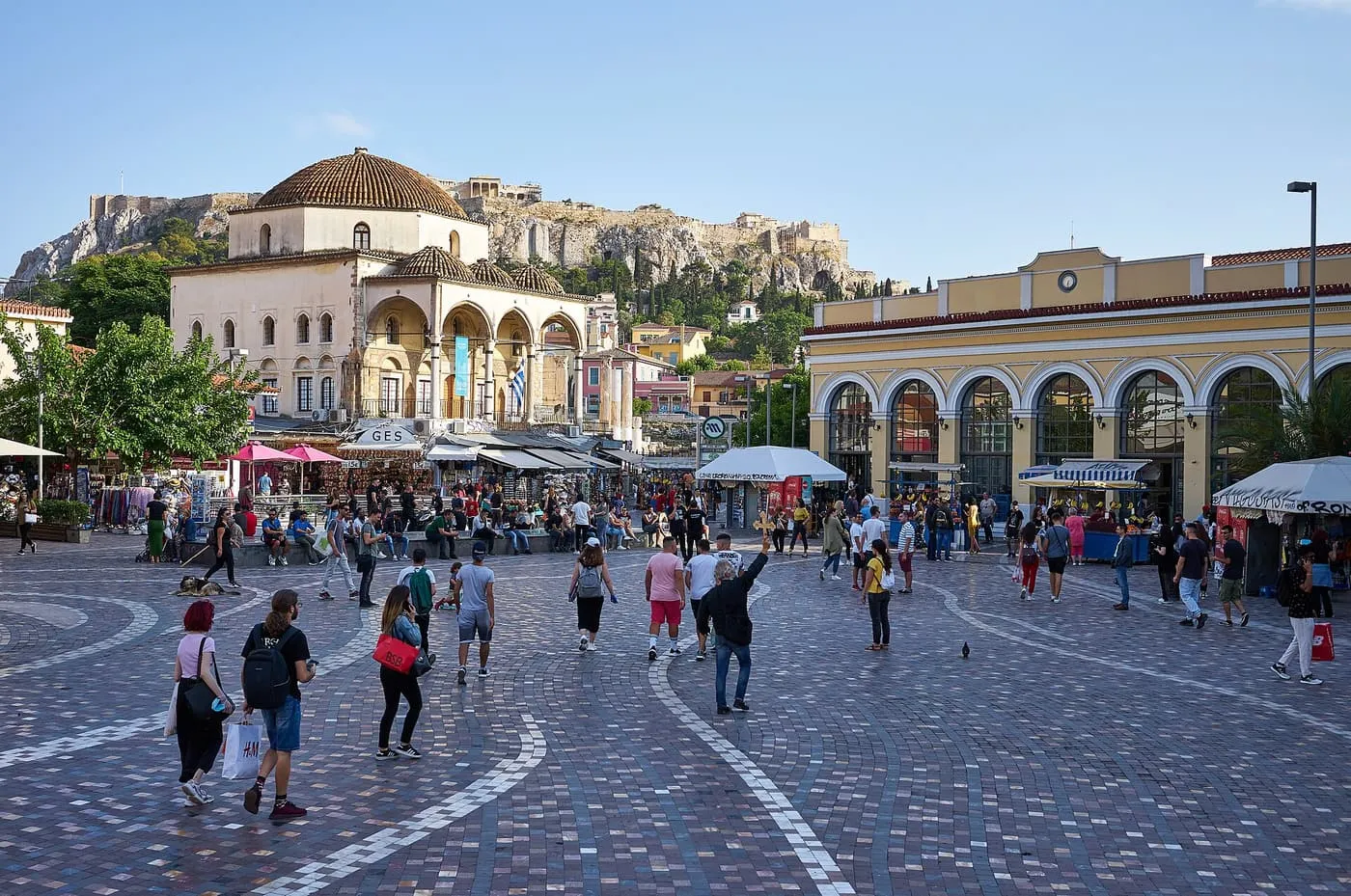
Monastiraki Square with the Acropolis behind. Photo: George E. Koronaios, Wikimedia Commons, CC BY-SA 4.0.
| Part of the market | What it is | When |
|---|---|---|
| Ifestou Street | The oldest flea market district of Athens: vintage records, second-hand clothes, leather goods, bead shops, souvenirs. About 200 metres of flat paving, sloping slightly down | Shops daily; busy while they are open, empty and dark at night |
| Avissinia Square | The heart of the market, the Yusurum second-hand bazaar. Not everything for sale is a bargain or an antique | Sundays for the stalls |
| South of the square | An open-air bazaar that spreads towards Thissio: old phone cards, trinkets and tools | Sundays |
- Sundays. The official guide describes a festive air, with live music from street bands. On Saturday nights junk sellers set up their stalls beside the bars and restaurants.
- How to walk it. Turn right out of Monastiraki station into Ifestou Street. At the end of the market, turn left to return to Adrianou Street.
- Psyrri. The neighbourhood beside Monastiraki, with its second-hand shops, street art and bars, is liveliest at night.
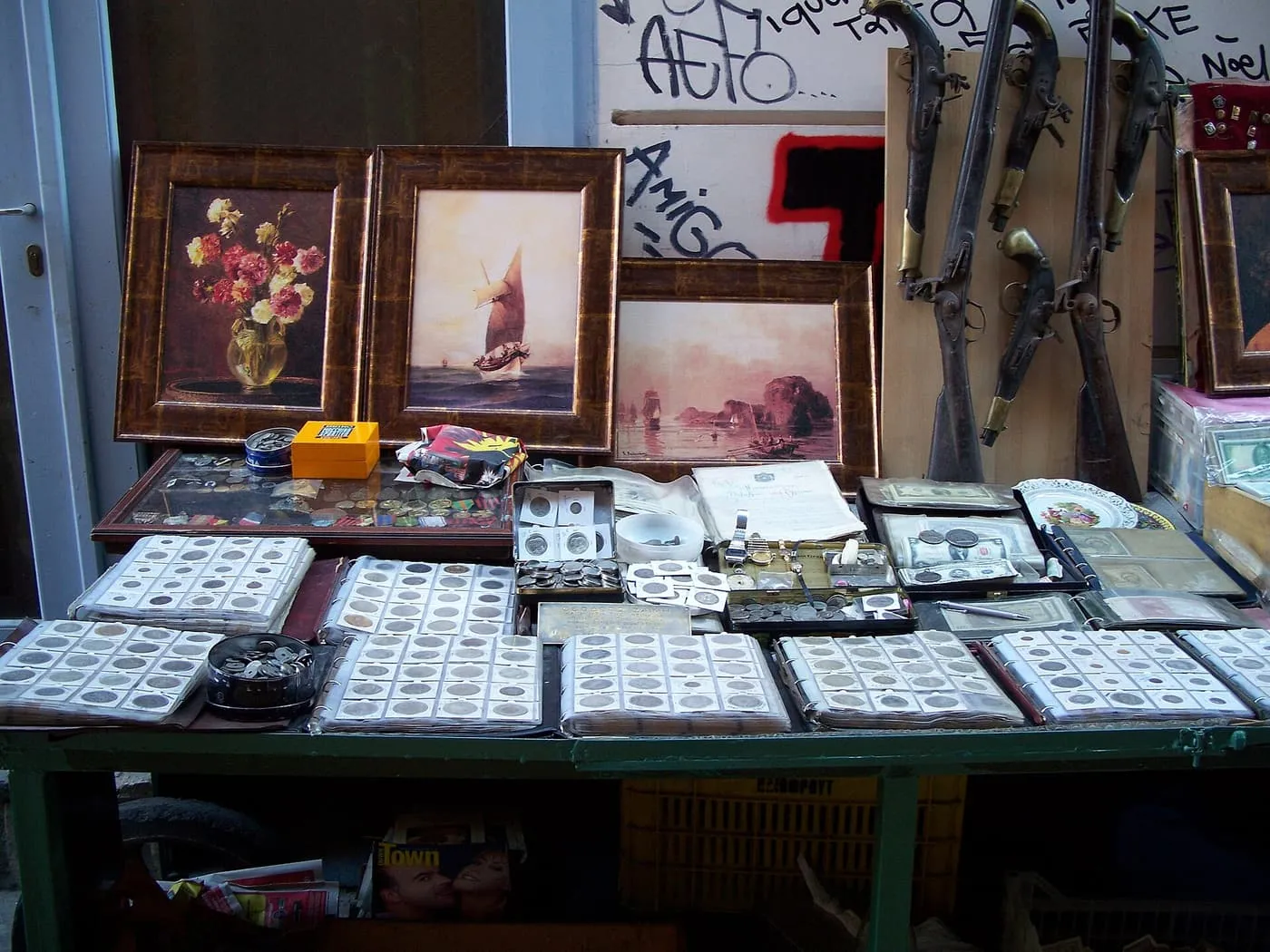
A stall of coins, prints and old pistols at the Monastiraki flea market. Photo: Badseed, Wikimedia Commons, CC BY-SA 3.0.
Tours worth paying for
The market needs no guide. This food walk passes through the same streets. Prices are GetYourGuide’s lowest “from” prices, per person.
Street food tasting tour
From €59 · 3 hours · 4,146 reviews
Athens: Street Food Tasting Tourad is run by Greekality. It starts at the round fountain in Syntagma Square, tastes cheese pie or spanakopita, souvlaki, a boat-shaped Greek pizza, loukoumades and Greek desserts, and walks through the shopping district and Psyrri. The price includes the guide and food and drinks, with beer or wine. Vegetarian options are available at every stop; vegan and lactose-free options are limited, and there are no gluten-free options. Be there on time, because the guide cannot be reached once the tour has left. Cancel up to 24 hours ahead for a full refund.
What is next to it
| Site | Entry | Winter closing | From the station |
|---|---|---|---|
| Roman Agora | €10 | 15:00 | 2 minutes |
| Hadrian’s Library | €10 | 15:00 | 2 minutes |
| Ancient Agora | €20 | 17:00 | 4 minutes from the square |
| Plaka and Anafiotika | Free | Streets | At the foot of the Acropolis |
The sites close at 15:00 from 1 November to 31 March, except the Ancient Agora, which closes at 17:00, so in winter shop after the sites.
Practical information
- Where: Monastiraki Square. Metro Monastiraki (lines 1 and 3); bus lines 025 and 026 stop there.
- Theft: Smartraveller says petty crime is a serious issue in tourist areas, including Monastiraki and Syntagma Square in central Athens, and that pickpocketing and bag snatching are common. Canada’s travel advice says tourists in Greece are frequently targeted.
- After dark: Ifestou Street empties and becomes quite dark once the shops close.
- The one thing that ruins a visit: carrying a bag that is open or a phone in a back pocket. Keep belongings in front of you.
The Central Market on Athinas Street is covered in where to eat in Athens, and free things to do in Athens lists the other places that cost nothing. What to book before you go to Athens has the closed days for every sight. Thanasis, Savvas, Hoocut and the Kostas shop on Agias Irinis Square are in Monastiraki: see best souvlaki in Athens. The food walks that start here are compared in Athens food tours, and the hotels of Monastiraki and Psyrri are in where to stay in Athens.
Common questions
When is the Monastiraki flea market open?
The shops on Ifestou Street and around Avissinia Square trade daily. The second-hand bazaar fills Avissinia Square on Sunday, with live music from street bands, and spreads south towards Thissio.
Where is the Monastiraki flea market?
Outside Monastiraki Metro station (lines 1 and 3). Turn right for Ifestou Street, the oldest flea market district of Athens. Adrianou Street is the market's main artery. Avissinia Square is the heart of it.
What is sold at the Monastiraki flea market?
Vintage records, second-hand clothes, leather goods, bead shops and souvenirs on Ifestou Street, and old phone cards, trinkets and tools in the Sunday bazaar towards Thissio. The official guide notes that not everything for sale is a bargain or an antique.
Is Monastiraki safe?
Smartraveller, the Australian government's travel advice, says petty crime is a serious issue in tourist areas including Monastiraki and Syntagma Square, and Canada's travel advice says tourists in Greece are frequently targeted. Pay attention to your belongings.
Is the Monastiraki flea market free?
Walking the streets and the bazaar costs nothing. The Roman Agora, Hadrian's Library and the Ancient Agora beside it charge for entry.
What is Yusurum?
The old name of the second-hand bazaar in Avissinia Square, from the Jewish merchants Noah and Elias Yusurum, members of the local antique dealers' association in the early 1900s.